Growing Back — Intercalary Meristem and the Bridge to Permanent Tissues
Why grass survives the lawn-mower, and what happens to cells that stop dividing
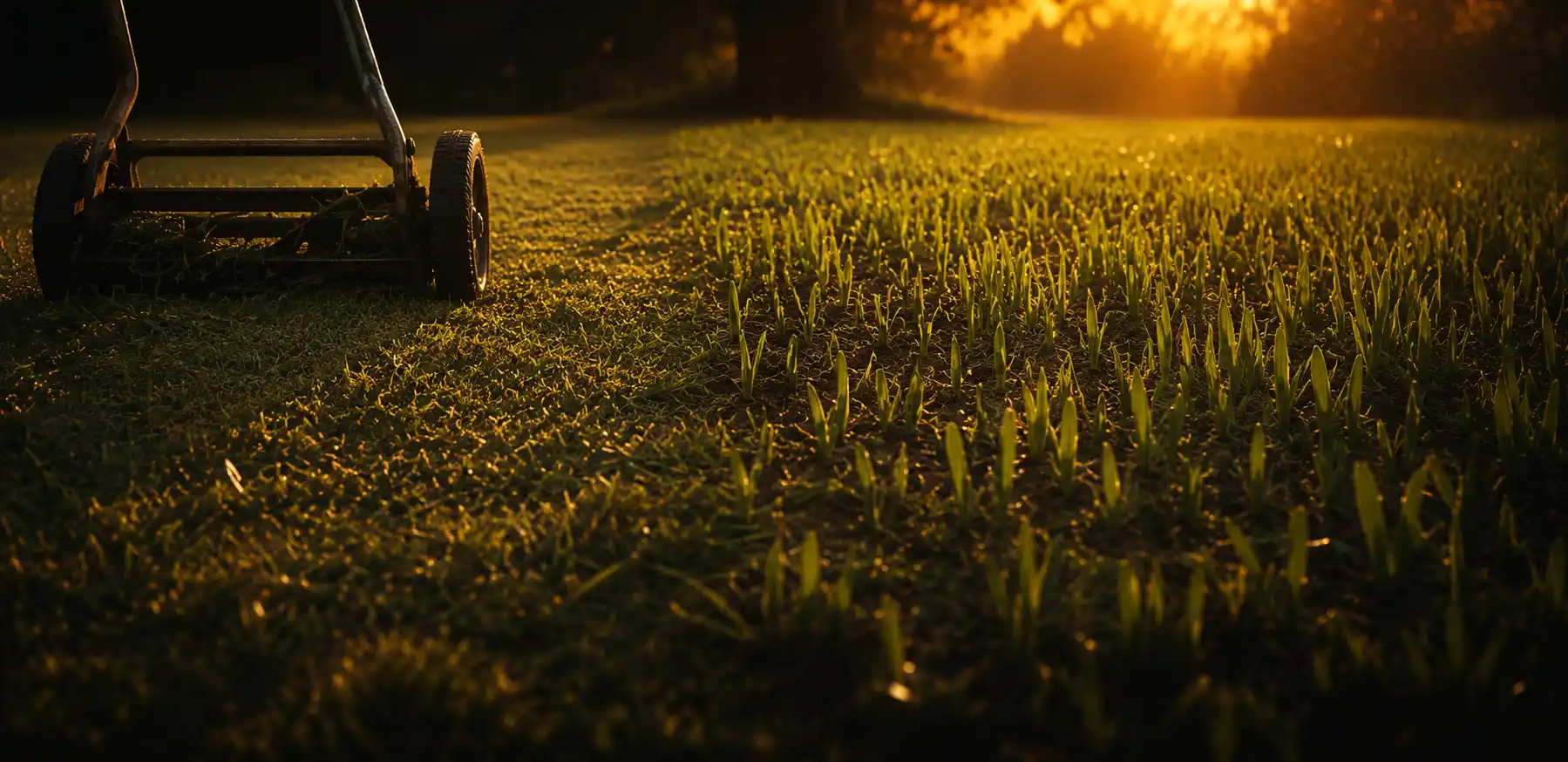
You can mow your lawn every Sunday and the grass keeps coming back, week after week, year after year. But if you cut the top off a sapling, it just stops growing taller from that cut. Both have apical meristems at their tips — so why does only the grass regrow?
Plants that bring back what is lost
या ओषधीः पूर्वा जाता देवेभ्यस्त्रियुगं पुरा।
Hindi: Jo aushadhiya (paudhe aur ghaas) devon se bhi pehle, teen yugon pehle, paida hue the — woh aaj bhi yahin hain.
English: The plants that came into being three ages before the gods — they are still here.
Grass and herbs have outlasted entire eras of giant beasts and forests. One reason: their special hidden meristems let them grow back even when grazed, burned, or trampled. Some plant types just refuse to die.
Intercalary Meristem — Growing Back from the Base
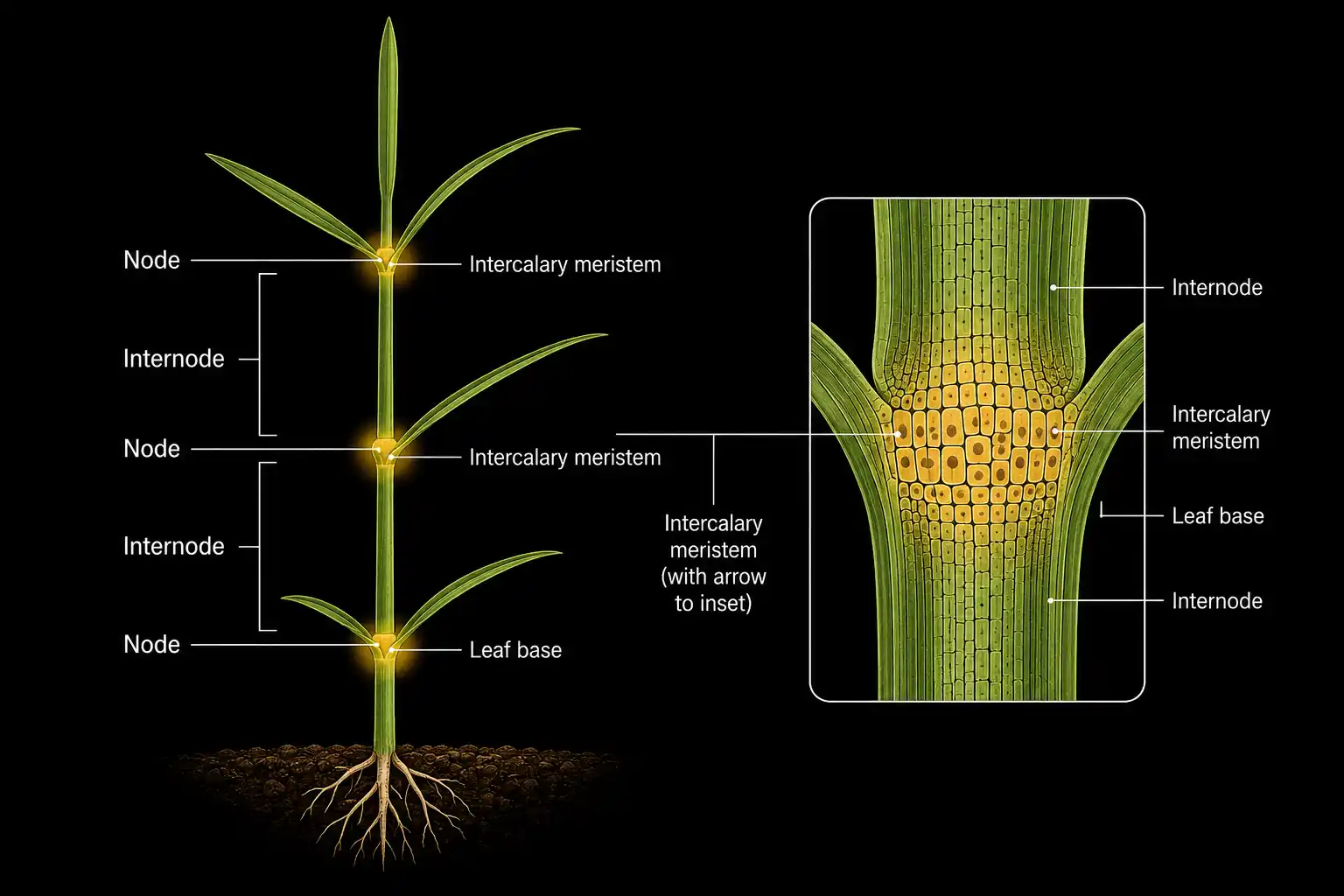
Look closely at a blade of grass. Notice that it grows from a small ridged section near the base — the node. If you cut the blade in half, the lower section, near the node, is where new growth comes from. The cut tip doesn't regrow — but the base pushes the blade longer.
There's a third type of meristem that lives at this base: the intercalary meristem (inter-calary = inserted between things). It sits at the base of leaves or just above nodes in the stem. When the upper part of a grass blade or a young grass shoot is cut or grazed, the intercalary meristem at the base divides and pushes new cells upward, replacing what was lost.
Where do you see this in real life?
- Lawns mowed every weekend keep growing back.
- Sugarcane in fields — the long stem is a chain of intercalary meristems between every joint.
- Bamboo can shoot up by a metre a day in some species — much of that growth happens at intercalary zones along the stem, not just at the tip.
- Grasslands and pastures survive grazing by herds for centuries because the grass keeps regrowing from below.
Without intercalary meristems, a single sheep eating the top of a grass blade would kill that plant forever. Entire ecosystems — savannas, alpine meadows, the cattle-keeping cultures of Rajasthan and the Himalayas — exist because of this small structural detail.
A farmer in Rajasthan keeps a herd of 50 goats. The goats graze on grass and on the leaves of small saplings. After a year, the grass field still looks healthy and green, but most of the saplings have died or shrunken. Using only what you've read, what's the cleanest explanation?
From Meristem to Permanent Tissue
We've now met all three meristems — apical, lateral, and intercalary. Together they explain how plants grow in length, in girth, and back from cuts. But meristems are only part of the story.
Most cells in a plant are NOT meristematic. Once a meristem cell finishes dividing and is pushed away from the meristem zone, it goes through a transformation. It stops dividing. It changes shape. It develops thicker walls or other special features. It takes on a fixed job — like storing food, providing support, or transporting water.
This process — where a dividing cell turns into a specialised, settled cell — is called differentiation. After differentiation, the cell becomes part of a permanent tissue. "Permanent" because the cell will stay this way for the rest of its life. It will not divide again.
Permanent tissues are where the actual work of the plant happens — protection, photosynthesis, support, transport of water and food. Meristems make the cells; permanent tissues run the body.
There are two big categories of permanent tissues:
- Simple permanent tissues — made of just one type of cell (parenchyma, collenchyma, sclerenchyma).
- Complex permanent tissues — made of several cell types working together (xylem and phloem).
The next pages take each one in turn.
Why Meristem Cells Have No Vacuole
A vacuole is a big bag of water inside a cell. Most plant cells have one — it provides storage, helps the cell stay plump, and stores stuff like sugar and pigments. But meristem cells have almost no vacuole.
Q1.The intercalary meristem is most active in:
You can mow your lawn every Sunday and the grass keeps coming back, week after week, year after year. But if you cut the top off a sapling, it just stops growing taller from that cut. Both have apical meristems at their tips — so why does only the grass regrow?
Plants that bring back what is lost
या ओषधीः पूर्वा जाता देवेभ्यस्त्रियुगं पुरा।
Hindi: Jo aushadhiya (paudhe aur ghaas) devon se bhi pehle, teen yugon pehle, paida hue the — woh aaj bhi yahin hain.
English: The plants that came into being three ages before the gods — they are still here.
Grass and herbs have outlasted entire eras of giant beasts and forests. One reason: their special hidden meristems let them grow back even when grazed, burned, or trampled. Some plant types just refuse to die.
Intercalary Meristem — Growing Back from the Base
Look closely at a blade of grass. Notice that it grows from a small ridged section near the base — the node. If you cut the blade in half, the lower section, near the node, is where new growth comes from. The cut tip doesn't regrow — but the base pushes the blade longer.
There's a third type of meristem that lives at this base: the intercalary meristem (inter-calary = inserted between things). It sits at the base of leaves or just above nodes in the stem. When the upper part of a grass blade or a young grass shoot is cut or grazed, the intercalary meristem at the base divides and pushes new cells upward, replacing what was lost.
Where do you see this in real life?
- Lawns mowed every weekend keep growing back.
- Sugarcane in fields — the long stem is a chain of intercalary meristems between every joint.
- Bamboo can shoot up by a metre a day in some species — much of that growth happens at intercalary zones along the stem, not just at the tip.
- Grasslands and pastures survive grazing by herds for centuries because the grass keeps regrowing from below.
Without intercalary meristems, a single sheep eating the top of a grass blade would kill that plant forever. Entire ecosystems — savannas, alpine meadows, the cattle-keeping cultures of Rajasthan and the Himalayas — exist because of this small structural detail.
A farmer in Rajasthan keeps a herd of 50 goats. The goats graze on grass and on the leaves of small saplings. After a year, the grass field still looks healthy and green, but most of the saplings have died or shrunken. Using only what you've read, what's the cleanest explanation?
From Meristem to Permanent Tissue
We've now met all three meristems — apical, lateral, and intercalary. Together they explain how plants grow in length, in girth, and back from cuts. But meristems are only part of the story.
Most cells in a plant are NOT meristematic. Once a meristem cell finishes dividing and is pushed away from the meristem zone, it goes through a transformation. It stops dividing. It changes shape. It develops thicker walls or other special features. It takes on a fixed job — like storing food, providing support, or transporting water.
This process — where a dividing cell turns into a specialised, settled cell — is called differentiation. After differentiation, the cell becomes part of a permanent tissue. "Permanent" because the cell will stay this way for the rest of its life. It will not divide again.
Permanent tissues are where the actual work of the plant happens — protection, photosynthesis, support, transport of water and food. Meristems make the cells; permanent tissues run the body.
There are two big categories of permanent tissues:
- Simple permanent tissues — made of just one type of cell (parenchyma, collenchyma, sclerenchyma).
- Complex permanent tissues — made of several cell types working together (xylem and phloem).
The next pages take each one in turn.
Why Meristem Cells Have No Vacuole
A vacuole is a big bag of water inside a cell. Most plant cells have one — it provides storage, helps the cell stay plump, and stores stuff like sugar and pigments. But meristem cells have almost no vacuole.
Q1.The intercalary meristem is most active in: