Blood — The Liquid Connective Tissue
RBCs, WBCs, platelets, plasma — and the four jobs blood does at once
Connective Tissue — The Matrix Family
Connective tissue is the second of the four animal tissue types. Its job is to bind, support, and connect different parts of the body. Without connective tissue, your bones wouldn't attach to your muscles, your muscles wouldn't attach to your skin, your nutrients wouldn't reach your cells, and your bones wouldn't have rigid structure. The body would simply fall apart.
What makes connective tissue different from epithelial tissue is the matrix — the non-cellular material between cells. Epithelial cells are packed tightly with no space between them. Connective tissue cells are spread out in a matrix that surrounds them. The matrix is what gives the tissue its character.
There are three families of connective tissue, distinguished by what their matrix is made of:
- Fluid matrix → Blood (cells suspended in liquid plasma)
- Solid jelly-like matrix → Cartilage (cells embedded in a soft, flexible gel)
- Hard mineral matrix → Bone (cells trapped in a calcium-rich solid)
Plus tendons and ligaments — bundles of strong protein fibres that connect muscle to bone (tendon) or bone to bone (ligament).
On this page we'll focus on blood — the most surprising connective tissue. The next page will cover bone, cartilage, tendon, and ligament.
What's Actually in Blood?
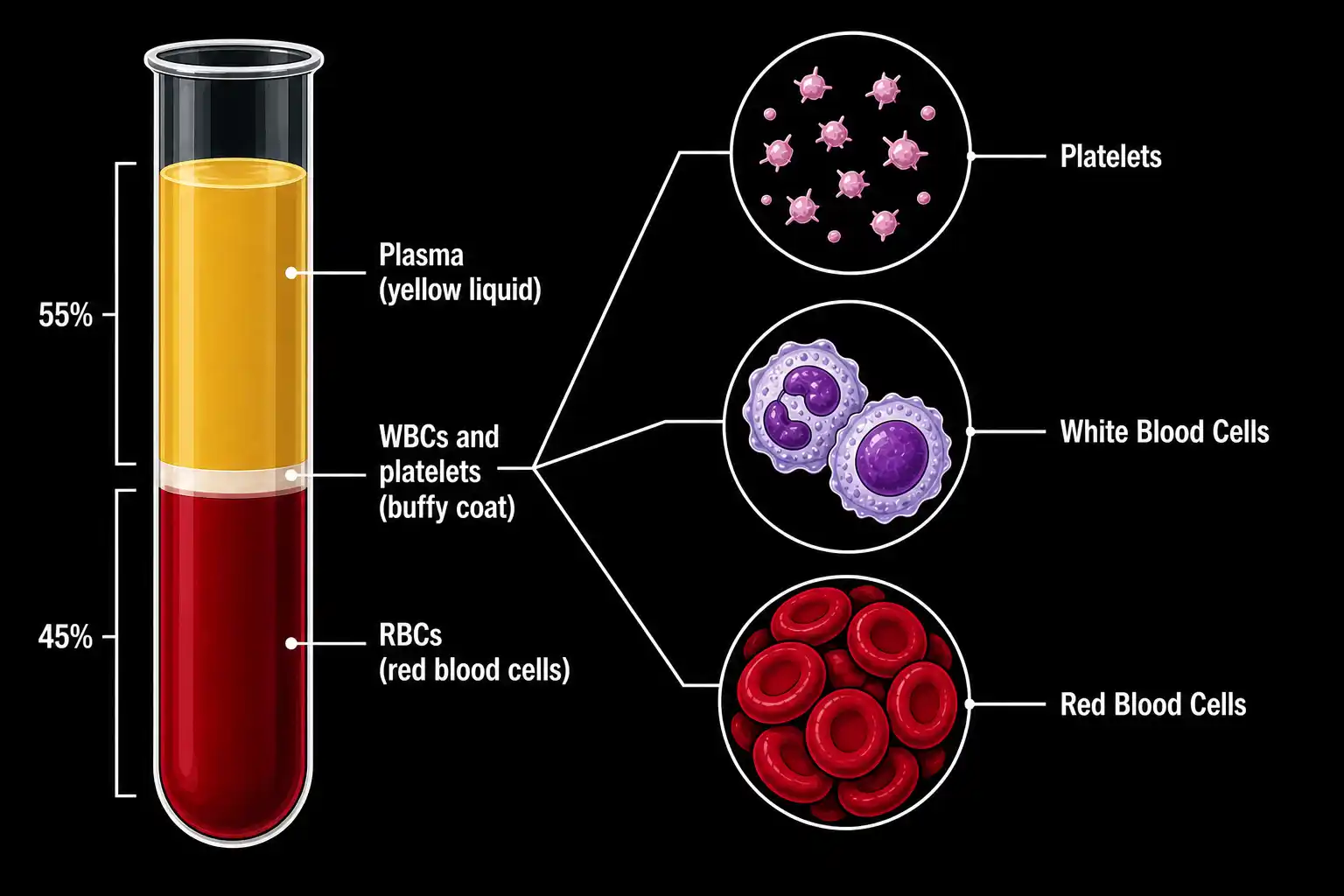
If you take a sample of fresh blood and let it settle in a test tube, three layers separate out:
1. Plasma — about 55% of blood by volume. A pale-yellow liquid that's mostly water (about 90%) with dissolved proteins, salts, sugar, vitamins, hormones, and waste products. Plasma is the matrix. Everything else floats in it.
2. Red Blood Cells (RBCs / erythrocytes) — sink to the bottom. About 45% of blood by volume. They are the most numerous cells in your body — roughly 5 million RBCs per drop of blood. Their job is to carry oxygen from lungs to every cell in the body, and bring carbon dioxide back. RBCs are red because they're full of a protein called haemoglobin that binds oxygen. Each RBC lives about 4 months before being broken down and replaced by new ones made in your bone marrow.
3. White Blood Cells (WBCs / leukocytes) — much fewer in number, but bigger. They form a thin pale layer between plasma and RBCs. Their job is defence. They patrol the body, find invading germs, and destroy them. When you have an infection, WBCs swarm to the area, release chemicals that kill bacteria, and themselves die in the process. Pus is largely the bodies of dead WBCs that fought your battle for you.
4. Platelets (thrombocytes) — tiny fragments of cells (not full cells), much smaller than RBCs. Their job is clotting. When you cut yourself, platelets stick to the wound, release chemicals, and trigger a chain reaction that turns part of your plasma into a sticky mesh. That mesh traps RBCs and stops the bleeding. Once the cut closes, the dried mesh is called a scab.
So a single drop of blood is doing four jobs at once: carrying oxygen (RBCs), fighting infection (WBCs), stopping leaks (platelets), and delivering nutrients and removing waste (plasma).
Connective Tissue — The Matrix Family
Connective tissue is the second of the four animal tissue types. Its job is to bind, support, and connect different parts of the body. Without connective tissue, your bones wouldn't attach to your muscles, your muscles wouldn't attach to your skin, your nutrients wouldn't reach your cells, and your bones wouldn't have rigid structure. The body would simply fall apart.
What makes connective tissue different from epithelial tissue is the matrix — the non-cellular material between cells. Epithelial cells are packed tightly with no space between them. Connective tissue cells are spread out in a matrix that surrounds them. The matrix is what gives the tissue its character.
There are three families of connective tissue, distinguished by what their matrix is made of:
- Fluid matrix → Blood (cells suspended in liquid plasma)
- Solid jelly-like matrix → Cartilage (cells embedded in a soft, flexible gel)
- Hard mineral matrix → Bone (cells trapped in a calcium-rich solid)
Plus tendons and ligaments — bundles of strong protein fibres that connect muscle to bone (tendon) or bone to bone (ligament).
On this page we'll focus on blood — the most surprising connective tissue. The next page will cover bone, cartilage, tendon, and ligament.
What's Actually in Blood?
If you take a sample of fresh blood and let it settle in a test tube, three layers separate out:
1. Plasma — about 55% of blood by volume. A pale-yellow liquid that's mostly water (about 90%) with dissolved proteins, salts, sugar, vitamins, hormones, and waste products. Plasma is the matrix. Everything else floats in it.
2. Red Blood Cells (RBCs / erythrocytes) — sink to the bottom. About 45% of blood by volume. They are the most numerous cells in your body — roughly 5 million RBCs per drop of blood. Their job is to carry oxygen from lungs to every cell in the body, and bring carbon dioxide back. RBCs are red because they're full of a protein called haemoglobin that binds oxygen. Each RBC lives about 4 months before being broken down and replaced by new ones made in your bone marrow.
3. White Blood Cells (WBCs / leukocytes) — much fewer in number, but bigger. They form a thin pale layer between plasma and RBCs. Their job is defence. They patrol the body, find invading germs, and destroy them. When you have an infection, WBCs swarm to the area, release chemicals that kill bacteria, and themselves die in the process. Pus is largely the bodies of dead WBCs that fought your battle for you.
4. Platelets (thrombocytes) — tiny fragments of cells (not full cells), much smaller than RBCs. Their job is clotting. When you cut yourself, platelets stick to the wound, release chemicals, and trigger a chain reaction that turns part of your plasma into a sticky mesh. That mesh traps RBCs and stops the bleeding. Once the cut closes, the dried mesh is called a scab.
So a single drop of blood is doing four jobs at once: carrying oxygen (RBCs), fighting infection (WBCs), stopping leaks (platelets), and delivering nutrients and removing waste (plasma).