The Soft Tissues — Parenchyma and Collenchyma
Storage, photosynthesis, and the secret of bending without breaking

Hold a fresh green stem of a plant — say, coriander — in your hand. Bend it. It bends easily without breaking. Now hold a small twig from a dry tree branch. Bend it. It snaps. Both came from plants. Both are made of cells. What's so different inside them?
Strength and softness, side by side
मृदुनि कठिनान्यपि स्वकर्मणा बद्धानि।
Hindi: Soft cheez aur kadi cheez — dono apna apna kaam karte hain. Ek bina doosre ka kaam adhura hai.
English: The soft and the firm — each bound to its own task. Neither is complete without the other.
Plants live by this. The soft tissues store food and do photosynthesis; the firm tissues hold the plant up. A plant with only one type would either flop over or starve.
Parenchyma — The Soft Filler
Inside almost every part of a plant — leaves, fruits, stems, roots — most of the cells you'll find are not the famous specialised types. They are simple, soft, and live: parenchyma cells.
Parenchyma cells are:
- Living (with a nucleus, cytoplasm, and active metabolism)
- Thin-walled (just cellulose, no thickening)
- Loosely packed with small spaces (intercellular spaces) between them
- Roughly round or polygonal in shape
These cells are the plant's general-purpose workforce. Their main job is storage — they keep starch, sugar, oil, and sometimes water for the plant. Every potato, every onion, every rice grain is mostly parenchyma cells stuffed with starch.
When parenchyma cells contain chloroplasts, they become chlorenchyma — the green photosynthesis tissue of leaves. Every time you eat a green leafy vegetable, you are eating chlorenchyma — a special parenchyma full of the molecular machinery of photosynthesis.
In aquatic plants like water lilies and lotus, parenchyma cells leave large air gaps between them. This forms aerenchyma — a special parenchyma whose air-filled spaces help the plant float and bring oxygen to underwater roots.
Collenchyma — The Flexible Strut
Now bend that fresh coriander stem again. The reason it bends rather than snaps is a tissue called collenchyma. Collenchyma sits just below the epidermis in young, green stems and the stalks of leaves.
Collenchyma cells are:
- Living (like parenchyma)
- Thickened at the corners with extra cellulose and a substance called pectin — the same pectin that makes jam set
- Elongated in shape, packed with no air gaps
The corner-thickening is the trick. It gives collenchyma both flexibility AND strength. The cell walls are thick enough to support the plant — but they bend with the wind instead of cracking. Think of a rubber pipe versus a glass tube: a rubber pipe bends and bounces back; a glass tube snaps. Collenchyma is the rubber pipe of plant tissues.
This is why young, green stems and tendrils — like those of a climbing pea plant or a coriander stem — can flex in wind, twist around supports, and bounce back to shape. Collenchyma allows them to grow tall AND survive movement.
The leaf stalks (petioles) you see on tomato or hibiscus plants are full of collenchyma. So is the part of celery you can pull and feel the long fibres in. Those fibres are collenchyma strands.
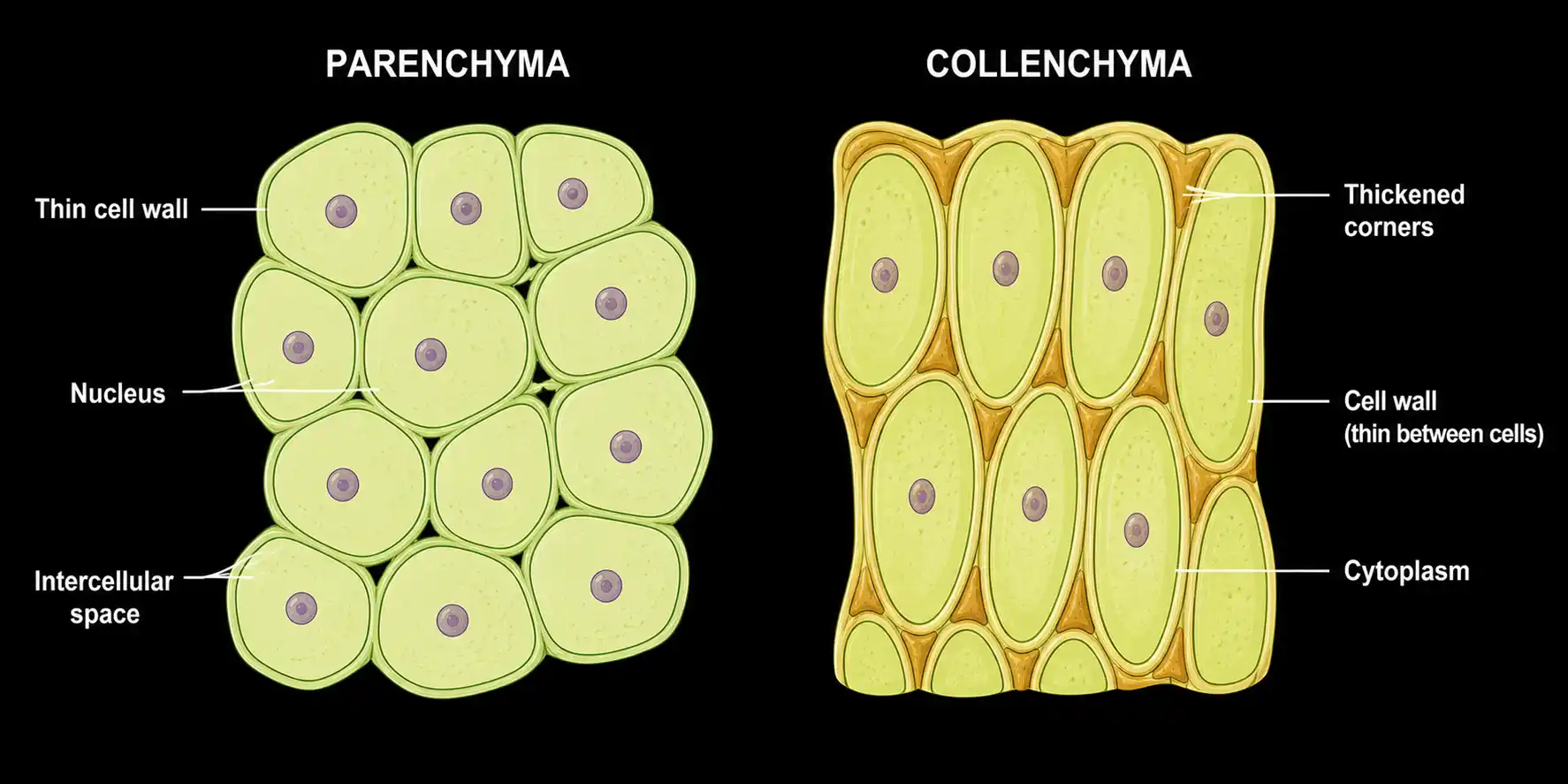
A botanist takes a stem from a plant, slices a thin cross-section, and looks at it under a microscope. She sees that the outer ring of cells (just below the epidermis) all have walls that are clearly thicker at the corners than along the flat sides. From this single observation, what is most likely true about the plant?
Why Lotus Leaves Float
Lotus leaves rest perfectly on water. Lift one and it's surprisingly light. Cut it open and you'll see — most of the leaf is air spaces, lined by parenchyma cells. This special version is called aerenchyma.
Why Celery Has 'Strings'
When you bite into raw celery, those tough fibres you feel — the strings that get stuck in your teeth — those are collenchyma. They run as long bundles down the length of each celery stalk, giving it the strength to stand upright while still bending in the breeze.
Q1.Which is the main function of parenchyma in a plant?
Hold a fresh green stem of a plant — say, coriander — in your hand. Bend it. It bends easily without breaking. Now hold a small twig from a dry tree branch. Bend it. It snaps. Both came from plants. Both are made of cells. What's so different inside them?
Strength and softness, side by side
मृदुनि कठिनान्यपि स्वकर्मणा बद्धानि।
Hindi: Soft cheez aur kadi cheez — dono apna apna kaam karte hain. Ek bina doosre ka kaam adhura hai.
English: The soft and the firm — each bound to its own task. Neither is complete without the other.
Plants live by this. The soft tissues store food and do photosynthesis; the firm tissues hold the plant up. A plant with only one type would either flop over or starve.
Parenchyma — The Soft Filler
Inside almost every part of a plant — leaves, fruits, stems, roots — most of the cells you'll find are not the famous specialised types. They are simple, soft, and live: parenchyma cells.
Parenchyma cells are:
- Living (with a nucleus, cytoplasm, and active metabolism)
- Thin-walled (just cellulose, no thickening)
- Loosely packed with small spaces (intercellular spaces) between them
- Roughly round or polygonal in shape
These cells are the plant's general-purpose workforce. Their main job is storage — they keep starch, sugar, oil, and sometimes water for the plant. Every potato, every onion, every rice grain is mostly parenchyma cells stuffed with starch.
When parenchyma cells contain chloroplasts, they become chlorenchyma — the green photosynthesis tissue of leaves. Every time you eat a green leafy vegetable, you are eating chlorenchyma — a special parenchyma full of the molecular machinery of photosynthesis.
In aquatic plants like water lilies and lotus, parenchyma cells leave large air gaps between them. This forms aerenchyma — a special parenchyma whose air-filled spaces help the plant float and bring oxygen to underwater roots.
Collenchyma — The Flexible Strut
Now bend that fresh coriander stem again. The reason it bends rather than snaps is a tissue called collenchyma. Collenchyma sits just below the epidermis in young, green stems and the stalks of leaves.
Collenchyma cells are:
- Living (like parenchyma)
- Thickened at the corners with extra cellulose and a substance called pectin — the same pectin that makes jam set
- Elongated in shape, packed with no air gaps
The corner-thickening is the trick. It gives collenchyma both flexibility AND strength. The cell walls are thick enough to support the plant — but they bend with the wind instead of cracking. Think of a rubber pipe versus a glass tube: a rubber pipe bends and bounces back; a glass tube snaps. Collenchyma is the rubber pipe of plant tissues.
This is why young, green stems and tendrils — like those of a climbing pea plant or a coriander stem — can flex in wind, twist around supports, and bounce back to shape. Collenchyma allows them to grow tall AND survive movement.
The leaf stalks (petioles) you see on tomato or hibiscus plants are full of collenchyma. So is the part of celery you can pull and feel the long fibres in. Those fibres are collenchyma strands.
A botanist takes a stem from a plant, slices a thin cross-section, and looks at it under a microscope. She sees that the outer ring of cells (just below the epidermis) all have walls that are clearly thicker at the corners than along the flat sides. From this single observation, what is most likely true about the plant?
Why Lotus Leaves Float
Lotus leaves rest perfectly on water. Lift one and it's surprisingly light. Cut it open and you'll see — most of the leaf is air spaces, lined by parenchyma cells. This special version is called aerenchyma.
Why Celery Has 'Strings'
When you bite into raw celery, those tough fibres you feel — the strings that get stuck in your teeth — those are collenchyma. They run as long bundles down the length of each celery stalk, giving it the strength to stand upright while still bending in the breeze.
Q1.Which is the main function of parenchyma in a plant?