Growing in Girth — Lateral Meristem
The hidden ring that turns saplings into massive trunks
A neem sapling next to your house was as thin as a pencil five years ago. Today its trunk is as wide as your arm. The shoot tip handles growth in length — but what makes the trunk thicker year after year? Where exactly are the new cells being added?
The patient growing of a tree
वनस्पते वीडुवण्होऽप्रथास्तना न उद्भिद।
Hindi: Hey vanaspati (ped), tum kaayam raho, mazboot raho, har taraf failo, hamesha bahar nikalte raho.
English: O tree, stand firm, grow strong, spread outward, keep emerging from within.
Trees do exactly this — they keep emerging from within. A thin ring of cells under their bark quietly adds new wood every year, making them stronger and wider. Without you noticing.
The Hidden Ring — Lateral Meristem
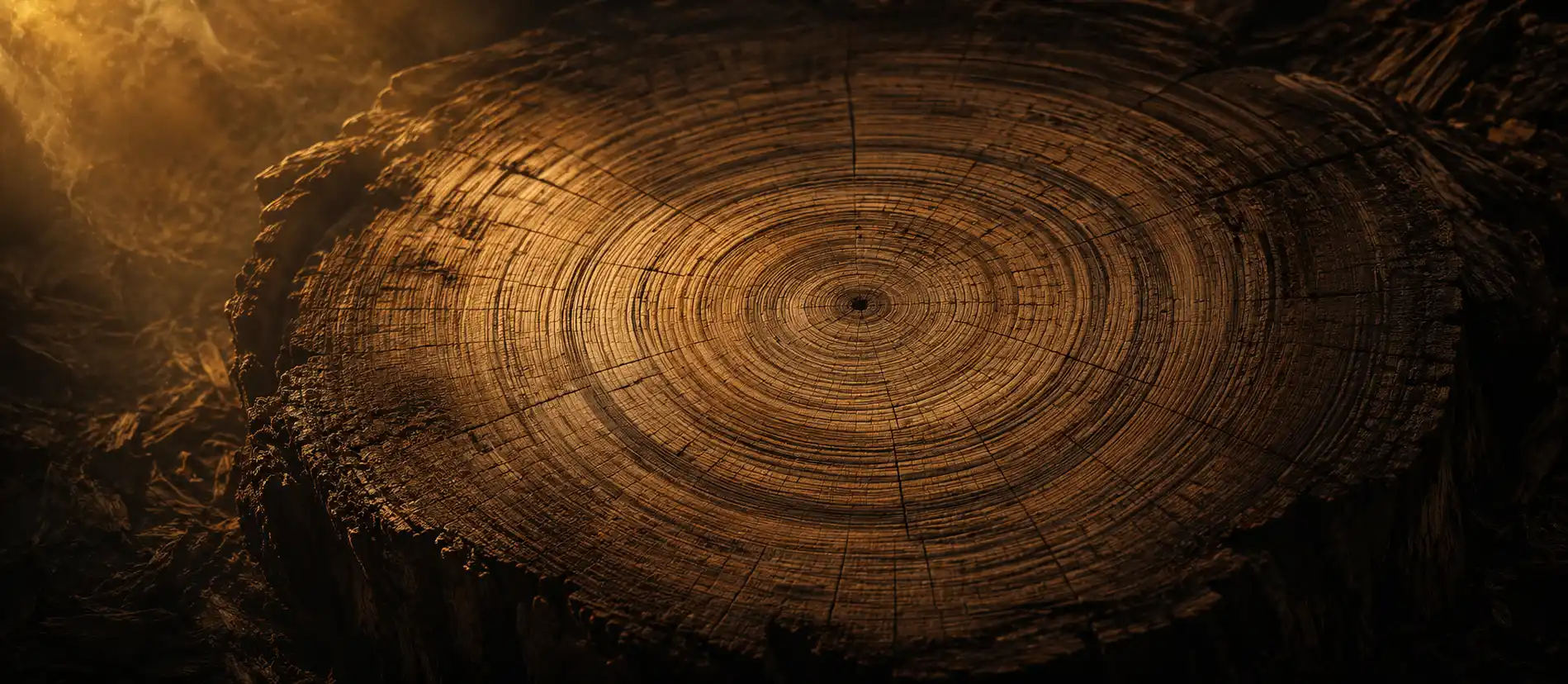
Cut across the trunk of a tree and you'll see a series of rings — concentric circles of wood. Some rings are wide. Some are narrow. Each ring represents one year of growth. Old timber yards and broken branches show this clearly: a 50-year-old tree has roughly 50 rings. A 200-year-old peepal tree has 200.
But how does a tree make these rings?
Hidden inside the trunk, just under the bark, there is a thin cylinder of meristematic cells arranged in a ring around the entire stem. This is the lateral meristem (lateral = sides). Unlike the apical meristem, which is a tiny patch at the tip, the lateral meristem is a continuous ring running all along the length of the stem.
Every year, the cells in this ring divide. Some new cells are pushed outward (forming new bark and protective tissue) and some are pushed inward (forming new wood, including xylem — the water-carrying tissue). The trunk gets a little fatter each year. Across decades, this adds up to a massive trunk.
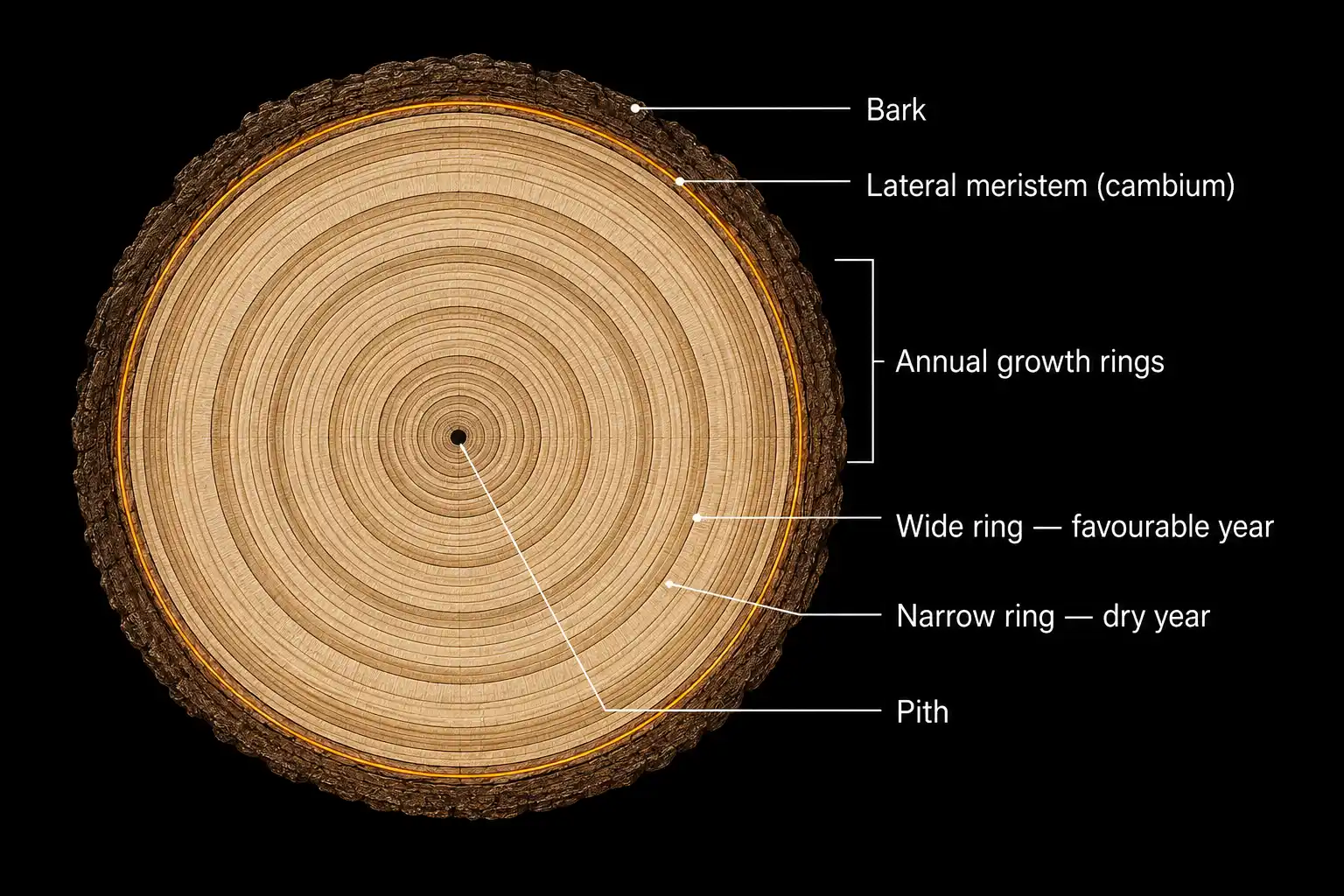
A scientist studies a 200-year-old tree's rings and notices that rings #87 to #94 are unusually narrow, while rings #95 to #100 are unusually wide. From this pattern alone, what is the most likely reason?
Why the Ring Shape?
Why is the lateral meristem arranged as a ring around the stem, instead of as a patch like the apical meristem? Look at what each one needs to do.
The apical meristem only has to add length in one direction — up for the shoot, down for the root. A small patch at the tip is enough.
But the lateral meristem has to make the trunk thicker on all sides equally. If it were just a patch on one side, the trunk would grow lopsided — fat on one face, thin on the other. By forming a ring, it adds new cells uniformly around the entire circumference. Result: a perfectly cylindrical, balanced trunk.
Most tall trees you see — peepal, banyan, neem, mango — owe their thick trunks to lateral meristems running for centuries. Soft herbs and grasses, on the other hand, often have very weak or no lateral meristem. That's why they stay slender — there's no factory thickening their stems.
Reading 4,000 Years of Climate from One Tree
In the deserts of California, scientists studied bristlecone pines whose annual rings stretch back over 4,000 years. By matching the patterns of wide and narrow rings across many trees (some living, some long dead but preserved as wood), they reconstructed rainfall and temperature for centuries before any human kept records.
Cork Cambium — A Second Lateral Meristem
As trees age, the original lateral meristem (called the vascular cambium) is joined by a second one — the cork cambium — that forms just under the outer skin. The cork cambium produces dead, waterproof cells that pile up to form the rough bark you see on old trees.
Q1.The lateral meristem is responsible for:
A neem sapling next to your house was as thin as a pencil five years ago. Today its trunk is as wide as your arm. The shoot tip handles growth in length — but what makes the trunk thicker year after year? Where exactly are the new cells being added?
The patient growing of a tree
वनस्पते वीडुवण्होऽप्रथास्तना न उद्भिद।
Hindi: Hey vanaspati (ped), tum kaayam raho, mazboot raho, har taraf failo, hamesha bahar nikalte raho.
English: O tree, stand firm, grow strong, spread outward, keep emerging from within.
Trees do exactly this — they keep emerging from within. A thin ring of cells under their bark quietly adds new wood every year, making them stronger and wider. Without you noticing.
The Hidden Ring — Lateral Meristem
Cut across the trunk of a tree and you'll see a series of rings — concentric circles of wood. Some rings are wide. Some are narrow. Each ring represents one year of growth. Old timber yards and broken branches show this clearly: a 50-year-old tree has roughly 50 rings. A 200-year-old peepal tree has 200.
But how does a tree make these rings?
Hidden inside the trunk, just under the bark, there is a thin cylinder of meristematic cells arranged in a ring around the entire stem. This is the lateral meristem (lateral = sides). Unlike the apical meristem, which is a tiny patch at the tip, the lateral meristem is a continuous ring running all along the length of the stem.
Every year, the cells in this ring divide. Some new cells are pushed outward (forming new bark and protective tissue) and some are pushed inward (forming new wood, including xylem — the water-carrying tissue). The trunk gets a little fatter each year. Across decades, this adds up to a massive trunk.
A scientist studies a 200-year-old tree's rings and notices that rings #87 to #94 are unusually narrow, while rings #95 to #100 are unusually wide. From this pattern alone, what is the most likely reason?
Why the Ring Shape?
Why is the lateral meristem arranged as a ring around the stem, instead of as a patch like the apical meristem? Look at what each one needs to do.
The apical meristem only has to add length in one direction — up for the shoot, down for the root. A small patch at the tip is enough.
But the lateral meristem has to make the trunk thicker on all sides equally. If it were just a patch on one side, the trunk would grow lopsided — fat on one face, thin on the other. By forming a ring, it adds new cells uniformly around the entire circumference. Result: a perfectly cylindrical, balanced trunk.
Most tall trees you see — peepal, banyan, neem, mango — owe their thick trunks to lateral meristems running for centuries. Soft herbs and grasses, on the other hand, often have very weak or no lateral meristem. That's why they stay slender — there's no factory thickening their stems.
Reading 4,000 Years of Climate from One Tree
In the deserts of California, scientists studied bristlecone pines whose annual rings stretch back over 4,000 years. By matching the patterns of wide and narrow rings across many trees (some living, some long dead but preserved as wood), they reconstructed rainfall and temperature for centuries before any human kept records.
Cork Cambium — A Second Lateral Meristem
As trees age, the original lateral meristem (called the vascular cambium) is joined by a second one — the cork cambium — that forms just under the outer skin. The cork cambium produces dead, waterproof cells that pile up to form the rough bark you see on old trees.
Q1.The lateral meristem is responsible for: