Animal Tissues — The Four That Make You
Epithelial, connective, muscle, and nervous — the entire animal kingdom in four tissues
Right now, your eyes are scanning these letters. Your fingers are holding a phone or book. Your heart is beating without you thinking about it. Your skin is keeping out germs. Different tissues are doing different jobs at this exact moment — and you're not aware of any of it. How many different KINDS of tissue do you think your body needs to do all this?
Many parts, one body
महाभूतान्यहंकारो बुद्धिरव्यक्तमेव च। इन्द्रियाणि दशैकं च पंच चेन्द्रियगोचराः॥
Hindi: Mahabhoot, ahankaar, buddhi, indriyan — itne saare hisse milkar ek body banate hain. Har hissa apna kaam karta hai.
English: The great elements, the senses, the mind, the intellect — many distinct parts come together to form a single body, each performing its function.
Modern biology tells the same story in different words. Your body is built from just four kinds of tissue, each highly specialised, each doing its part. None alone makes a person. Together they make you.
Why Animal Tissues Are Different from Plant Tissues
You've spent the last several pages with plants — their meristems, their xylem, their parenchyma, their bark. Now we shift to animals, which face a completely different set of problems.
Plants stand still. They make their own food. They don't sense things in real time. Animals are the opposite: they move, they hunt or graze, they sense danger, they feel pain. These needs require different tissues built to different specifications.
Three big shifts from plants to animals:
1. Movement matters. A grass blade doesn't need a tissue that contracts on demand. You do — to walk, blink, breathe, swallow, pump blood. So animals invented a tissue category plants don't have: muscle tissue.
2. Speed of response matters. A plant can take hours to react to sunlight. An animal needs to react in milliseconds — pull your hand from a hot stove, jump back from a snake, blink before dust hits your eye. This required another new category: nervous tissue.
3. The body has to hold itself together while moving. Plant cells have walls — they stick together by glue. Animal cells don't have walls — they need a separate tissue to bind them, support them, and connect distant parts. That's connective tissue.
Add to these three a fourth — epithelial tissue — which forms protective sheets covering the outside of the body and lining every internal organ — and you have all four major animal tissue types.
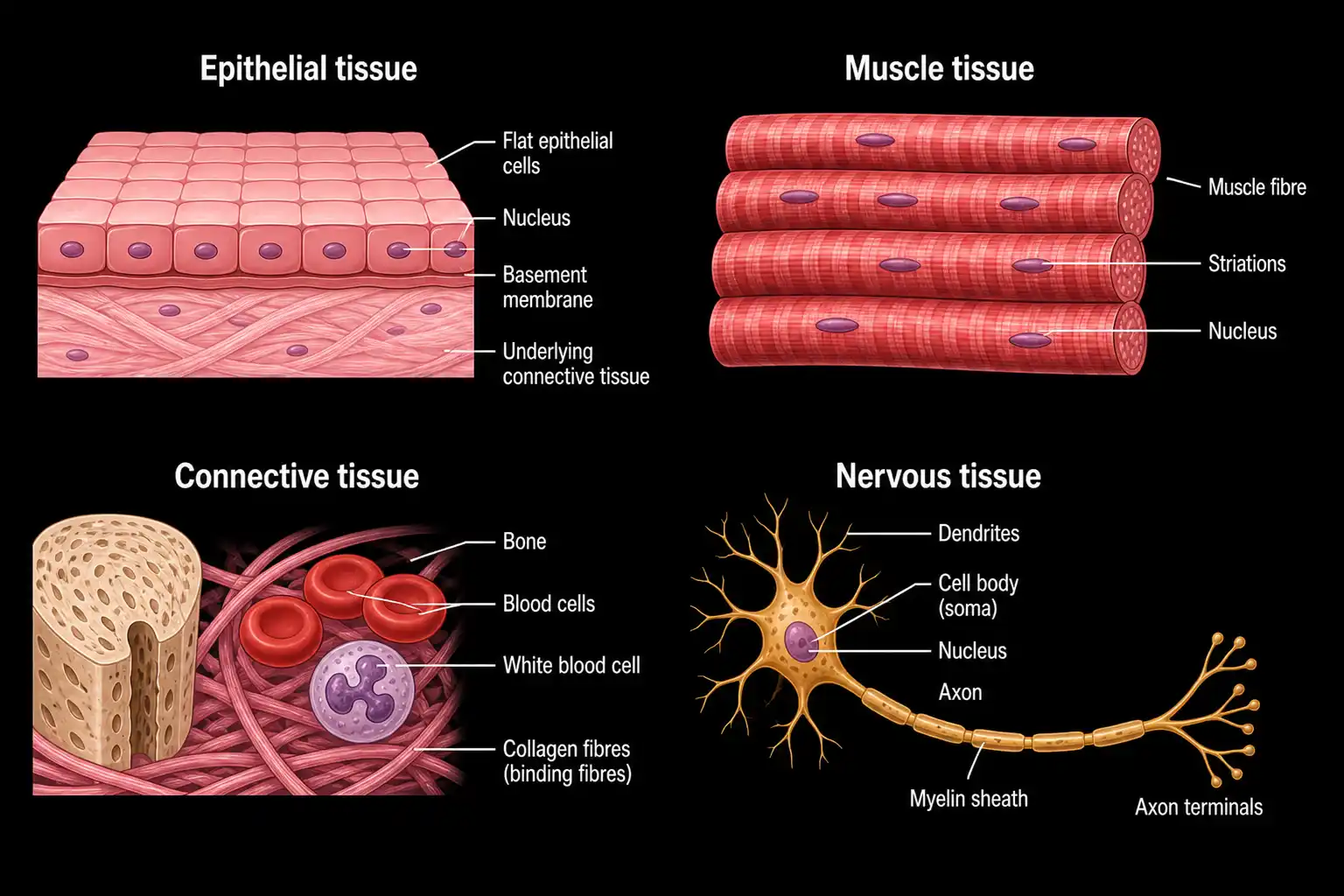
The Four Animal Tissues — At a Glance
Epithelial
- Covering and lining tissue
- Tight sheets of cells with little gap
- Outer body surface (skin) and internal organ linings (stomach, lungs, mouth)
- Protects, absorbs, secretes, senses
Connective
- Binds, supports, connects
- Cells embedded in a matrix — fluid (blood), gel (cartilage), or hard (bone)
- Blood, bones, cartilage, tendons, ligaments
- Holds the body together; carries materials
Muscle
- Movement tissue
- Long, contractile cells called muscle fibres
- Skeletal muscle, smooth muscle, cardiac muscle
- Voluntary motion, heartbeat, digestion
Nervous
- Information tissue
- Specialised cells called neurons that transmit electrical signals
- Brain, spinal cord, nerves throughout the body
- Senses, decides, signals, controls
Epithelial
- Covering and lining tissue
- Tight sheets of cells with little gap
- Outer body surface (skin) and internal organ linings (stomach, lungs, mouth)
- Protects, absorbs, secretes, senses
Connective
- Binds, supports, connects
- Cells embedded in a matrix — fluid (blood), gel (cartilage), or hard (bone)
- Blood, bones, cartilage, tendons, ligaments
- Holds the body together; carries materials
Muscle
- Movement tissue
- Long, contractile cells called muscle fibres
- Skeletal muscle, smooth muscle, cardiac muscle
- Voluntary motion, heartbeat, digestion
Nervous
- Information tissue
- Specialised cells called neurons that transmit electrical signals
- Brain, spinal cord, nerves throughout the body
- Senses, decides, signals, controls
A scientist removes a tiny tissue sample from an unknown organ inside a frog. Under the microscope, she sees: cells that are NOT tightly packed, that float in a liquid matrix, with no fibres holding them together rigidly. Which of the four animal tissue categories is this most likely to be?
Plant vs Animal Tissues — One Last Comparison
Stepping back, here's how plant and animal tissues differ:
Plants don't have:
- Muscle tissue (they don't move)
- Nervous tissue (they don't need millisecond reactions — chemical signalling is enough)
Animals don't have:
- Meristematic tissue in the same way (animal cells in some places do divide, like skin and gut, but there's no permanent 'growth zone' like a root tip)
- Xylem or phloem (animals don't transport water and food the same way; they have blood instead)
- Cell walls (so animal cells need connective tissue to glue them together — plants don't need this)
Both have:
- Epithelial-like covering tissues (epidermis in plants, epithelial in animals — both made of tightly packed protective cells)
- Storage tissue (parenchyma in plants, fat tissue in animals)
- Structural support tissue (sclerenchyma in plants, bone and cartilage in animals)
- Transport tissue (xylem/phloem in plants, blood in animals)
Different chemistry, different building blocks — but the problems are the same: protection, support, transport, growth, reproduction. Each kingdom solved them in its own way. The next pages dive into how animals solved the four big problems with their four tissue types.
Animals Without Brains — and Without Nerves
Sponges — the simplest animals — have no nervous tissue at all. No brain, no nerves, no neurons. They live for years, reproduce, even respond to touch — entirely without the signalling tissue we humans depend on for every thought.
Q1.How many major types of tissue are found in animals?
Right now, your eyes are scanning these letters. Your fingers are holding a phone or book. Your heart is beating without you thinking about it. Your skin is keeping out germs. Different tissues are doing different jobs at this exact moment — and you're not aware of any of it. How many different KINDS of tissue do you think your body needs to do all this?
Many parts, one body
महाभूतान्यहंकारो बुद्धिरव्यक्तमेव च। इन्द्रियाणि दशैकं च पंच चेन्द्रियगोचराः॥
Hindi: Mahabhoot, ahankaar, buddhi, indriyan — itne saare hisse milkar ek body banate hain. Har hissa apna kaam karta hai.
English: The great elements, the senses, the mind, the intellect — many distinct parts come together to form a single body, each performing its function.
Modern biology tells the same story in different words. Your body is built from just four kinds of tissue, each highly specialised, each doing its part. None alone makes a person. Together they make you.
Why Animal Tissues Are Different from Plant Tissues
You've spent the last several pages with plants — their meristems, their xylem, their parenchyma, their bark. Now we shift to animals, which face a completely different set of problems.
Plants stand still. They make their own food. They don't sense things in real time. Animals are the opposite: they move, they hunt or graze, they sense danger, they feel pain. These needs require different tissues built to different specifications.
Three big shifts from plants to animals:
1. Movement matters. A grass blade doesn't need a tissue that contracts on demand. You do — to walk, blink, breathe, swallow, pump blood. So animals invented a tissue category plants don't have: muscle tissue.
2. Speed of response matters. A plant can take hours to react to sunlight. An animal needs to react in milliseconds — pull your hand from a hot stove, jump back from a snake, blink before dust hits your eye. This required another new category: nervous tissue.
3. The body has to hold itself together while moving. Plant cells have walls — they stick together by glue. Animal cells don't have walls — they need a separate tissue to bind them, support them, and connect distant parts. That's connective tissue.
Add to these three a fourth — epithelial tissue — which forms protective sheets covering the outside of the body and lining every internal organ — and you have all four major animal tissue types.
The Four Animal Tissues — At a Glance
Epithelial
- Covering and lining tissue
- Tight sheets of cells with little gap
- Outer body surface (skin) and internal organ linings (stomach, lungs, mouth)
- Protects, absorbs, secretes, senses
Connective
- Binds, supports, connects
- Cells embedded in a matrix — fluid (blood), gel (cartilage), or hard (bone)
- Blood, bones, cartilage, tendons, ligaments
- Holds the body together; carries materials
Muscle
- Movement tissue
- Long, contractile cells called muscle fibres
- Skeletal muscle, smooth muscle, cardiac muscle
- Voluntary motion, heartbeat, digestion
Nervous
- Information tissue
- Specialised cells called neurons that transmit electrical signals
- Brain, spinal cord, nerves throughout the body
- Senses, decides, signals, controls
Epithelial
- Covering and lining tissue
- Tight sheets of cells with little gap
- Outer body surface (skin) and internal organ linings (stomach, lungs, mouth)
- Protects, absorbs, secretes, senses
Connective
- Binds, supports, connects
- Cells embedded in a matrix — fluid (blood), gel (cartilage), or hard (bone)
- Blood, bones, cartilage, tendons, ligaments
- Holds the body together; carries materials
Muscle
- Movement tissue
- Long, contractile cells called muscle fibres
- Skeletal muscle, smooth muscle, cardiac muscle
- Voluntary motion, heartbeat, digestion
Nervous
- Information tissue
- Specialised cells called neurons that transmit electrical signals
- Brain, spinal cord, nerves throughout the body
- Senses, decides, signals, controls
A scientist removes a tiny tissue sample from an unknown organ inside a frog. Under the microscope, she sees: cells that are NOT tightly packed, that float in a liquid matrix, with no fibres holding them together rigidly. Which of the four animal tissue categories is this most likely to be?
Plant vs Animal Tissues — One Last Comparison
Stepping back, here's how plant and animal tissues differ:
Plants don't have:
- Muscle tissue (they don't move)
- Nervous tissue (they don't need millisecond reactions — chemical signalling is enough)
Animals don't have:
- Meristematic tissue in the same way (animal cells in some places do divide, like skin and gut, but there's no permanent 'growth zone' like a root tip)
- Xylem or phloem (animals don't transport water and food the same way; they have blood instead)
- Cell walls (so animal cells need connective tissue to glue them together — plants don't need this)
Both have:
- Epithelial-like covering tissues (epidermis in plants, epithelial in animals — both made of tightly packed protective cells)
- Storage tissue (parenchyma in plants, fat tissue in animals)
- Structural support tissue (sclerenchyma in plants, bone and cartilage in animals)
- Transport tissue (xylem/phloem in plants, blood in animals)
Different chemistry, different building blocks — but the problems are the same: protection, support, transport, growth, reproduction. Each kingdom solved them in its own way. The next pages dive into how animals solved the four big problems with their four tissue types.
Animals Without Brains — and Without Nerves
Sponges — the simplest animals — have no nervous tissue at all. No brain, no nerves, no neurons. They live for years, reproduce, even respond to touch — entirely without the signalling tissue we humans depend on for every thought.
Q1.How many major types of tissue are found in animals?