The Musculoskeletal System — Six Tissues, One Movement
How bones, muscles, joints, tendons, ligaments, and cartilage move you through the world
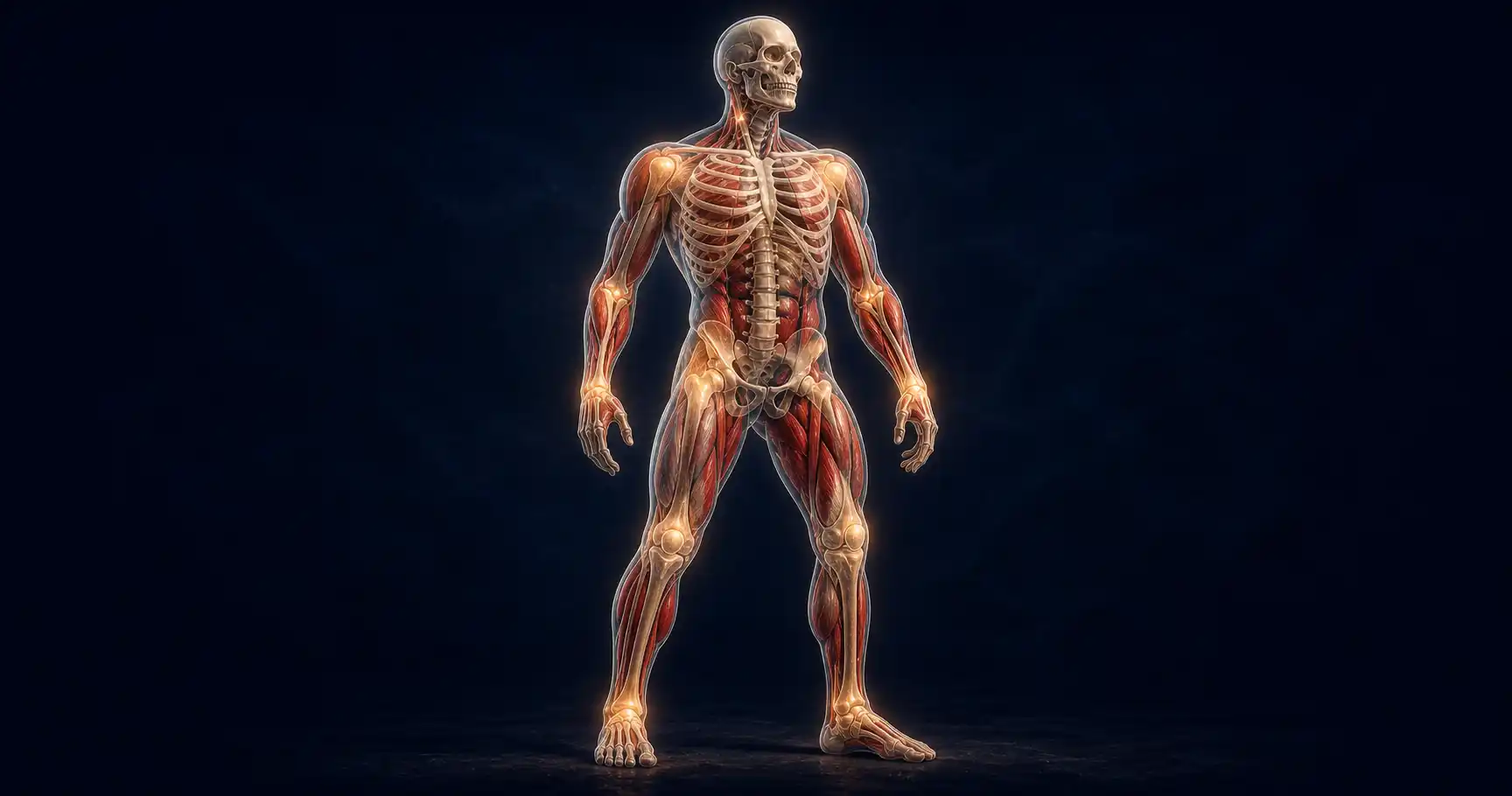
Pick up a glass of water. Easy, right? But notice everything that just happened: your brain decided to lift the glass, sent a signal through nerves, your muscles contracted in the right order, your tendons pulled on the right bones, your joints bent at exactly the right angles, and your fingers closed around the glass with just enough force not to crush it. Six different tissues coordinated in under a second. How does the body get all six to work together so smoothly?
One body, many organs, working as one
एकं अनेकेषु शरीरेषु अनेकं एकेषु शरीरेषु।
Hindi: Anek angg ek body banate hain, aur ek body anek angg chalata hai — alag rehte hue bhi ek hai.
English: Many organs make one body; one body moves many organs — distinct yet inseparable.
Lift one finger and you've already used bone, joint, muscle, tendon, and nerve. Five tissues for one tiny motion. Multiply that by every movement you make in a day, and you'll see why the human body is one of the most coordinated machines anywhere on Earth.
What Is the Musculoskeletal System?
Until now you've met individual tissues — epithelial, connective, muscle, nervous. But your body doesn't work as a list of tissues. It works as systems — groups of tissues that come together to do bigger jobs. Each system is built from several tissue types working as a team.
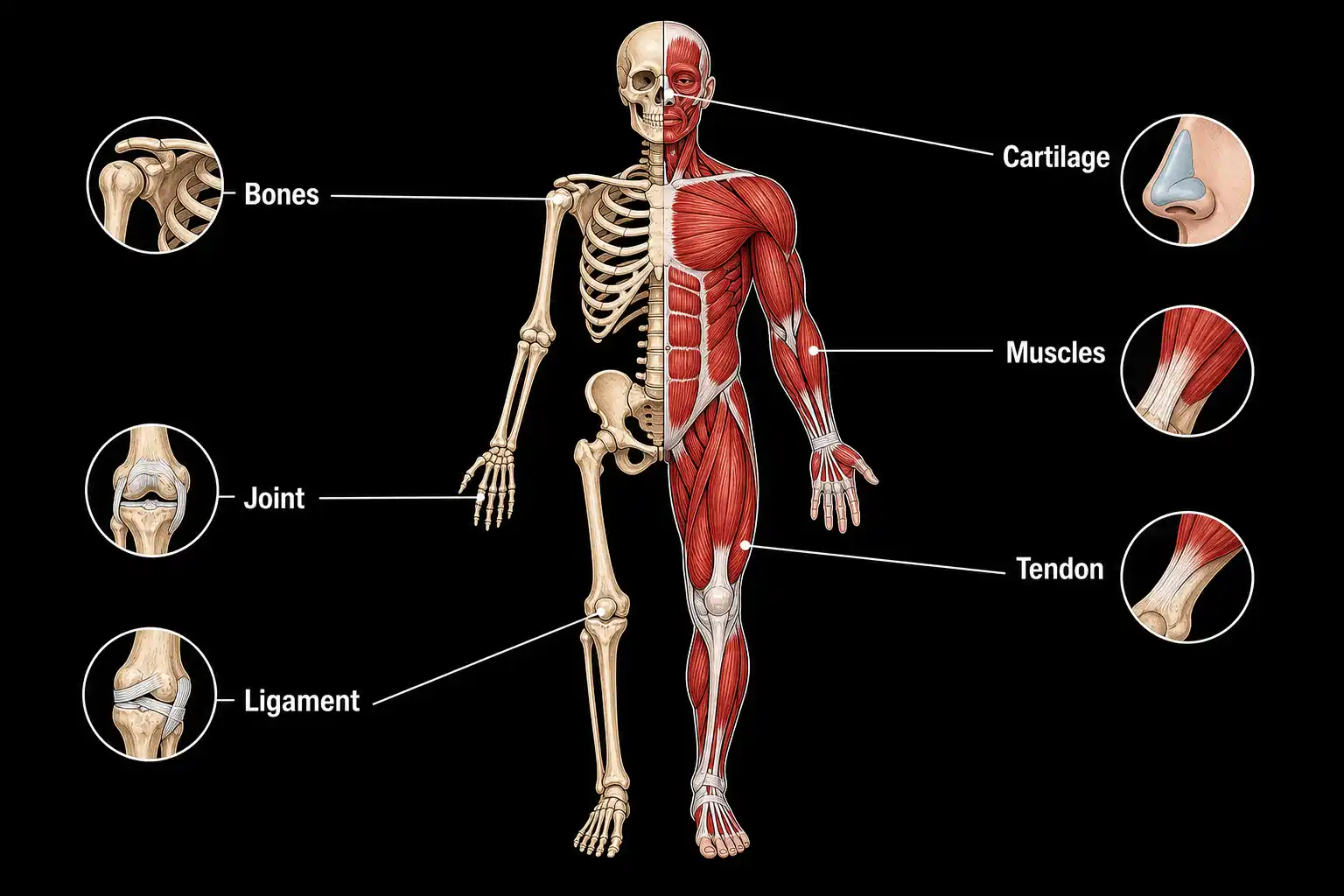
The musculoskeletal system is one of the most important. It includes:
- Bones — provide the rigid frame
- Joints — places where bones meet, allowing movement
- Muscles — produce the force that moves the bones
- Tendons — connect muscles to bones, transmitting that force
- Ligaments — connect bones to bones at joints, keeping the structure stable
- Cartilage — cushions where bones meet, absorbing impact
Every movement you make — walking, blinking, breathing, smiling, dancing — uses some combination of these. The musculoskeletal system does three big things together:
1. Holds you up. Without a skeleton, you'd be a soft heap on the floor. Bones give shape and rigidity. Without ligaments, the bones would fall apart. Without muscles, you couldn't stay upright against gravity.
2. Lets you move. Muscles pull on bones via tendons. Joints allow the bones to rotate or hinge. The nervous system sends timing signals so the right muscle contracts at the right moment.
3. Protects your organs. The skull surrounds the brain. The rib cage surrounds the heart and lungs. The vertebral column surrounds the spinal cord. Bones and ligaments form a protective armour over the body's most fragile parts.
Roughly 40-50% of an adult man's body weight is muscle, and 12-15% is bone. Together, the musculoskeletal system is more than half of you.
How Movement Actually Happens
Let's slow down a single act — bending your elbow to bring food to your mouth — and trace what each tissue does:
- Your brain decides to bend the elbow. A nerve signal travels from the brain down the spinal cord and out to your bicep muscle.
- The signal reaches the bicep muscle, which begins to contract. The muscle fibres shorten.
- The tendon connecting the bicep to the bone of your forearm transmits this contraction force. The tendon doesn't stretch; it just transmits.
- The forearm bone is pulled upward by the tendon's tug. The bones of your upper arm and forearm meet at the elbow joint — a hinge that lets them swing closer together.
- The ligaments around the elbow stay taut, ensuring the joint bends only in the allowed direction (forward, not sideways).
- Cartilage at the joint surface keeps the bones from grinding directly. It compresses slightly to absorb the force.
All of this in less than half a second, and it happens whenever you eat, scratch your face, or wave at someone.
Now consider running. Hundreds of muscles, dozens of joints, thousands of nerve signals, all sequenced perfectly within fractions of a second — while your eyes track where you're going, your lungs expand, and your heart pumps faster. The musculoskeletal system never works alone; it always works in tight coordination with the nervous system, the respiratory system, and the cardiovascular system. Every act of movement involves your entire body.
Imagine someone is born with healthy bones, healthy muscles, and a healthy nervous system — but completely missing tendons. What would happen when they tried to move?
What Happens to Astronauts in Space
Astronauts spending months in zero gravity face a strange problem: their musculoskeletal system starts to weaken. Without gravity to work against, muscles atrophy (shrink) and bones lose calcium. After 6 months in space, an astronaut can lose up to 20% of their bone mass and significant muscle strength.
Antagonistic Muscle Pairs
Most muscles in your body work in opposing pairs. To bend your elbow, the bicep contracts. To straighten it again, the tricep contracts (and the bicep relaxes). Two muscles, opposite jobs.
Q1.The musculoskeletal system is made up primarily of:
Pick up a glass of water. Easy, right? But notice everything that just happened: your brain decided to lift the glass, sent a signal through nerves, your muscles contracted in the right order, your tendons pulled on the right bones, your joints bent at exactly the right angles, and your fingers closed around the glass with just enough force not to crush it. Six different tissues coordinated in under a second. How does the body get all six to work together so smoothly?
One body, many organs, working as one
एकं अनेकेषु शरीरेषु अनेकं एकेषु शरीरेषु।
Hindi: Anek angg ek body banate hain, aur ek body anek angg chalata hai — alag rehte hue bhi ek hai.
English: Many organs make one body; one body moves many organs — distinct yet inseparable.
Lift one finger and you've already used bone, joint, muscle, tendon, and nerve. Five tissues for one tiny motion. Multiply that by every movement you make in a day, and you'll see why the human body is one of the most coordinated machines anywhere on Earth.
What Is the Musculoskeletal System?
Until now you've met individual tissues — epithelial, connective, muscle, nervous. But your body doesn't work as a list of tissues. It works as systems — groups of tissues that come together to do bigger jobs. Each system is built from several tissue types working as a team.
The musculoskeletal system is one of the most important. It includes:
- Bones — provide the rigid frame
- Joints — places where bones meet, allowing movement
- Muscles — produce the force that moves the bones
- Tendons — connect muscles to bones, transmitting that force
- Ligaments — connect bones to bones at joints, keeping the structure stable
- Cartilage — cushions where bones meet, absorbing impact
Every movement you make — walking, blinking, breathing, smiling, dancing — uses some combination of these. The musculoskeletal system does three big things together:
1. Holds you up. Without a skeleton, you'd be a soft heap on the floor. Bones give shape and rigidity. Without ligaments, the bones would fall apart. Without muscles, you couldn't stay upright against gravity.
2. Lets you move. Muscles pull on bones via tendons. Joints allow the bones to rotate or hinge. The nervous system sends timing signals so the right muscle contracts at the right moment.
3. Protects your organs. The skull surrounds the brain. The rib cage surrounds the heart and lungs. The vertebral column surrounds the spinal cord. Bones and ligaments form a protective armour over the body's most fragile parts.
Roughly 40-50% of an adult man's body weight is muscle, and 12-15% is bone. Together, the musculoskeletal system is more than half of you.
How Movement Actually Happens
Let's slow down a single act — bending your elbow to bring food to your mouth — and trace what each tissue does:
- Your brain decides to bend the elbow. A nerve signal travels from the brain down the spinal cord and out to your bicep muscle.
- The signal reaches the bicep muscle, which begins to contract. The muscle fibres shorten.
- The tendon connecting the bicep to the bone of your forearm transmits this contraction force. The tendon doesn't stretch; it just transmits.
- The forearm bone is pulled upward by the tendon's tug. The bones of your upper arm and forearm meet at the elbow joint — a hinge that lets them swing closer together.
- The ligaments around the elbow stay taut, ensuring the joint bends only in the allowed direction (forward, not sideways).
- Cartilage at the joint surface keeps the bones from grinding directly. It compresses slightly to absorb the force.
All of this in less than half a second, and it happens whenever you eat, scratch your face, or wave at someone.
Now consider running. Hundreds of muscles, dozens of joints, thousands of nerve signals, all sequenced perfectly within fractions of a second — while your eyes track where you're going, your lungs expand, and your heart pumps faster. The musculoskeletal system never works alone; it always works in tight coordination with the nervous system, the respiratory system, and the cardiovascular system. Every act of movement involves your entire body.
Imagine someone is born with healthy bones, healthy muscles, and a healthy nervous system — but completely missing tendons. What would happen when they tried to move?
What Happens to Astronauts in Space
Astronauts spending months in zero gravity face a strange problem: their musculoskeletal system starts to weaken. Without gravity to work against, muscles atrophy (shrink) and bones lose calcium. After 6 months in space, an astronaut can lose up to 20% of their bone mass and significant muscle strength.
Antagonistic Muscle Pairs
Most muscles in your body work in opposing pairs. To bend your elbow, the bicep contracts. To straighten it again, the tricep contracts (and the bicep relaxes). Two muscles, opposite jobs.
Q1.The musculoskeletal system is made up primarily of: