Three Ways a Plant Grows
Meeting the meristems — the engines of plant growth
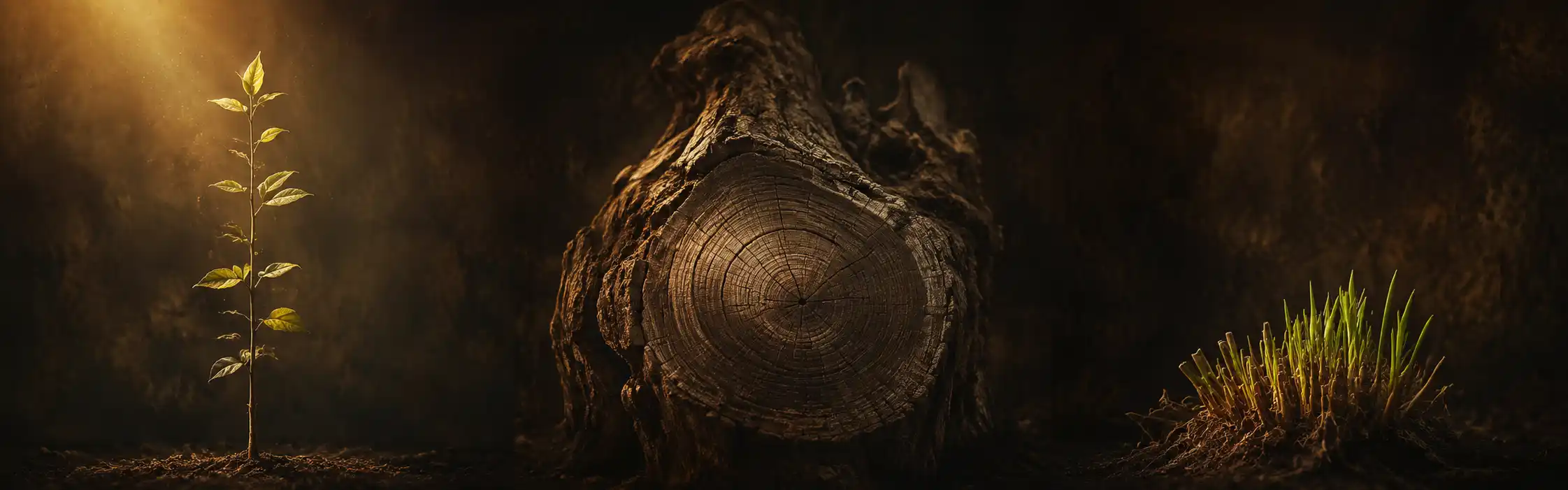
A goat reaches its full size in two years and then stops growing. A neem tree near your school keeps getting taller, thicker, AND grows new branches every year — for 200 years. What does the tree have that the goat doesn't?
The seed of all that grows
बीजं मां सर्वभूतानां विद्धि पार्थ सनातनम्।
Hindi: Hey Partha, jaan le — main hi har jeev ka shaashvat (eternal) beej hoon.
English: Know me as the eternal seed of all beings, O Partha.
Inside every plant, there are tiny cell patches that act like permanent seeds — always ready to make new cells. These are called meristems, and a 30-metre banyan tree owes every centimetre of its size to them.
Three Ways a Plant Grows
Walk past any garden and you'll notice plants grow in three different ways:
- Length — a sapling becomes a tall tree. Roots dig deeper into the soil. The shoot reaches higher into the sun.
- Girth — the trunk gets thicker over time. The same neem sapling that was as thin as a pencil is now as wide as your arm.
- Regrowth — cut the grass on a lawn, and within a few days, fresh blades push back up. Trim a hedge, and new branches sprout.
All three need the same thing: cells that can keep dividing to make new cells. But these cells are not scattered everywhere. They sit in specific locations in the plant body — and that is the key insight of this section.
A tissue made up of actively dividing cells is called a meristematic tissue, or simply a meristem (from the Greek meristos, 'divided'). Wherever a plant is growing — at a tip, around a stem, near a node — you'll find meristem cells doing the work.
Plants have three types of meristems, each responsible for one of the three growth modes above:
The Three Meristems — At a Glance
Apical meristem
- Located at root tips and shoot tips
- Responsible for growth in length
- First meristem to form when a seed sprouts
Lateral meristem
- Arranged in a thin ring around the stem
- Responsible for growth in girth
- Produces new cells inward and outward — making the trunk wider
Intercalary meristem
- Located at the base of leaves or above nodes
- Responsible for regrowth after cutting or grazing
- Most active in grasses and bamboo
Apical meristem
- Located at root tips and shoot tips
- Responsible for growth in length
- First meristem to form when a seed sprouts
Lateral meristem
- Arranged in a thin ring around the stem
- Responsible for growth in girth
- Produces new cells inward and outward — making the trunk wider
Intercalary meristem
- Located at the base of leaves or above nodes
- Responsible for regrowth after cutting or grazing
- Most active in grasses and bamboo
A farmer cuts off the top of a young mango sapling because it has grown too tall too fast. Based only on what you've just read, what would you predict?
What Makes a Meristem Cell Special?
Why are these cells able to keep dividing forever, while most other cells in the plant settle down and stop? Look at a meristem cell under a microscope and you'll see four clues:
- Small size — meristem cells are compact, not bloated
- Thin cell walls — easy to expand when the cell divides
- Large nucleus, dense cytoplasm — packed with the machinery for cell division
- Almost no vacuole — they are full of working parts, not storage water
Most other plant cells are the opposite — they have a big central vacuole filled with water and stored food, thicker walls, and a nucleus pushed to the side. Those cells have already 'settled down' and are doing other jobs (storage, support, transport). They have lost the ability to divide.
The next three pages each take one type of meristem and show how it does its job. We'll start where most of plant growth begins — at the tips of the roots and shoots.
Bristlecone Pines and the Oldest Meristems Alive
There's a tree called Methuselah in California's White Mountains — a bristlecone pine over 4,800 years old. It was already 700 years old when the pyramids of Giza were built.
Q1.A tissue made of actively dividing cells is called a:
A goat reaches its full size in two years and then stops growing. A neem tree near your school keeps getting taller, thicker, AND grows new branches every year — for 200 years. What does the tree have that the goat doesn't?
The seed of all that grows
बीजं मां सर्वभूतानां विद्धि पार्थ सनातनम्।
Hindi: Hey Partha, jaan le — main hi har jeev ka shaashvat (eternal) beej hoon.
English: Know me as the eternal seed of all beings, O Partha.
Inside every plant, there are tiny cell patches that act like permanent seeds — always ready to make new cells. These are called meristems, and a 30-metre banyan tree owes every centimetre of its size to them.
Three Ways a Plant Grows
Walk past any garden and you'll notice plants grow in three different ways:
- Length — a sapling becomes a tall tree. Roots dig deeper into the soil. The shoot reaches higher into the sun.
- Girth — the trunk gets thicker over time. The same neem sapling that was as thin as a pencil is now as wide as your arm.
- Regrowth — cut the grass on a lawn, and within a few days, fresh blades push back up. Trim a hedge, and new branches sprout.
All three need the same thing: cells that can keep dividing to make new cells. But these cells are not scattered everywhere. They sit in specific locations in the plant body — and that is the key insight of this section.
A tissue made up of actively dividing cells is called a meristematic tissue, or simply a meristem (from the Greek meristos, 'divided'). Wherever a plant is growing — at a tip, around a stem, near a node — you'll find meristem cells doing the work.
Plants have three types of meristems, each responsible for one of the three growth modes above:
The Three Meristems — At a Glance
Apical meristem
- Located at root tips and shoot tips
- Responsible for growth in length
- First meristem to form when a seed sprouts
Lateral meristem
- Arranged in a thin ring around the stem
- Responsible for growth in girth
- Produces new cells inward and outward — making the trunk wider
Intercalary meristem
- Located at the base of leaves or above nodes
- Responsible for regrowth after cutting or grazing
- Most active in grasses and bamboo
Apical meristem
- Located at root tips and shoot tips
- Responsible for growth in length
- First meristem to form when a seed sprouts
Lateral meristem
- Arranged in a thin ring around the stem
- Responsible for growth in girth
- Produces new cells inward and outward — making the trunk wider
Intercalary meristem
- Located at the base of leaves or above nodes
- Responsible for regrowth after cutting or grazing
- Most active in grasses and bamboo
A farmer cuts off the top of a young mango sapling because it has grown too tall too fast. Based only on what you've just read, what would you predict?
What Makes a Meristem Cell Special?
Why are these cells able to keep dividing forever, while most other cells in the plant settle down and stop? Look at a meristem cell under a microscope and you'll see four clues:
- Small size — meristem cells are compact, not bloated
- Thin cell walls — easy to expand when the cell divides
- Large nucleus, dense cytoplasm — packed with the machinery for cell division
- Almost no vacuole — they are full of working parts, not storage water
Most other plant cells are the opposite — they have a big central vacuole filled with water and stored food, thicker walls, and a nucleus pushed to the side. Those cells have already 'settled down' and are doing other jobs (storage, support, transport). They have lost the ability to divide.
The next three pages each take one type of meristem and show how it does its job. We'll start where most of plant growth begins — at the tips of the roots and shoots.
Bristlecone Pines and the Oldest Meristems Alive
There's a tree called Methuselah in California's White Mountains — a bristlecone pine over 4,800 years old. It was already 700 years old when the pyramids of Giza were built.
Q1.A tissue made of actively dividing cells is called a: