The Skeletal System — Skull, Spine, and Rib Cage
How 206 bones make a frame that is rigid, flexible, and breathing all at once
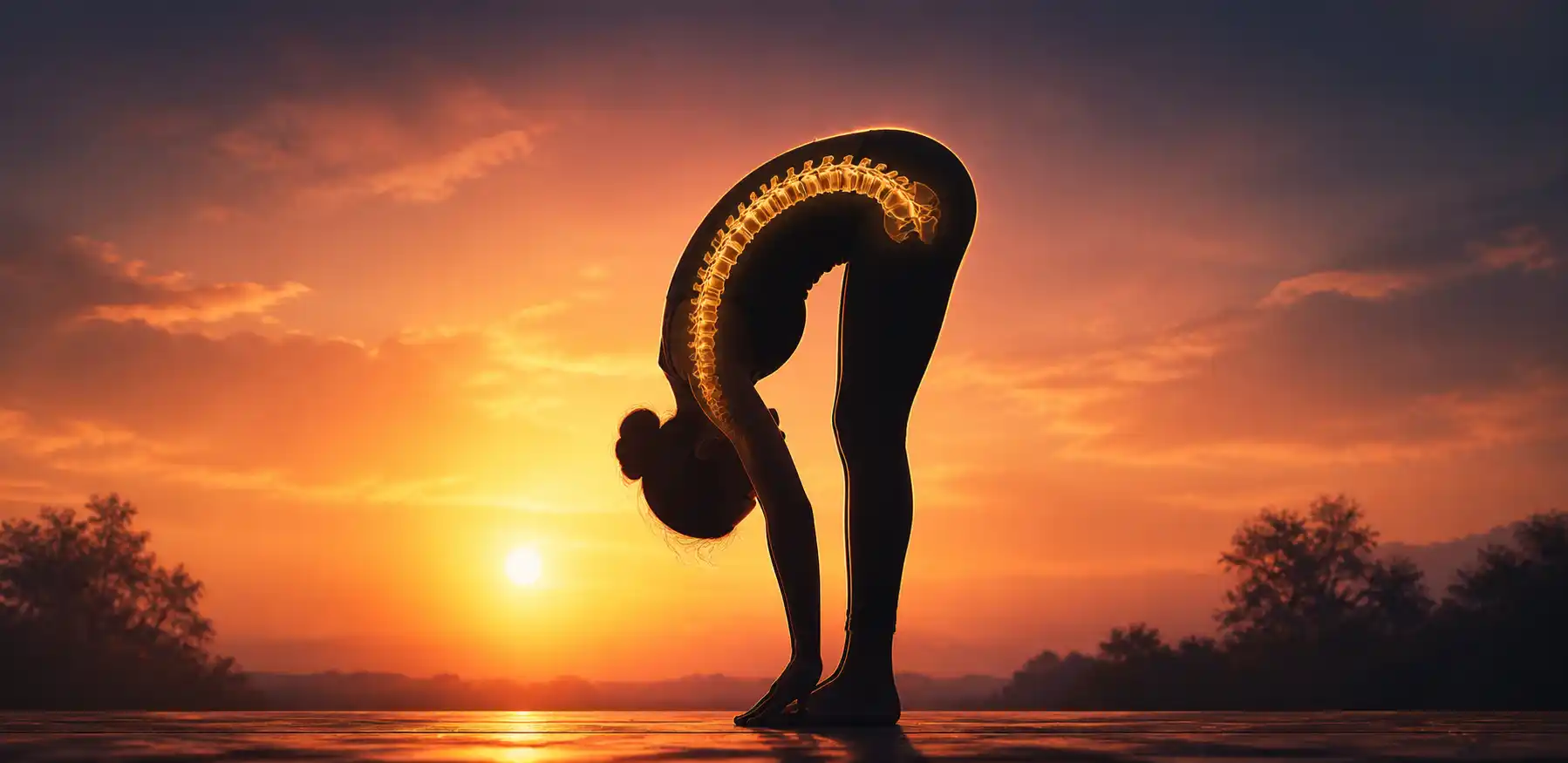
Stand up straight. Now bend slowly forward as far as you can. Now twist to the right. Now to the left. Your back has just done four very different things — and somehow it's still in one piece, with a delicate spinal cord (the bundle of nerves running from your brain) intact inside it. How is your spine flexible enough to bend AND strong enough to protect the most precious tissue in your body?
The spine — the central axis of life
मेरुदण्डे प्राणाः सञ्चरन्ति।
Hindi: Reedh ki haddi mein praan (life-energy) chalti hai — body ka asli kendra (centre) yahan hai.
English: Through the spine flows the life-force — the body's true centre lies along this column.
Ancient Indian thought saw the spine as the body's main axis. Modern biology agrees: the spine carries the spinal cord, the bundle of nerves that connects the brain to almost every other part of the body. Damage the spine, and signals stop flowing. Few structures are more important.
The Skeletal System — A Living Frame
The skeletal system is the body's framework — the 206 bones of an adult human, joined together by joints, ligaments, and cartilage, providing shape, support, protection, and the levers for muscles to pull on.
It has three main parts:
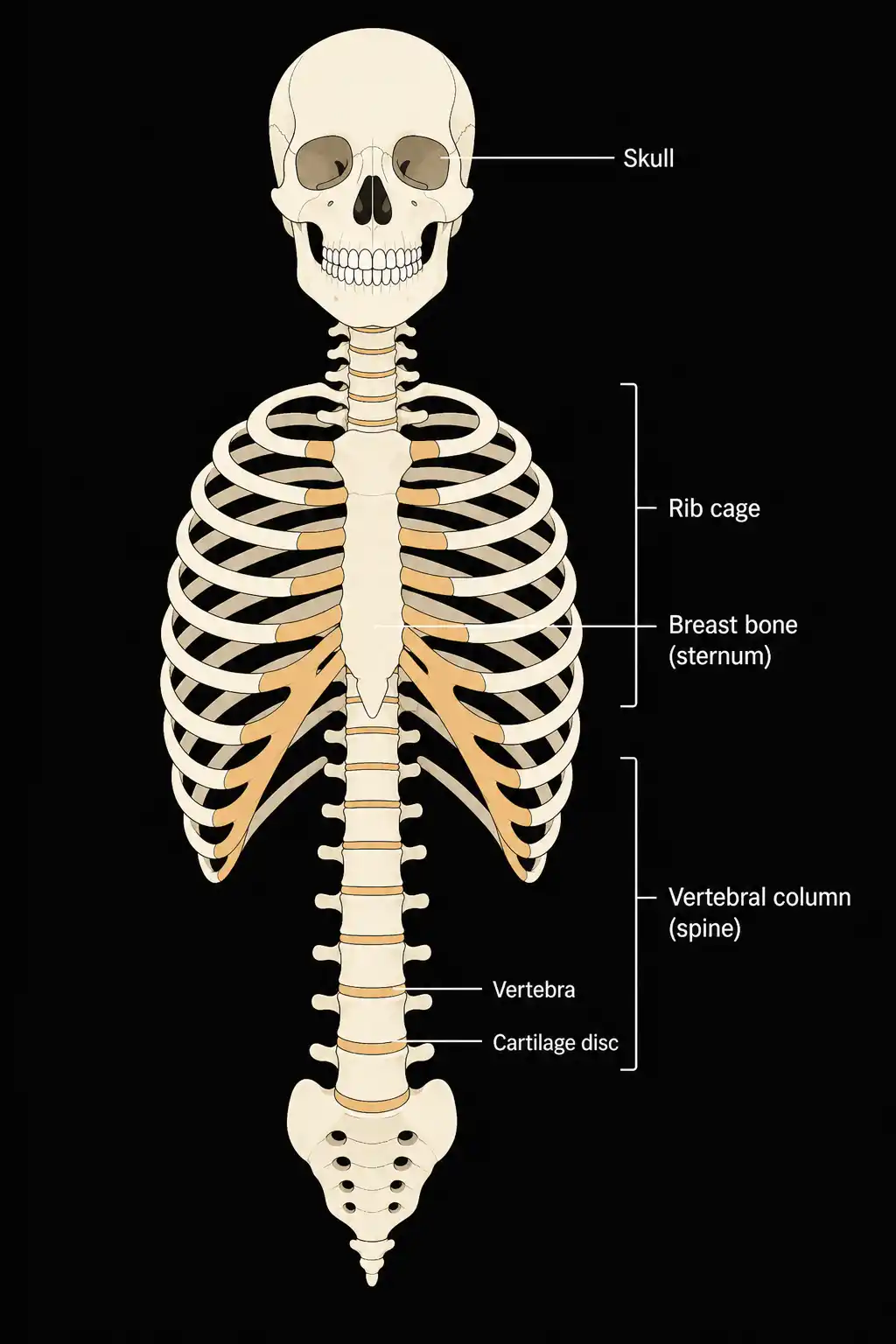
1. The skull — the bony case around the brain. Made of more than 20 bones fused together at fixed sutures. Houses your brain, the back of your eyes, your inner ear, your nasal cavity, and your upper teeth. The lower jaw is the only freely movable bone of the skull.
2. The vertebral column (spine) — a flexible stack of 33 small bones called vertebrae. Runs from the base of your skull down to your tailbone. Inside its central canal lies the spinal cord — the main nerve highway between your brain and the rest of your body.
3. The rib cage — 12 pairs of curved bones (ribs) attached to the spine at the back and to a flat breast bone (sternum) at the front. Forms a protective cage for your heart and lungs. The bones are joined by flexible cartilage, which is why the cage can expand and contract as you breathe.
Plus the bones of the arms and legs (called the appendicular skeleton) attached to the central frame at the shoulders and hips.
Together, these structures hold you upright, protect your most important organs, and give your muscles something to pull on. About 12-15% of an adult's body weight is bone.
The Spine — Strong and Flexible at the Same Time
The vertebral column is the body's most beautifully designed structure. It has to do two opposite jobs at once:
- Stay strong enough to hold up the weight of your head, chest, and arms
- Stay flexible enough to bend, twist, and absorb shocks when you walk, run, or jump
It manages this through a clever design. The spine isn't a single long bone — it's 33 vertebrae (small ring-shaped bones) stacked one above another. Between every two vertebrae sits a soft disc of cartilage that acts as a cushion. The bones provide rigidity; the cartilage discs allow movement and absorb impact.
Each vertebra has a hole in its centre. When you stack all 33 vertebrae together, those holes line up to form a long tunnel — and inside that tunnel runs the spinal cord, your main nerve cable.
When you bend forward, the cartilage discs on the front side of your spine compress, and those on the back side stretch slightly. Your spine can bend without crushing the cord because the bones act like protective armour around a soft hose, and the cartilage discs let everything flex.
When something goes wrong — a 'slipped disc' — usually the cartilage cushion has bulged out and is pressing on a nerve. The pain can be severe, but the design as a whole is incredibly successful: most spines work for 70-80 years without a serious problem.
The Rib Cage — Hard Bones That Must Bend
Touch your chest just below your collarbone. The hard ridges you feel are your ribs. You have 12 pairs of them. They curve around your chest, attaching to the spine at the back and (mostly) to the breast bone (sternum) at the front. Together, they form a hard cage that wraps around and protects the heart and lungs.
But here's an interesting puzzle. Your lungs need to expand and contract every time you breathe — about 20,000 breaths a day. If the rib cage were completely rigid, your lungs couldn't expand. So how does a 'cage of bones' breathe?
The answer is cartilage. The ribs don't connect directly to the breastbone with bone-to-bone fusion. They connect via flexible cartilage joints. When you breathe in, special muscles between the ribs (called intercostal muscles) pull the ribs upward and outward, and the cartilage joints flex to let the cage expand. The chest gets bigger; the lungs fill with air. When you breathe out, the muscles relax, the cage shrinks, and air pushes out.
This is one of the most elegant designs in the body: hard protective bones held together by soft flexible cartilage so they can move just enough to let you breathe — but not enough to risk damaging the heart and lungs inside.
Injury to the ribs — say from a hard fall or accident — makes breathing painful, because every breath now has to flex an injured joint. It's a reminder that bones aren't lone soldiers; they work as part of a larger system that moves and breathes.
What would happen if your spine was a single solid bone (like a femur) instead of 33 small vertebrae with cartilage discs in between?
Yoga and the Skeletal System
Yoga, described in ancient Indian texts (the Yoga Sutras of Patanjali, around 200 BCE), is built around understanding the spine and joints. Asanas like Tadasana (mountain pose) align the spine vertically; Bhujangasana (cobra) extends the upper spine backward; Paschimottanasana (seated forward bend) flexes it forward; Trikonasana (triangle) twists it sideways. Each pose deliberately moves a different combination of joints in a controlled way.
Why Babies Have More Bones Than Adults
A newborn baby has about 270-300 bones. An adult has just 206. So where do the extra bones go?
Q1.How many bones does an adult human skeleton have?
Stand up straight. Now bend slowly forward as far as you can. Now twist to the right. Now to the left. Your back has just done four very different things — and somehow it's still in one piece, with a delicate spinal cord (the bundle of nerves running from your brain) intact inside it. How is your spine flexible enough to bend AND strong enough to protect the most precious tissue in your body?
The spine — the central axis of life
मेरुदण्डे प्राणाः सञ्चरन्ति।
Hindi: Reedh ki haddi mein praan (life-energy) chalti hai — body ka asli kendra (centre) yahan hai.
English: Through the spine flows the life-force — the body's true centre lies along this column.
Ancient Indian thought saw the spine as the body's main axis. Modern biology agrees: the spine carries the spinal cord, the bundle of nerves that connects the brain to almost every other part of the body. Damage the spine, and signals stop flowing. Few structures are more important.
The Skeletal System — A Living Frame
The skeletal system is the body's framework — the 206 bones of an adult human, joined together by joints, ligaments, and cartilage, providing shape, support, protection, and the levers for muscles to pull on.
It has three main parts:
1. The skull — the bony case around the brain. Made of more than 20 bones fused together at fixed sutures. Houses your brain, the back of your eyes, your inner ear, your nasal cavity, and your upper teeth. The lower jaw is the only freely movable bone of the skull.
2. The vertebral column (spine) — a flexible stack of 33 small bones called vertebrae. Runs from the base of your skull down to your tailbone. Inside its central canal lies the spinal cord — the main nerve highway between your brain and the rest of your body.
3. The rib cage — 12 pairs of curved bones (ribs) attached to the spine at the back and to a flat breast bone (sternum) at the front. Forms a protective cage for your heart and lungs. The bones are joined by flexible cartilage, which is why the cage can expand and contract as you breathe.
Plus the bones of the arms and legs (called the appendicular skeleton) attached to the central frame at the shoulders and hips.
Together, these structures hold you upright, protect your most important organs, and give your muscles something to pull on. About 12-15% of an adult's body weight is bone.
The Spine — Strong and Flexible at the Same Time
The vertebral column is the body's most beautifully designed structure. It has to do two opposite jobs at once:
- Stay strong enough to hold up the weight of your head, chest, and arms
- Stay flexible enough to bend, twist, and absorb shocks when you walk, run, or jump
It manages this through a clever design. The spine isn't a single long bone — it's 33 vertebrae (small ring-shaped bones) stacked one above another. Between every two vertebrae sits a soft disc of cartilage that acts as a cushion. The bones provide rigidity; the cartilage discs allow movement and absorb impact.
Each vertebra has a hole in its centre. When you stack all 33 vertebrae together, those holes line up to form a long tunnel — and inside that tunnel runs the spinal cord, your main nerve cable.
When you bend forward, the cartilage discs on the front side of your spine compress, and those on the back side stretch slightly. Your spine can bend without crushing the cord because the bones act like protective armour around a soft hose, and the cartilage discs let everything flex.
When something goes wrong — a 'slipped disc' — usually the cartilage cushion has bulged out and is pressing on a nerve. The pain can be severe, but the design as a whole is incredibly successful: most spines work for 70-80 years without a serious problem.
The Rib Cage — Hard Bones That Must Bend
Touch your chest just below your collarbone. The hard ridges you feel are your ribs. You have 12 pairs of them. They curve around your chest, attaching to the spine at the back and (mostly) to the breast bone (sternum) at the front. Together, they form a hard cage that wraps around and protects the heart and lungs.
But here's an interesting puzzle. Your lungs need to expand and contract every time you breathe — about 20,000 breaths a day. If the rib cage were completely rigid, your lungs couldn't expand. So how does a 'cage of bones' breathe?
The answer is cartilage. The ribs don't connect directly to the breastbone with bone-to-bone fusion. They connect via flexible cartilage joints. When you breathe in, special muscles between the ribs (called intercostal muscles) pull the ribs upward and outward, and the cartilage joints flex to let the cage expand. The chest gets bigger; the lungs fill with air. When you breathe out, the muscles relax, the cage shrinks, and air pushes out.
This is one of the most elegant designs in the body: hard protective bones held together by soft flexible cartilage so they can move just enough to let you breathe — but not enough to risk damaging the heart and lungs inside.
Injury to the ribs — say from a hard fall or accident — makes breathing painful, because every breath now has to flex an injured joint. It's a reminder that bones aren't lone soldiers; they work as part of a larger system that moves and breathes.
What would happen if your spine was a single solid bone (like a femur) instead of 33 small vertebrae with cartilage discs in between?
Yoga and the Skeletal System
Yoga, described in ancient Indian texts (the Yoga Sutras of Patanjali, around 200 BCE), is built around understanding the spine and joints. Asanas like Tadasana (mountain pose) align the spine vertically; Bhujangasana (cobra) extends the upper spine backward; Paschimottanasana (seated forward bend) flexes it forward; Trikonasana (triangle) twists it sideways. Each pose deliberately moves a different combination of joints in a controlled way.
Why Babies Have More Bones Than Adults
A newborn baby has about 270-300 bones. An adult has just 206. So where do the extra bones go?
Q1.How many bones does an adult human skeleton have?