From One Cell to a Whole You
How a single cell becomes thirty trillion specialists
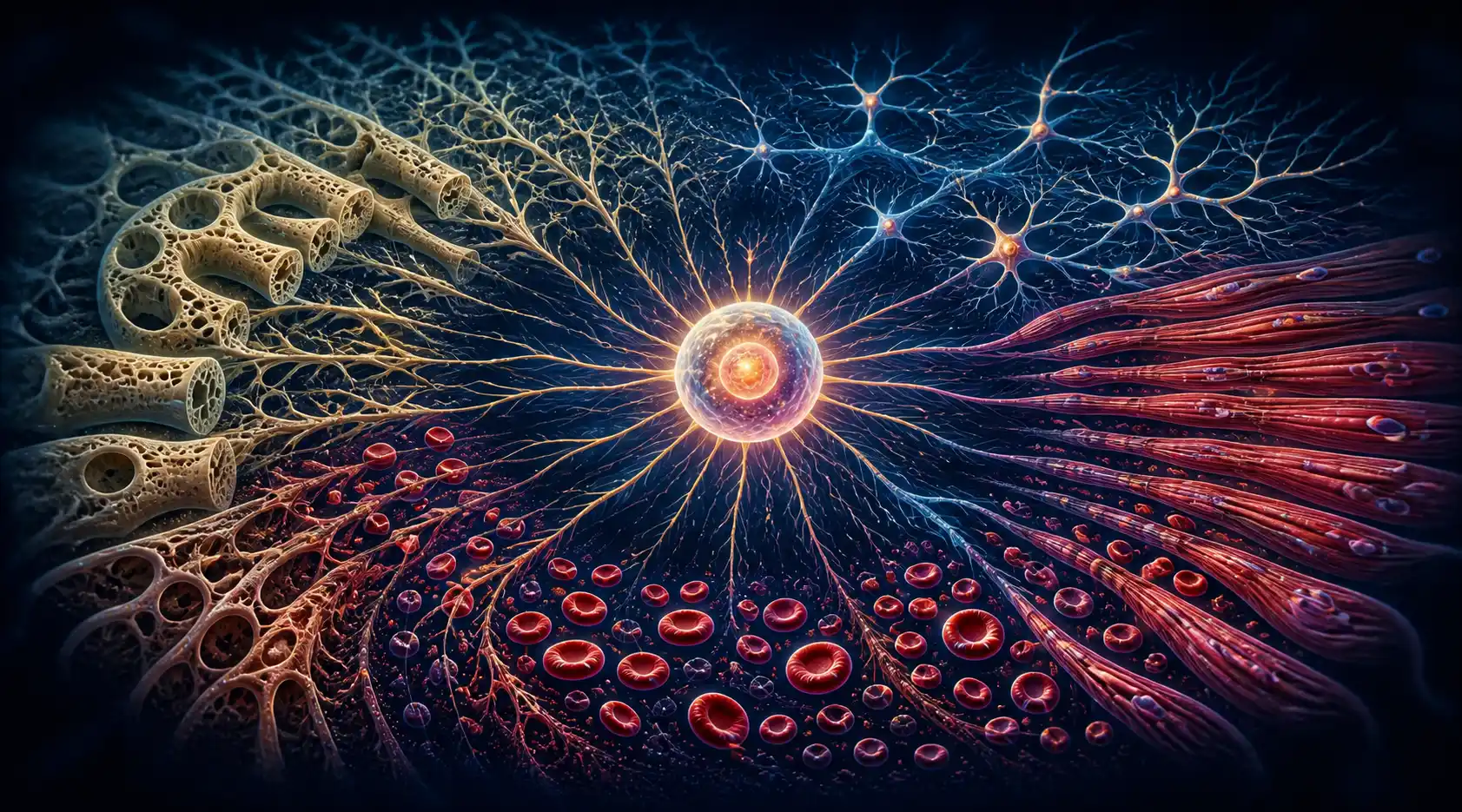
You started life as a single cell — smaller than a grain of sand. Today your body has hard bones, soft skin, red blood, electrical nerves, and meaty muscles. All of it came from that one starting cell. How does ONE cell turn into so many different kinds of cells?
Many forms, one source
यथा सुदीप्तात्पावकाद्विस्फुलिङ्गाः
सहस्रशः प्रभवन्ते सरूपाः।
तथाक्षराद्विविधाः सोम्य भावाः
प्रजायन्ते तत्र चैवापि यन्ति॥
Hindi: Jaise ek tej jalti aag se hazaaron ek-jaisi chingariyan nikalti hain — vaise hi ek hi mool srot se anek tarah ke jeev aur roop paida hote hain, aur usi mein laut jaate hain.
English: As thousands of sparks of similar form arise from a brightly burning fire, countless forms emerge from one imperishable source — and into it they return.
From One Cell to a Whole You
Look at your hand. The skin is soft and waterproof. The bones underneath are hard. The blood inside is liquid. The muscles are stretchy. Four completely different materials — but all made of cells.
So how does the body manage this? Cells of similar type group together to do one specific job. This group is called a tissue. Skin cells form skin tissue. Muscle cells form muscle tissue. Bone cells form bone tissue.
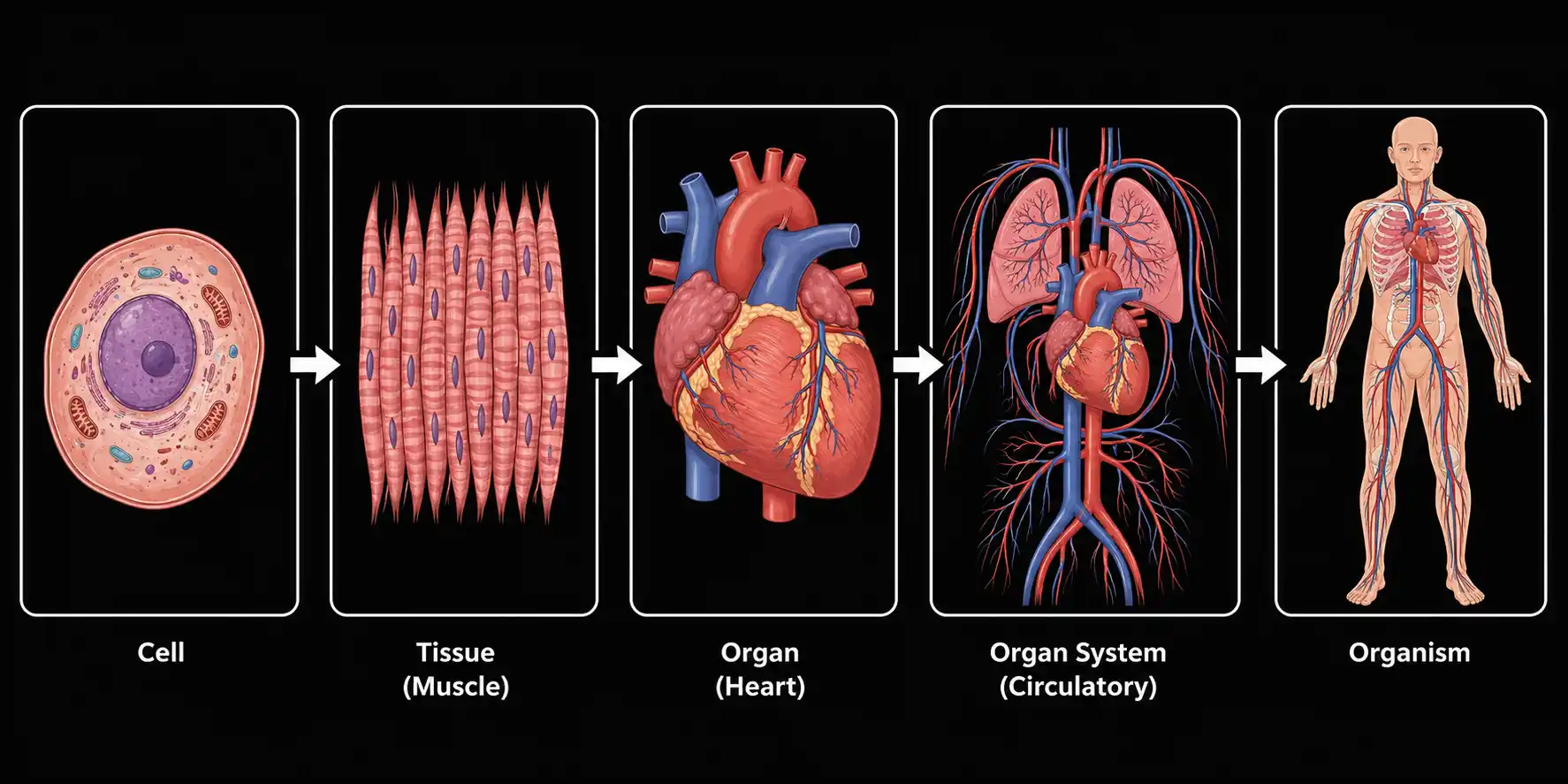
When different tissues team up, they form an organ — like your heart, kidney, or stomach. Several organs working together form an organ system — like the digestive system or nervous system. All these systems together make a complete organism — you.
So the ladder of life goes: cell → tissue → organ → organ system → organism. Each level is bigger and more capable than the one below it.
A scientist looks at a small piece of pink material under a microscope. She sees many cells of the same kind, packed tightly together, all looking similar. From this observation alone, what can she conclude?
Why Tissues at All? The Power of Division of Labour
Imagine a tiny dhaba where one person does everything — chopping vegetables, cooking, washing dishes, and serving customers. Tiring, slow, and the food is just okay.
Now imagine a big restaurant. One worker only chops. One only cooks. One only handles billing. Each person does ONE job — and gets really good at it. Result: faster service, better food.
Your body runs on the same principle. Instead of every cell trying to do every job, cells specialise. Muscle cells get really good at contracting. Nerve cells get really good at sending signals. Blood cells get really good at carrying oxygen. This sharing of work between specialised cells is called division of labour. It is the reason a complex body like yours works smoothly.
A single-celled creature like an Amoeba does not have this option — its one cell has to do everything. That is why amoebas stay tiny and simple. Your body is huge and capable precisely because your cells split the workload.
The Lonely Worker
Inside an Amoeba — a single-celled organism living in pond water — one cell does the work of digestion, breathing, movement, sensing, and reproduction. All of it. No teammates.
Dhatus — India's Ancient Tissue Theory
Long before microscopes existed, the Sushruta Samhita (compiled around 600 BCE in ancient India) listed seven dhatus — body tissues — that build the human body: rasa (plasma), rakta (blood), mamsa (muscle), medas (fat), asthi (bone), majja (marrow), and shukra (reproductive tissue).
Q1.Cells of similar type that work together to perform a specific function form a:
You started life as a single cell — smaller than a grain of sand. Today your body has hard bones, soft skin, red blood, electrical nerves, and meaty muscles. All of it came from that one starting cell. How does ONE cell turn into so many different kinds of cells?
Many forms, one source
यथा सुदीप्तात्पावकाद्विस्फुलिङ्गाः
सहस्रशः प्रभवन्ते सरूपाः।
तथाक्षराद्विविधाः सोम्य भावाः
प्रजायन्ते तत्र चैवापि यन्ति॥
Hindi: Jaise ek tej jalti aag se hazaaron ek-jaisi chingariyan nikalti hain — vaise hi ek hi mool srot se anek tarah ke jeev aur roop paida hote hain, aur usi mein laut jaate hain.
English: As thousands of sparks of similar form arise from a brightly burning fire, countless forms emerge from one imperishable source — and into it they return.
From One Cell to a Whole You
Look at your hand. The skin is soft and waterproof. The bones underneath are hard. The blood inside is liquid. The muscles are stretchy. Four completely different materials — but all made of cells.
So how does the body manage this? Cells of similar type group together to do one specific job. This group is called a tissue. Skin cells form skin tissue. Muscle cells form muscle tissue. Bone cells form bone tissue.
When different tissues team up, they form an organ — like your heart, kidney, or stomach. Several organs working together form an organ system — like the digestive system or nervous system. All these systems together make a complete organism — you.
So the ladder of life goes: cell → tissue → organ → organ system → organism. Each level is bigger and more capable than the one below it.
A scientist looks at a small piece of pink material under a microscope. She sees many cells of the same kind, packed tightly together, all looking similar. From this observation alone, what can she conclude?
Why Tissues at All? The Power of Division of Labour
Imagine a tiny dhaba where one person does everything — chopping vegetables, cooking, washing dishes, and serving customers. Tiring, slow, and the food is just okay.
Now imagine a big restaurant. One worker only chops. One only cooks. One only handles billing. Each person does ONE job — and gets really good at it. Result: faster service, better food.
Your body runs on the same principle. Instead of every cell trying to do every job, cells specialise. Muscle cells get really good at contracting. Nerve cells get really good at sending signals. Blood cells get really good at carrying oxygen. This sharing of work between specialised cells is called division of labour. It is the reason a complex body like yours works smoothly.
A single-celled creature like an Amoeba does not have this option — its one cell has to do everything. That is why amoebas stay tiny and simple. Your body is huge and capable precisely because your cells split the workload.
The Lonely Worker
Inside an Amoeba — a single-celled organism living in pond water — one cell does the work of digestion, breathing, movement, sensing, and reproduction. All of it. No teammates.
Dhatus — India's Ancient Tissue Theory
Long before microscopes existed, the Sushruta Samhita (compiled around 600 BCE in ancient India) listed seven dhatus — body tissues — that build the human body: rasa (plasma), rakta (blood), mamsa (muscle), medas (fat), asthi (bone), majja (marrow), and shukra (reproductive tissue).
Q1.Cells of similar type that work together to perform a specific function form a: