Growing from the Tips — Apical Meristem
How a single root tip drives the entire growth in length

Place an onion bulb in a glass of water. After a few days, white roots come out and start growing longer. Now snip off the very tip of one root with scissors — only the last 1 cm. What do you predict will happen to that root in the next few days?
From the inside, life unfolds outward
तस्माद्वा एतस्मादात्मन आकाशः सम्भूतः। आकाशाद्वायुः। वायोरग्निः। अग्नेरापः।
Hindi: Us mool tatva se aakaash bana, aakaash se vaayu, vaayu se agni, agni se jal — ek ke andar se doosra unfold hota gaya.
English: From this Self came space; from space, air; from air, fire; from fire, water — each unfolding from within the one before it.
Plants grow exactly like this — not by adding new pieces from outside, but by unfolding from within, from a tiny patch of cells at every tip.
The Onion Root Experiment
Take two glass jars filled with water. Place one onion bulb in each so the base touches the water. Both bulbs will grow roots. Measure the roots every day with a ruler.
On day 3, take one of the bulbs (call it Jar B) and snip off about 1 cm from each root tip with scissors. Leave the other bulb (Jar A) untouched. Now keep measuring both for the next four days.
What you'll see is striking:
- Jar A roots keep growing longer — about 0.5 to 1 cm a day, smoothly going from 1 cm on day 1 to 5–6 cm by day 7.
- Jar B roots stop. They sit at the length they had when you cut them. They don't catch up. They don't even slow — they simply stop.
This experiment was done in the NCERT textbook. The graph below shows what the data looks like.
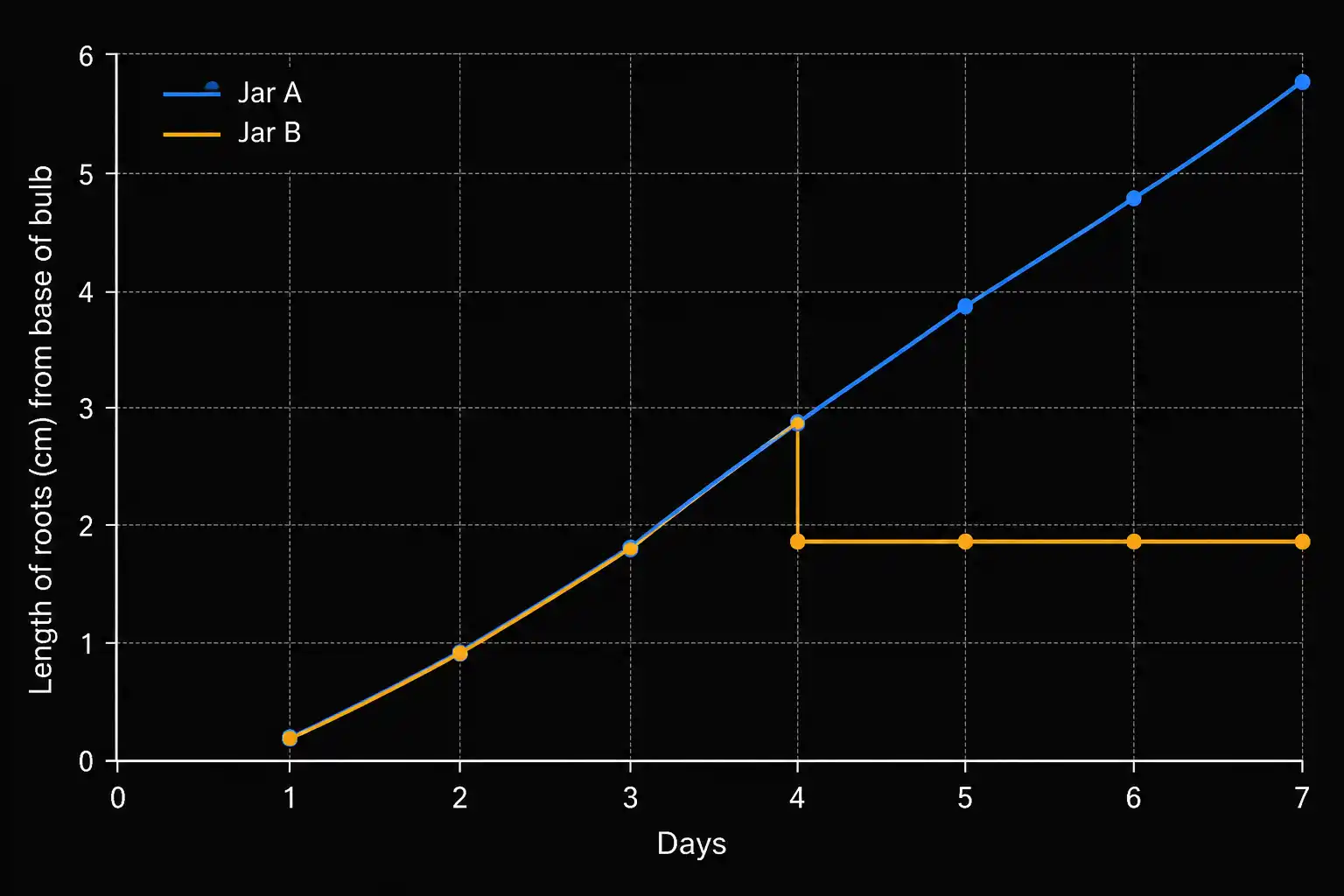
From the graph and the experiment, what is the cleanest conclusion you can draw about WHERE in the root the growth happens?
What's Inside the Tip — The Apical Meristem
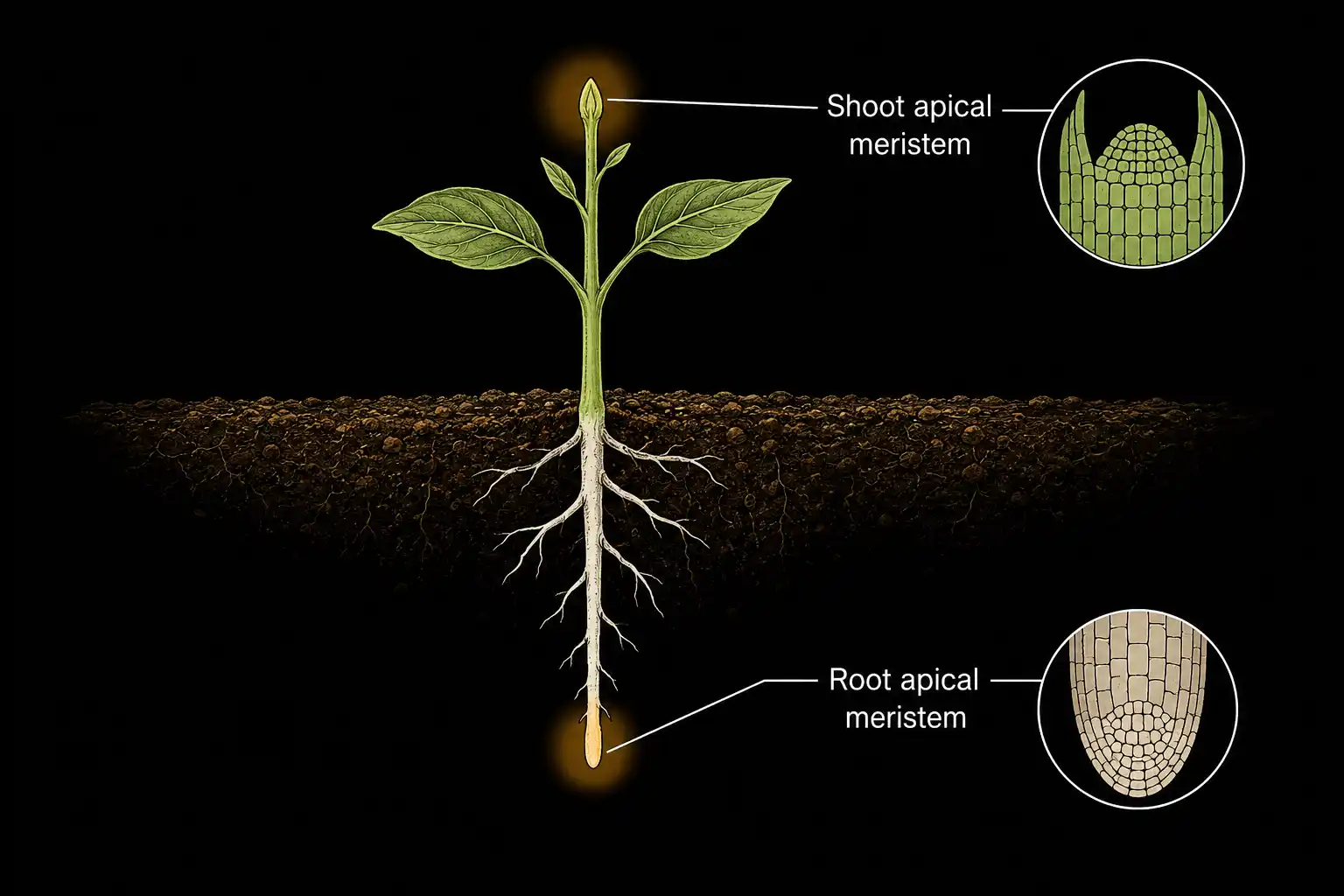
Zoom into a root tip under a microscope and you'll see a dense cluster of small, square-shaped cells with big nuclei — actively dividing, again and again. This patch of cells is called the apical meristem (apex = tip). The same kind of patch sits at the tip of every shoot too.
Here's how it works:
- The apical meristem cells divide continuously, producing new cells.
- Some of the new cells stay in the meristem — to keep dividing forever.
- The other new cells slip downward (in roots) or upward (in shoots), away from the tip.
- Once they leave the meristem zone, they stop dividing and start growing in size and changing shape — becoming part of the permanent tissue of the root or shoot.
So the tip of the root or shoot doesn't actually move forward. The meristem stays roughly in the same place — but it keeps pushing out new cells behind itself. Those new cells form the new length of the root or shoot. The plant grows the way you'd extrude toothpaste from a tube — the tube doesn't move, it just keeps pushing more toothpaste out the front.
This is also why root tips are delicate — damaging them stops growth in that root completely. When you transplant a sapling, careful gardeners always protect the root tips.
Why Tips, and Not Bases?
There's a deeper question hiding in this experiment: why does evolution put the growth zone at the tips, and not somewhere safer like the middle of the stem?
Think about what a plant actually needs. A root needs to reach water and minerals in soil it hasn't explored yet. A shoot needs to reach sunlight above where its leaves currently are. In both cases, the useful direction of growth is outward, away from the existing body. So the new cells should be added at the front of the journey — the tip — not the middle.
It's the same logic as a road-building crew. You don't add new road in the middle of an existing highway. You add it at the end where the road is being extended.
Why Farmers 'Pinch' Their Plants
Tomato farmers, rose growers, and tea-plant cultivators often deliberately pinch off the shoot tips of their plants. They're not damaging the plant — they're using exactly what you just learned.
Q1.The apical meristem is located at the:
Place an onion bulb in a glass of water. After a few days, white roots come out and start growing longer. Now snip off the very tip of one root with scissors — only the last 1 cm. What do you predict will happen to that root in the next few days?
From the inside, life unfolds outward
तस्माद्वा एतस्मादात्मन आकाशः सम्भूतः। आकाशाद्वायुः। वायोरग्निः। अग्नेरापः।
Hindi: Us mool tatva se aakaash bana, aakaash se vaayu, vaayu se agni, agni se jal — ek ke andar se doosra unfold hota gaya.
English: From this Self came space; from space, air; from air, fire; from fire, water — each unfolding from within the one before it.
Plants grow exactly like this — not by adding new pieces from outside, but by unfolding from within, from a tiny patch of cells at every tip.
The Onion Root Experiment
Take two glass jars filled with water. Place one onion bulb in each so the base touches the water. Both bulbs will grow roots. Measure the roots every day with a ruler.
On day 3, take one of the bulbs (call it Jar B) and snip off about 1 cm from each root tip with scissors. Leave the other bulb (Jar A) untouched. Now keep measuring both for the next four days.
What you'll see is striking:
- Jar A roots keep growing longer — about 0.5 to 1 cm a day, smoothly going from 1 cm on day 1 to 5–6 cm by day 7.
- Jar B roots stop. They sit at the length they had when you cut them. They don't catch up. They don't even slow — they simply stop.
This experiment was done in the NCERT textbook. The graph below shows what the data looks like.
From the graph and the experiment, what is the cleanest conclusion you can draw about WHERE in the root the growth happens?
What's Inside the Tip — The Apical Meristem
Zoom into a root tip under a microscope and you'll see a dense cluster of small, square-shaped cells with big nuclei — actively dividing, again and again. This patch of cells is called the apical meristem (apex = tip). The same kind of patch sits at the tip of every shoot too.
Here's how it works:
- The apical meristem cells divide continuously, producing new cells.
- Some of the new cells stay in the meristem — to keep dividing forever.
- The other new cells slip downward (in roots) or upward (in shoots), away from the tip.
- Once they leave the meristem zone, they stop dividing and start growing in size and changing shape — becoming part of the permanent tissue of the root or shoot.
So the tip of the root or shoot doesn't actually move forward. The meristem stays roughly in the same place — but it keeps pushing out new cells behind itself. Those new cells form the new length of the root or shoot. The plant grows the way you'd extrude toothpaste from a tube — the tube doesn't move, it just keeps pushing more toothpaste out the front.
This is also why root tips are delicate — damaging them stops growth in that root completely. When you transplant a sapling, careful gardeners always protect the root tips.
Why Tips, and Not Bases?
There's a deeper question hiding in this experiment: why does evolution put the growth zone at the tips, and not somewhere safer like the middle of the stem?
Think about what a plant actually needs. A root needs to reach water and minerals in soil it hasn't explored yet. A shoot needs to reach sunlight above where its leaves currently are. In both cases, the useful direction of growth is outward, away from the existing body. So the new cells should be added at the front of the journey — the tip — not the middle.
It's the same logic as a road-building crew. You don't add new road in the middle of an existing highway. You add it at the end where the road is being extended.
Why Farmers 'Pinch' Their Plants
Tomato farmers, rose growers, and tea-plant cultivators often deliberately pinch off the shoot tips of their plants. They're not damaging the plant — they're using exactly what you just learned.
Q1.The apical meristem is located at the: