Epithelial Tissue — The Body's Boundary
Five versions of one tissue, each tuned for protection, exchange, secretion, sensing, or absorption

Right now, every cell of your body is bathed in fluid that you have to keep INSIDE you. And the entire outside world — full of bacteria, dust, viruses, dirt, pollen — is pressed up against you, trying to get IN. Only one tissue stands between the two: a thin sheet of cells that's just one or a few layers thick. What kind of cell architecture do you think can hold off the entire world like that?
The boundary that protects what is inside
अन्तर्बहिर्व्याप्तं तत्त्वम्।
Hindi: Andar ka tatva bahar tak phaila hua hai — par dono ke beech ek razdaan deewar hai jo dono ko alag rakhti hai.
English: The essence pervades both within and without — yet a discerning boundary keeps each in its place.
Every animal body is a sealed system. The fluids that keep it alive must stay inside; the world's threats must stay outside. The tissue that draws this line is epithelial tissue — a single defining boundary, repeated wherever inside meets outside.
What Is Epithelial Tissue?
Epithelial tissue is what biologists call the body's covering and lining tissue. Wherever a surface inside the body touches anything outside it — air, food, blood, urine, the external world — there is a layer of epithelium between the two.
Where do you find it?
- Skin — the outermost epithelial layer covering your entire body
- Inside the mouth — lining your cheeks and tongue
- The food pipe and stomach — lining the digestive tract from end to end
- Lungs — lining the tiny air sacs where oxygen enters your blood
- Blood vessels — a single layer of cells coats every vein and artery from inside
- Sweat glands, salivary glands, milk glands — all built from epithelial cells
- Inside your nose and ears — for sensing smell and balance
All of these have one thing in common at the cellular level: cells packed tightly together with almost no space between them. This packing is the whole point. With no gaps, nothing can sneak through. Germs, water, dust — they all hit the wall.
But epithelial tissue isn't just a passive barrier. Different parts of the body need different versions — for absorbing food, for letting gases through, for releasing fluids, for sensing taste. So epithelial tissue comes in several varieties, each shaped to do a specific job.
Five Specialised Versions
The same basic plan — tightly packed cells in sheets — gets reshaped into different forms depending on what each location needs. Here are the five main versions and where you'll find them:
1. Squamous epithelium — Exchange. A single layer of very thin, flat cells (like floor tiles laid flat). The thinness lets gases and small molecules diffuse through quickly. Found in the lining of blood vessels (where oxygen needs to pass into red cells) and the air sacs of lungs (where O₂ and CO₂ need to cross fast). When speed of exchange is the priority, the wall has to be paper-thin.
2. Stratified squamous epithelium — Protection. Many layers of cells stacked on top of each other; the outer layer is flat and tightly packed. Found in your skin, the inside of your mouth, and the food pipe — places that take constant abrasion. The outer cells get rubbed off, and new ones from below replace them. When protection is the priority, the wall has to be thick.
3. Cuboidal/Columnar epithelium — Secretion. Cube-shaped or tall pillar-like cells, often arranged in rows that form glands. They specialise in producing and releasing substances. Found in salivary glands (saliva), sweat glands (sweat), the lining of the stomach (digestive juices and mucus), and many hormonal glands. When the job is making and releasing fluid, the cells need internal volume — hence cube or pillar shapes.
4. Ciliated epithelium — Sensory and movement. Cells with tiny hair-like projections on their surface called cilia. The cilia either sense things (smell, taste, sound, balance) or move things along (sweeping mucus and dust out of your lungs). Found in nostrils, taste buds, the inner ear, and the respiratory tract. The cilia are the key feature — without them, this tissue couldn't do either of its jobs.
5. Columnar epithelium with absorption — Absorption. Tall pillar-like cells with their surface folded into thousands of tiny finger-like projections (microvilli) to maximise surface area. Found in the lining of the small intestine, where every nutrient from your food must be absorbed. The folding multiplies the surface area by hundreds of times — a flat sheet would absorb far too slowly.
Epithelial tissue types — function, structure, and where to find them
| Function | Structure | Where in the body |
|---|---|---|
| Exchange (gases, fluids) | Single layer of thin flat cells | Lining of blood vessels, air sacs of lungs |
| Protection from abrasion | Many layers of cells; outer cells flat and tightly packed | Skin, mouth, food pipe (oesophagus) |
| Secretion (mucus, saliva, sweat, hormones) | Cube-shaped or tall pillar-shaped cells | Salivary glands, sweat glands, stomach lining |
| Sensing and moving things | Cells with hair-like cilia on the surface | Nose, taste buds, inner ear, respiratory tract |
| Absorption | Tall pillar-like cells with surface folded into microvilli | Lining of the small intestine |
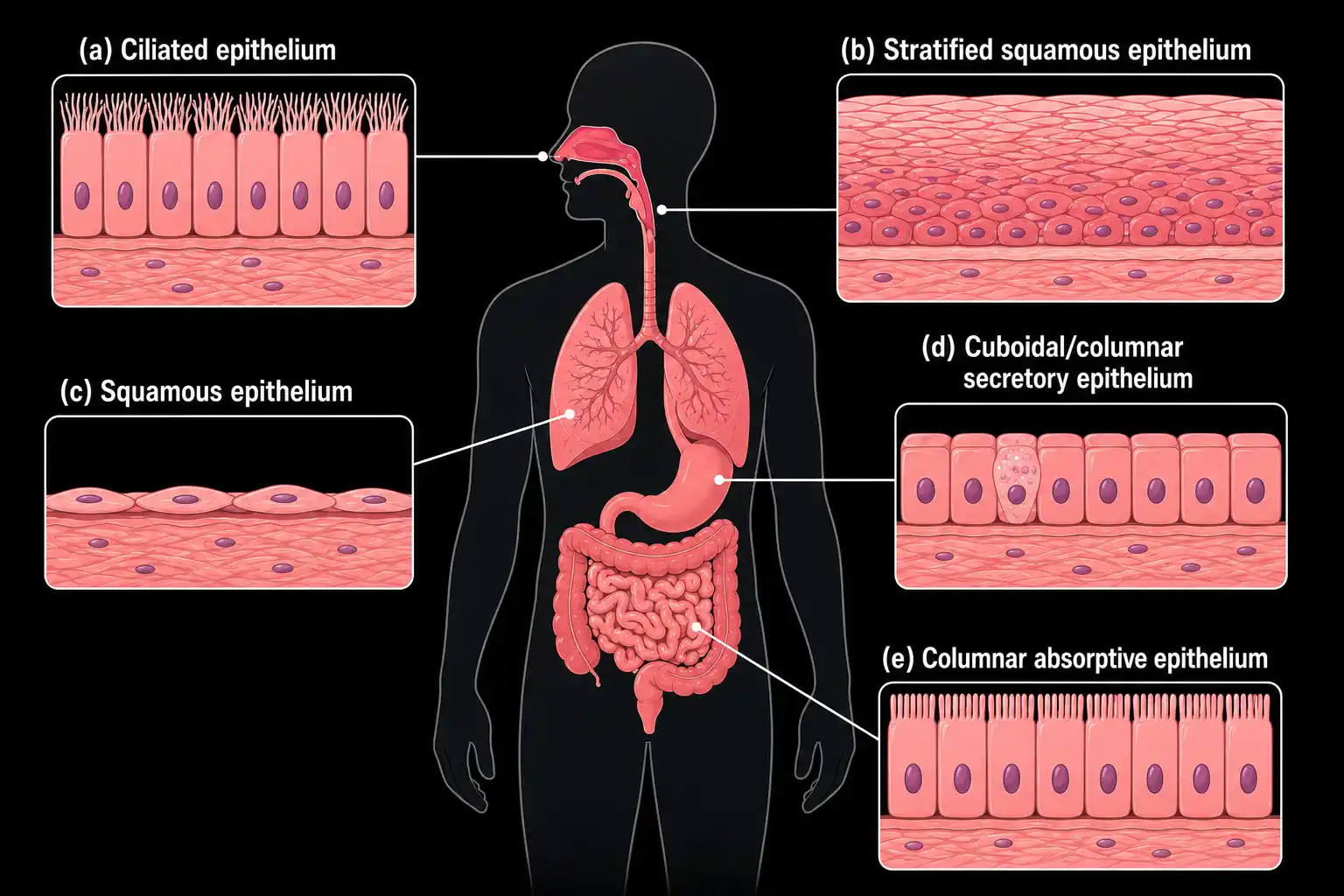
Your skin needs to be tough and abrasion-resistant. The lining of your lungs needs to let gases pass through quickly. Both are made of epithelial tissue — yet they look completely different under a microscope. Why does the SAME tissue type take such different forms?
Why Smokers Cough So Much
The lining of your respiratory tract — windpipe, bronchi, all the way down — is ciliated epithelium. The cilia constantly sweep mucus, dust, and germs upward and out of your lungs, like millions of tiny brooms working all day.
How Often Does Your Body Replace Its Skin?
Your skin is stratified squamous epithelium — multi-layered, with outer cells rubbing off constantly. They are replaced from below.
Q1.Which is the defining structural feature of epithelial tissue?
Right now, every cell of your body is bathed in fluid that you have to keep INSIDE you. And the entire outside world — full of bacteria, dust, viruses, dirt, pollen — is pressed up against you, trying to get IN. Only one tissue stands between the two: a thin sheet of cells that's just one or a few layers thick. What kind of cell architecture do you think can hold off the entire world like that?
The boundary that protects what is inside
अन्तर्बहिर्व्याप्तं तत्त्वम्।
Hindi: Andar ka tatva bahar tak phaila hua hai — par dono ke beech ek razdaan deewar hai jo dono ko alag rakhti hai.
English: The essence pervades both within and without — yet a discerning boundary keeps each in its place.
Every animal body is a sealed system. The fluids that keep it alive must stay inside; the world's threats must stay outside. The tissue that draws this line is epithelial tissue — a single defining boundary, repeated wherever inside meets outside.
What Is Epithelial Tissue?
Epithelial tissue is what biologists call the body's covering and lining tissue. Wherever a surface inside the body touches anything outside it — air, food, blood, urine, the external world — there is a layer of epithelium between the two.
Where do you find it?
- Skin — the outermost epithelial layer covering your entire body
- Inside the mouth — lining your cheeks and tongue
- The food pipe and stomach — lining the digestive tract from end to end
- Lungs — lining the tiny air sacs where oxygen enters your blood
- Blood vessels — a single layer of cells coats every vein and artery from inside
- Sweat glands, salivary glands, milk glands — all built from epithelial cells
- Inside your nose and ears — for sensing smell and balance
All of these have one thing in common at the cellular level: cells packed tightly together with almost no space between them. This packing is the whole point. With no gaps, nothing can sneak through. Germs, water, dust — they all hit the wall.
But epithelial tissue isn't just a passive barrier. Different parts of the body need different versions — for absorbing food, for letting gases through, for releasing fluids, for sensing taste. So epithelial tissue comes in several varieties, each shaped to do a specific job.
Five Specialised Versions
The same basic plan — tightly packed cells in sheets — gets reshaped into different forms depending on what each location needs. Here are the five main versions and where you'll find them:
1. Squamous epithelium — Exchange. A single layer of very thin, flat cells (like floor tiles laid flat). The thinness lets gases and small molecules diffuse through quickly. Found in the lining of blood vessels (where oxygen needs to pass into red cells) and the air sacs of lungs (where O₂ and CO₂ need to cross fast). When speed of exchange is the priority, the wall has to be paper-thin.
2. Stratified squamous epithelium — Protection. Many layers of cells stacked on top of each other; the outer layer is flat and tightly packed. Found in your skin, the inside of your mouth, and the food pipe — places that take constant abrasion. The outer cells get rubbed off, and new ones from below replace them. When protection is the priority, the wall has to be thick.
3. Cuboidal/Columnar epithelium — Secretion. Cube-shaped or tall pillar-like cells, often arranged in rows that form glands. They specialise in producing and releasing substances. Found in salivary glands (saliva), sweat glands (sweat), the lining of the stomach (digestive juices and mucus), and many hormonal glands. When the job is making and releasing fluid, the cells need internal volume — hence cube or pillar shapes.
4. Ciliated epithelium — Sensory and movement. Cells with tiny hair-like projections on their surface called cilia. The cilia either sense things (smell, taste, sound, balance) or move things along (sweeping mucus and dust out of your lungs). Found in nostrils, taste buds, the inner ear, and the respiratory tract. The cilia are the key feature — without them, this tissue couldn't do either of its jobs.
5. Columnar epithelium with absorption — Absorption. Tall pillar-like cells with their surface folded into thousands of tiny finger-like projections (microvilli) to maximise surface area. Found in the lining of the small intestine, where every nutrient from your food must be absorbed. The folding multiplies the surface area by hundreds of times — a flat sheet would absorb far too slowly.
Epithelial tissue types — function, structure, and where to find them
| Function | Structure | Where in the body |
|---|---|---|
| Exchange (gases, fluids) | Single layer of thin flat cells | Lining of blood vessels, air sacs of lungs |
| Protection from abrasion | Many layers of cells; outer cells flat and tightly packed | Skin, mouth, food pipe (oesophagus) |
| Secretion (mucus, saliva, sweat, hormones) | Cube-shaped or tall pillar-shaped cells | Salivary glands, sweat glands, stomach lining |
| Sensing and moving things | Cells with hair-like cilia on the surface | Nose, taste buds, inner ear, respiratory tract |
| Absorption | Tall pillar-like cells with surface folded into microvilli | Lining of the small intestine |
Your skin needs to be tough and abrasion-resistant. The lining of your lungs needs to let gases pass through quickly. Both are made of epithelial tissue — yet they look completely different under a microscope. Why does the SAME tissue type take such different forms?
Why Smokers Cough So Much
The lining of your respiratory tract — windpipe, bronchi, all the way down — is ciliated epithelium. The cilia constantly sweep mucus, dust, and germs upward and out of your lungs, like millions of tiny brooms working all day.
How Often Does Your Body Replace Its Skin?
Your skin is stratified squamous epithelium — multi-layered, with outer cells rubbing off constantly. They are replaced from below.
Q1.Which is the defining structural feature of epithelial tissue?