Types of Joints — Where Bones Meet and Move
Ball-and-socket, hinge, pivot, and fixed — four designs for four kinds of motion
Try this. Move your shoulder — it can swing in any direction: forward, backward, up, down, in circles. Now try to do the same with your elbow. It only bends one way — like a door hinge. Now try moving your skull bones. They don't move at all. Same body, three completely different kinds of joint behaviour. Why does the body need so many different designs?
Where bone meets bone, life expresses itself
अंगसन्धिषु अभिनयो वसति।
Hindi: Joints mein hi abhinay rehta hai — har dance ki bhasha haddiyon ke milne ki jagahon se hi nikalti hai.
English: In the joints of the body, expression resides — every movement of dance arises from where bones meet.
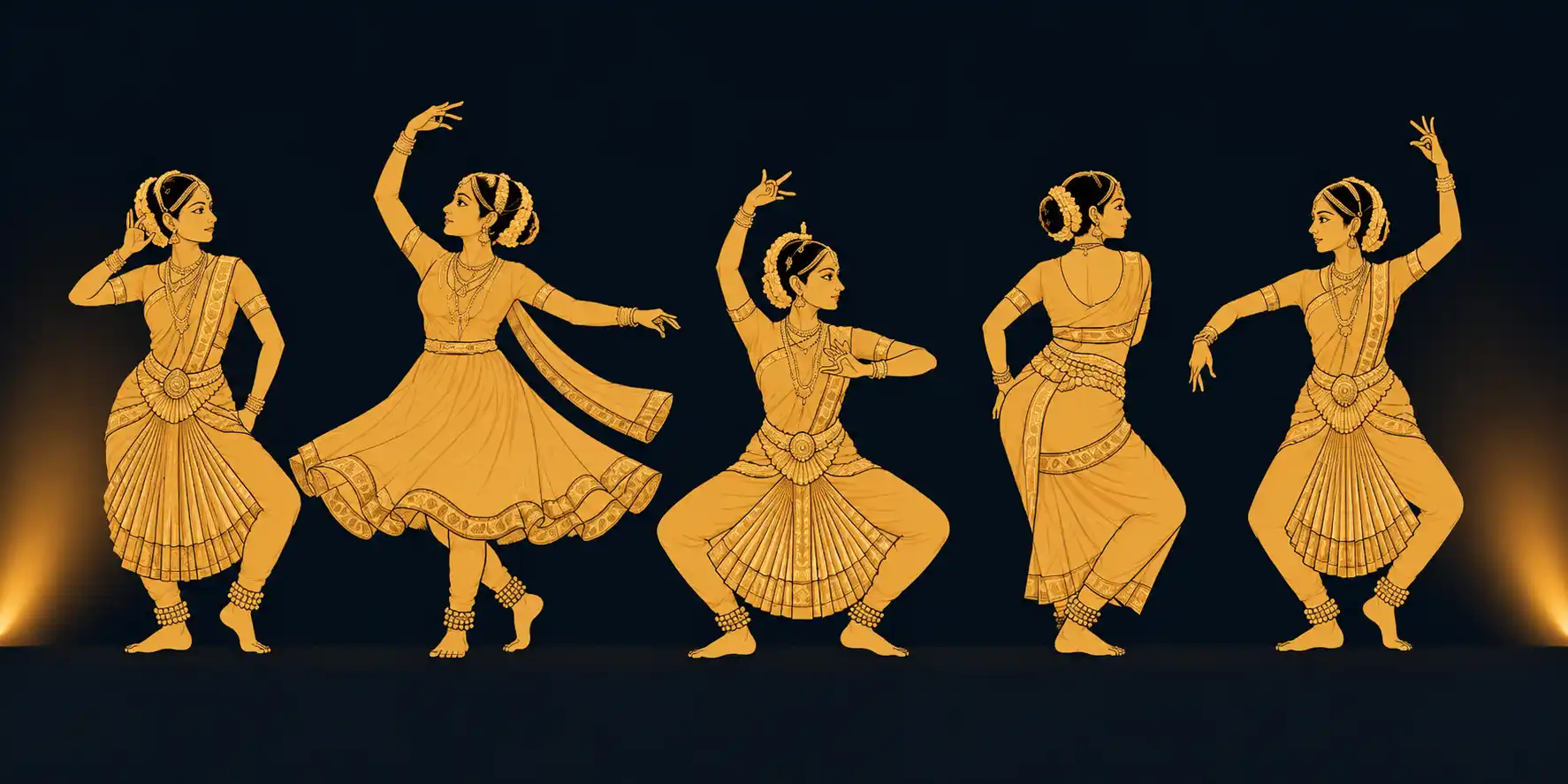
Bharata's Natyashastra — written around 200 BCE — devoted entire chapters to joint movements: how the head turns, how the elbow bends, how the hip rotates. Indian classical dance was, in a way, an anatomy lesson before anatomy lessons existed.
What Is a Joint?
A joint is a place where two or more bones meet. By itself, a joint cannot move — it's just an interface. Movement at the joint comes from muscles pulling on the bones via tendons, while ligaments hold the bones together and limit how far the joint can travel.
But not all joints work the same way. The shape of the bone surfaces where they meet — and the way ligaments wrap around them — determines what kind of movement is possible. The body has four main joint designs, each suited for a different kind of motion.
1. Ball-and-socket joint — Maximum freedom.
The rounded end of one bone fits into a cup-shaped hollow in another. Found at the shoulder (where the upper arm meets the shoulder bone) and the hip (where the thigh bone meets the pelvis). Allows movement in all directions — forward, backward, sideways, and rotational. Think of how freely you can wave your arm around or swing your leg.
Trade-off: the more freedom a joint has, the less stable it is. The shoulder's shallow socket gives huge range but also makes it the most commonly dislocated joint in the body. The hip's deeper socket makes it more stable but slightly less mobile.
2. Hinge joint — Strength in one direction.
Two bones meet so they can swing back and forth in a single plane — like a door hinge. Found at the elbow and knee, and in your fingers. Allows bending and straightening, but no sideways or rotational motion. (You can twist your wrist, but you cannot twist your elbow.)
Hinge joints are perfect when you need power in one direction — pulling, lifting, kicking — without worrying about side-to-side stability. The knee carries your full body weight and yet rarely buckles, because its hinge design transfers force straight down.
3. Pivot joint — Rotation only.
One bone rotates around another along a single axis. The most famous example is the joint between your skull and the topmost vertebra of your spine — it lets you turn your head from side to side ('no') without nodding it. Another pivot joint sits between the two bones of your forearm, letting you rotate your palm to face up or down.
4. Fixed (immovable) joint — No movement.
Some bones are fused tightly so they don't move at all. The most important example is the skull — over 20 separate bones knit together at rigid seams called sutures to form a single hard case for the brain. Movement here would actually be dangerous; the skull's job is to be a permanent helmet, not a flexible cap.
Children's skull bones are not fully fused at birth (which is how the head can squeeze through the birth canal), but the seams close in early childhood and stay fixed for life.
Tap to Explore — Joints in the Body
If your shoulder used a hinge joint instead of a ball-and-socket joint, what would change about how you live your life?
Joints in Indian Classical Dance
Classical Indian dance forms — Bharatanatyam, Kathak, Kathakali, Odissi, Manipuri, Mohiniyattam, Kuchipudi, Sattriya — all explicitly use joint movements as the building blocks of expression.
Bone Marrow and Stem Cells
Inside the long bones around your major joints lies bone marrow — soft tissue rich in stem cells that can divide and become different blood cells (red, white, platelets). When someone has blood cancer (like leukaemia) or genetic disorders (like thalassaemia), doctors can transplant healthy stem cells from a donor.
Q1.Which type of joint allows the most freedom of movement?
Try this. Move your shoulder — it can swing in any direction: forward, backward, up, down, in circles. Now try to do the same with your elbow. It only bends one way — like a door hinge. Now try moving your skull bones. They don't move at all. Same body, three completely different kinds of joint behaviour. Why does the body need so many different designs?
Where bone meets bone, life expresses itself
अंगसन्धिषु अभिनयो वसति।
Hindi: Joints mein hi abhinay rehta hai — har dance ki bhasha haddiyon ke milne ki jagahon se hi nikalti hai.
English: In the joints of the body, expression resides — every movement of dance arises from where bones meet.
Bharata's Natyashastra — written around 200 BCE — devoted entire chapters to joint movements: how the head turns, how the elbow bends, how the hip rotates. Indian classical dance was, in a way, an anatomy lesson before anatomy lessons existed.
What Is a Joint?
A joint is a place where two or more bones meet. By itself, a joint cannot move — it's just an interface. Movement at the joint comes from muscles pulling on the bones via tendons, while ligaments hold the bones together and limit how far the joint can travel.
But not all joints work the same way. The shape of the bone surfaces where they meet — and the way ligaments wrap around them — determines what kind of movement is possible. The body has four main joint designs, each suited for a different kind of motion.
1. Ball-and-socket joint — Maximum freedom.
The rounded end of one bone fits into a cup-shaped hollow in another. Found at the shoulder (where the upper arm meets the shoulder bone) and the hip (where the thigh bone meets the pelvis). Allows movement in all directions — forward, backward, sideways, and rotational. Think of how freely you can wave your arm around or swing your leg.
Trade-off: the more freedom a joint has, the less stable it is. The shoulder's shallow socket gives huge range but also makes it the most commonly dislocated joint in the body. The hip's deeper socket makes it more stable but slightly less mobile.
2. Hinge joint — Strength in one direction.
Two bones meet so they can swing back and forth in a single plane — like a door hinge. Found at the elbow and knee, and in your fingers. Allows bending and straightening, but no sideways or rotational motion. (You can twist your wrist, but you cannot twist your elbow.)
Hinge joints are perfect when you need power in one direction — pulling, lifting, kicking — without worrying about side-to-side stability. The knee carries your full body weight and yet rarely buckles, because its hinge design transfers force straight down.
3. Pivot joint — Rotation only.
One bone rotates around another along a single axis. The most famous example is the joint between your skull and the topmost vertebra of your spine — it lets you turn your head from side to side ('no') without nodding it. Another pivot joint sits between the two bones of your forearm, letting you rotate your palm to face up or down.
4. Fixed (immovable) joint — No movement.
Some bones are fused tightly so they don't move at all. The most important example is the skull — over 20 separate bones knit together at rigid seams called sutures to form a single hard case for the brain. Movement here would actually be dangerous; the skull's job is to be a permanent helmet, not a flexible cap.
Children's skull bones are not fully fused at birth (which is how the head can squeeze through the birth canal), but the seams close in early childhood and stay fixed for life.
Tap to Explore — Joints in the Body
If your shoulder used a hinge joint instead of a ball-and-socket joint, what would change about how you live your life?
Joints in Indian Classical Dance
Classical Indian dance forms — Bharatanatyam, Kathak, Kathakali, Odissi, Manipuri, Mohiniyattam, Kuchipudi, Sattriya — all explicitly use joint movements as the building blocks of expression.
Bone Marrow and Stem Cells
Inside the long bones around your major joints lies bone marrow — soft tissue rich in stem cells that can divide and become different blood cells (red, white, platelets). When someone has blood cancer (like leukaemia) or genetic disorders (like thalassaemia), doctors can transplant healthy stem cells from a donor.
Q1.Which type of joint allows the most freedom of movement?