The Three Tissue Systems — A Plant's Internal Map
How dermal, ground, and vascular tissues organise every plant on Earth
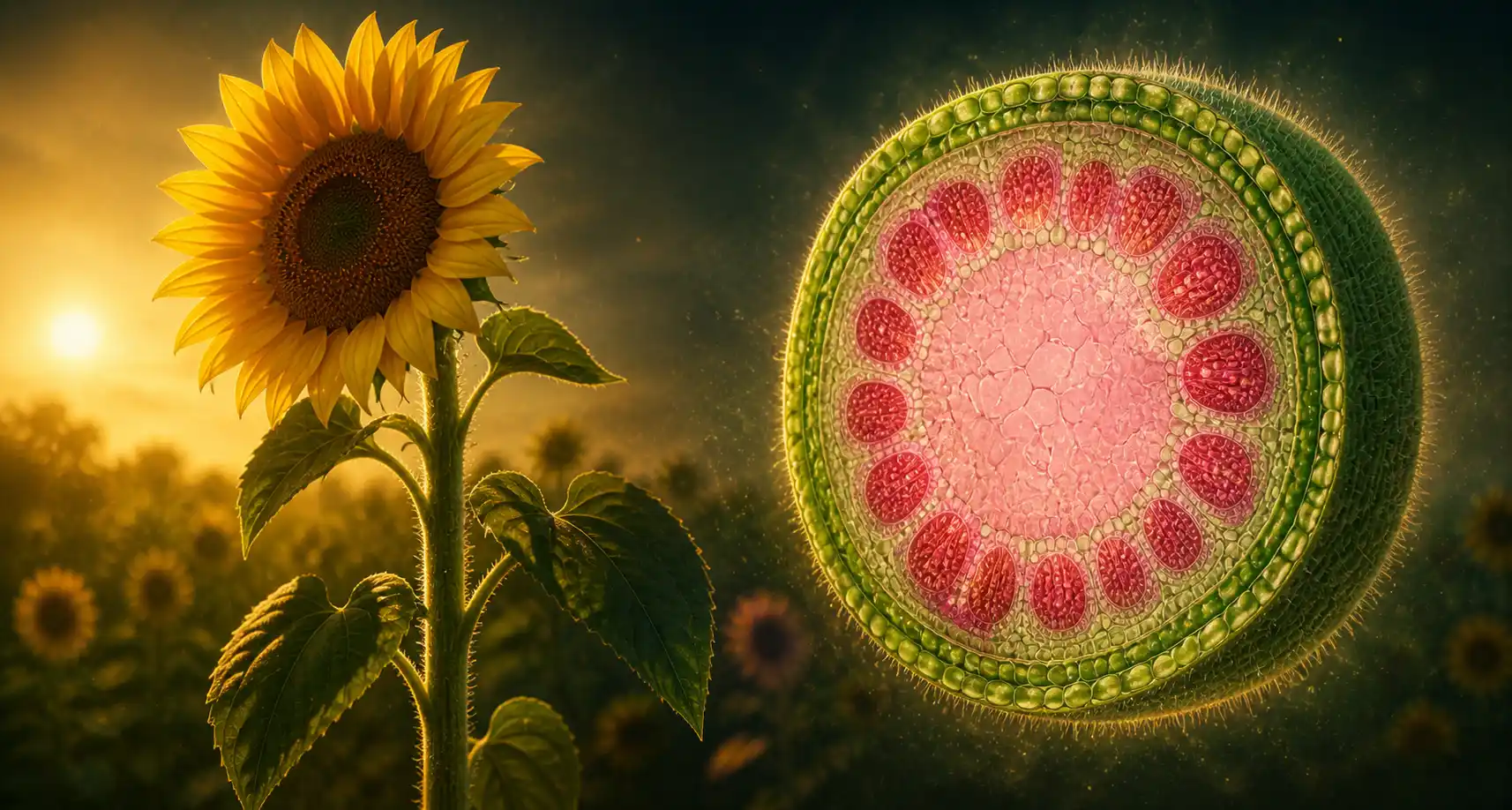
If you cut a sunflower stem cleanly across with a sharp knife and look at the flat circle you've exposed, you'll see different colours and textures arranged in rings and dots. It's not random. Every patch is a specific tissue with a specific job. Looking at this circle, can you guess WHY the tissues are arranged in that particular pattern?
Each part has its task
स्वकर्मणा तं अभ्यर्च्य सिद्धिं विन्दति मानवः।
Hindi: Apna apna kaam karke insaan apni manzil paata hai. Plant ke har tissue ka bhi yahi niyam hai.
English: Through one's own duty, a person attains fulfilment.
Inside a stem, every tissue has a specific assigned place — and a specific job. Together, they form a coordinated organism. No tissue does another's work. Each is in its position because that position is where it is most useful.
The Three Tissue Systems
Every plant tissue you've met on the previous pages — epidermis, parenchyma, collenchyma, sclerenchyma, xylem, phloem — fits into one of just three tissue systems that organise the entire plant body.
1. Dermal tissue system — the outer boundary.
This is the plant's skin. In young plants, it's the epidermis (one cell thick, covered with cuticle). In old trees, the original epidermis is replaced by a thicker layer of dead cork cells — the bark. Either way, the dermal tissue's job is to keep things out (germs, dust, water from outside) and keep things in (water from inside the plant).
2. Ground tissue system — the bulk of the body.
Everything between the outer dermal layer and the inner vascular bundles is ground tissue. This is where the actual biological work happens — photosynthesis (in leaves), food storage (in roots and stems), and structural support. Ground tissue is mostly parenchyma, with collenchyma for flexible support and sclerenchyma for rigid support.
3. Vascular tissue system — the transport network.
Threading through the ground tissue are bundles of xylem and phloem — the water and sugar highways. Together they form the vascular tissue system, the plant's circulatory network.
Now look at a stem cross-section and the layout makes sense:
- Outside → Dermal (epidermis) — protection comes first
- Just inside → Collenchyma — flexible support without blocking light
- Middle (most of the volume) → Parenchyma — soft tissue that fills space cheaply
- Embedded in the parenchyma → Vascular bundles (xylem + phloem) — placed where they can serve every part of the stem
- Patches of sclerenchyma — placed where mechanical bending stress is highest, like reinforcement bars in concrete
Tap to Explore — Sunflower Stem T.S.
In the cross-section of a sunflower stem, the xylem (water-carrying tissue) sits toward the inside of each vascular bundle, and the phloem (sugar-carrying tissue) sits toward the outside. Why might this arrangement make sense?
Why Monocots and Dicots Look So Different Inside
Cut across a wheat or rice stem (a monocot — one seed leaf) and you'll see vascular bundles scattered randomly through the ground tissue. Cut across a sunflower or mango stem (a dicot — two seed leaves) and the bundles are arranged in a neat ring near the edge.
Cork Cambium and the Bark of Old Trees
As a young stem ages, the original epidermis can't stretch enough to keep up with the thickening trunk. So the plant grows a second meristem layer just under the epidermis — the cork cambium. The cork cambium produces dead, waterproof, gas-tight cells called cork cells that pile up on the outside.
Q1.How many tissue systems make up the body of a plant?
If you cut a sunflower stem cleanly across with a sharp knife and look at the flat circle you've exposed, you'll see different colours and textures arranged in rings and dots. It's not random. Every patch is a specific tissue with a specific job. Looking at this circle, can you guess WHY the tissues are arranged in that particular pattern?
Each part has its task
स्वकर्मणा तं अभ्यर्च्य सिद्धिं विन्दति मानवः।
Hindi: Apna apna kaam karke insaan apni manzil paata hai. Plant ke har tissue ka bhi yahi niyam hai.
English: Through one's own duty, a person attains fulfilment.
Inside a stem, every tissue has a specific assigned place — and a specific job. Together, they form a coordinated organism. No tissue does another's work. Each is in its position because that position is where it is most useful.
The Three Tissue Systems
Every plant tissue you've met on the previous pages — epidermis, parenchyma, collenchyma, sclerenchyma, xylem, phloem — fits into one of just three tissue systems that organise the entire plant body.
1. Dermal tissue system — the outer boundary.
This is the plant's skin. In young plants, it's the epidermis (one cell thick, covered with cuticle). In old trees, the original epidermis is replaced by a thicker layer of dead cork cells — the bark. Either way, the dermal tissue's job is to keep things out (germs, dust, water from outside) and keep things in (water from inside the plant).
2. Ground tissue system — the bulk of the body.
Everything between the outer dermal layer and the inner vascular bundles is ground tissue. This is where the actual biological work happens — photosynthesis (in leaves), food storage (in roots and stems), and structural support. Ground tissue is mostly parenchyma, with collenchyma for flexible support and sclerenchyma for rigid support.
3. Vascular tissue system — the transport network.
Threading through the ground tissue are bundles of xylem and phloem — the water and sugar highways. Together they form the vascular tissue system, the plant's circulatory network.
Now look at a stem cross-section and the layout makes sense:
- Outside → Dermal (epidermis) — protection comes first
- Just inside → Collenchyma — flexible support without blocking light
- Middle (most of the volume) → Parenchyma — soft tissue that fills space cheaply
- Embedded in the parenchyma → Vascular bundles (xylem + phloem) — placed where they can serve every part of the stem
- Patches of sclerenchyma — placed where mechanical bending stress is highest, like reinforcement bars in concrete
Tap to Explore — Sunflower Stem T.S.
In the cross-section of a sunflower stem, the xylem (water-carrying tissue) sits toward the inside of each vascular bundle, and the phloem (sugar-carrying tissue) sits toward the outside. Why might this arrangement make sense?
Why Monocots and Dicots Look So Different Inside
Cut across a wheat or rice stem (a monocot — one seed leaf) and you'll see vascular bundles scattered randomly through the ground tissue. Cut across a sunflower or mango stem (a dicot — two seed leaves) and the bundles are arranged in a neat ring near the edge.
Cork Cambium and the Bark of Old Trees
As a young stem ages, the original epidermis can't stretch enough to keep up with the thickening trunk. So the plant grows a second meristem layer just under the epidermis — the cork cambium. The cork cambium produces dead, waterproof, gas-tight cells called cork cells that pile up on the outside.
Q1.How many tissue systems make up the body of a plant?