Coagulation
Making colloids unstable
River water is muddy and brown. But if you collect it in a bucket and wait, the mud slowly settles and the water above becomes clear. What if you needed it clear in minutes, not hours — what would you add?
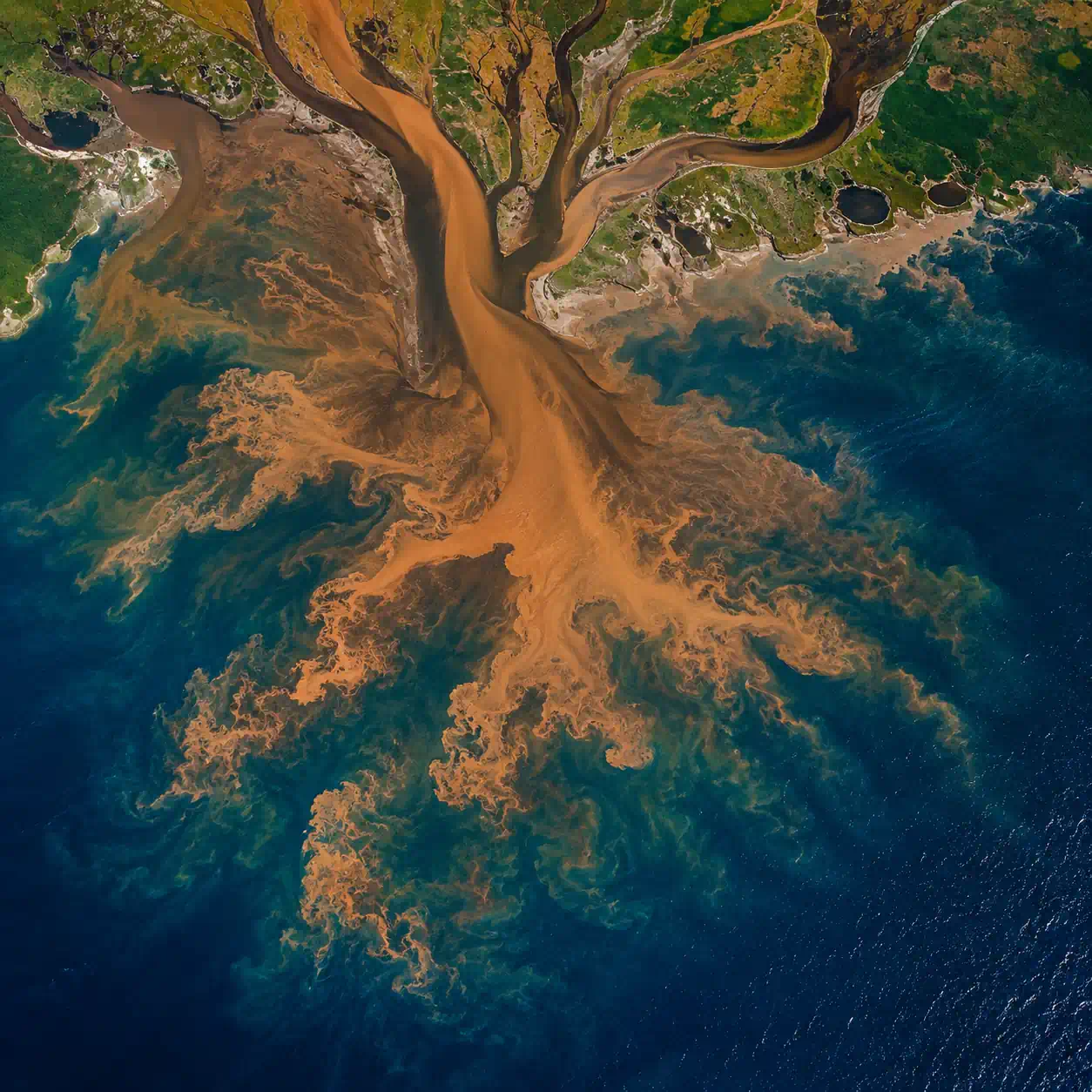
Rivers carry clay as a colloid — negatively charged clay particles that stay suspended for hundreds of kilometres. Where a river meets the sea, the salt in seawater contains positive ions (Na⁺, Ca²⁺) that neutralise the charge on clay particles. They clump together and sink — forming the rich, fertile deltas of the Ganga, Brahmaputra, and Krishna rivers. The Sundarbans delta was literally built by coagulation.
What is Coagulation?
Coagulation (also called flocculation) is the process of making colloidal particles clump together so they can be separated by settling or filtration.
Why are colloids stable in the first place? Colloidal particles carry electric charges (usually negative for clay, gold sols, etc.). Particles with the same charge repel each other — preventing them from clumping and settling.
Coagulation works by neutralising the charge on colloidal particles, allowing them to come together, clump, and settle out.
Methods of coagulation:
-
Adding an electrolyte: Oppositely charged ions from salts neutralise the colloidal charge. Higher charge = more effective. Al³⁺ (from alum) is more effective than Ca²⁺ or Na⁺.
-
Heating: Increases particle collision energy, helping them overcome repulsion.
-
Persistent agitation: Mechanical stirring can cause particles to collide and aggregate.
Applications:
- Water treatment: Alum (potassium aluminium sulfate) is added to turbid river water — Al³⁺ ions coagulate clay colloids; the floc settles and is removed by filtration. Used in every municipal water treatment plant in India
- Cheese making: Rennet or acid causes milk proteins (casein colloid) to coagulate → curd forms
- Rubber production: Latex (a colloid) is coagulated with acetic acid to produce rubber sheets
- Sewage treatment: Coagulants cause suspended organic matter to flocculate and settle
When a river carrying muddy water meets the sea, a delta forms — mud deposits at the river mouth. Alum added to muddy drinking water also makes mud settle. A student asks: "Are these two events connected by the same principle?" How would you explain the connection?
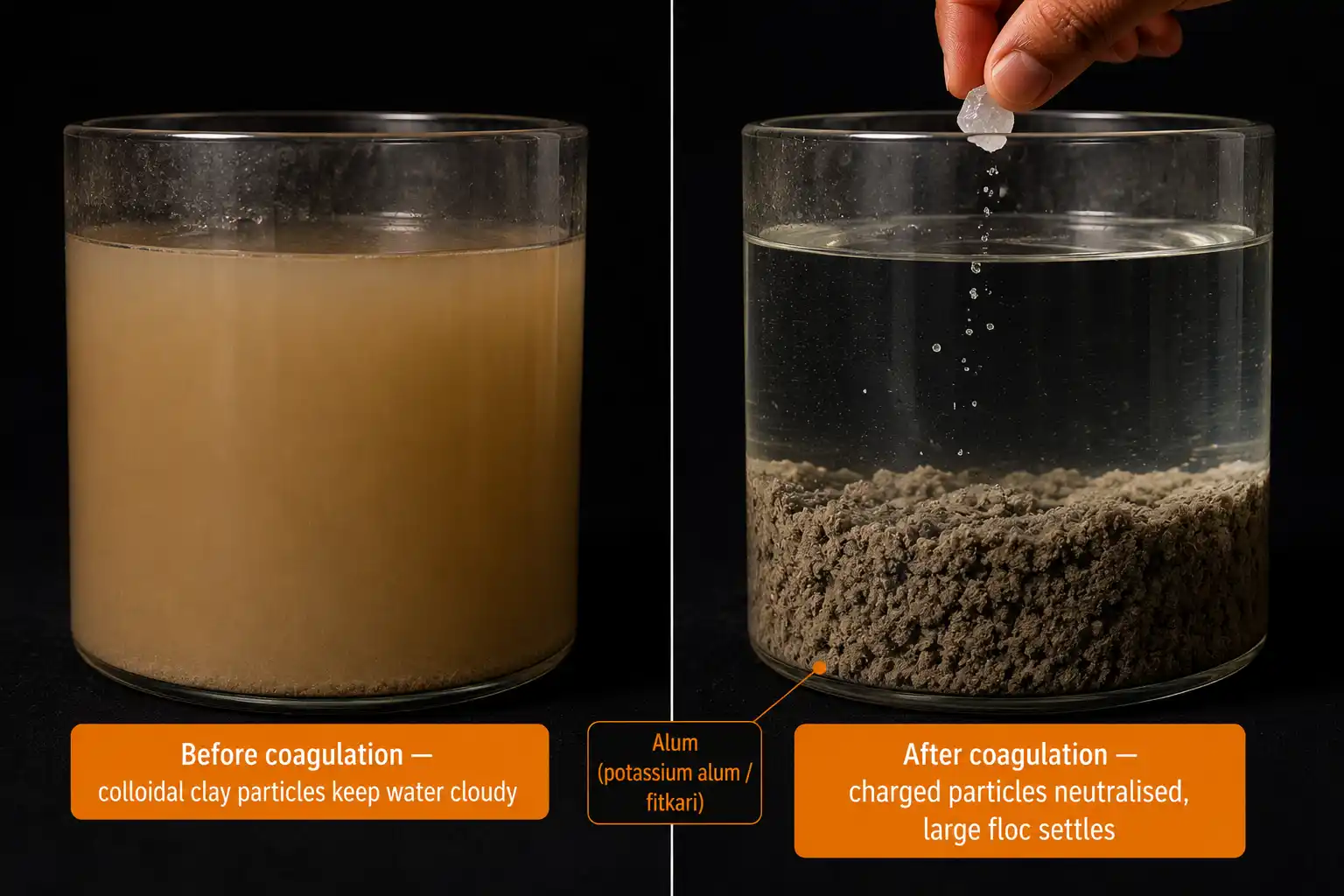
Activity — Cleaning Muddy Water with Fitkari
Walk into almost any village kitchen across India and you will find a small, white, crystalline lump called fitkari — known in English as alum. For generations it has been used to make muddy river water safe to drink.
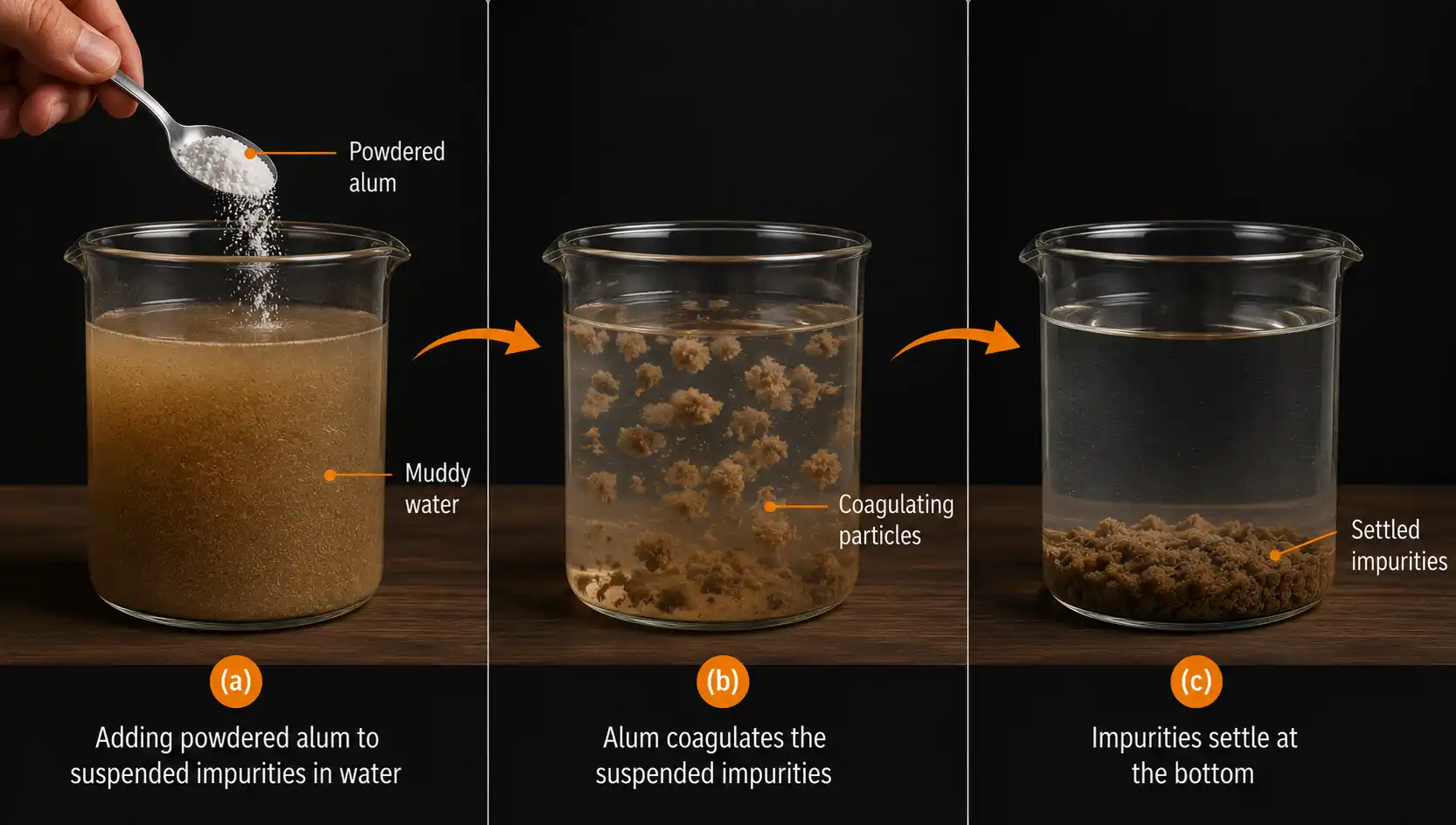
Try this. Take a glass beaker and fill it with muddy water from a pond or a tap that's been disturbed. The water looks brown and cloudy, and even after standing for a while, the very fine particles refuse to settle. Now sprinkle a small pinch of powdered alum into the water and stir gently for a few seconds.
Watch what happens next. The fine, scattered particles begin to clump together into bigger, heavier flakes. These large flakes then sink slowly to the bottom of the beaker — pulled down by gravity. After a few minutes, the upper part of the water becomes remarkably clear. You can pour the clean water out (this is called decantation) or pass it through filter paper to remove the last bits of flakes.
This whole process is called coagulation, and the alum is acting as a coagulant. The trick: alum dissolves in water and releases ions that cancel out the tiny electric charges holding the suspended particles apart. Once the charges are gone, the particles can finally come together — first as small clumps, then as bigger flakes that gravity can pull down.
Three simple steps: (a) sprinkle alum, (b) particles clump up, (c) clumps settle at the bottom. That's it.
Coagulation in Your Own Kitchen — Making *Paneer*
You don't need a lab to see coagulation. The next time someone in your kitchen makes paneer, watch carefully.
Where You See This Every Day
Coagulation is used wherever cloudy colloidal dispersions need to be clarified or separated:
- Municipal Water Treatment — Before water reaches your tap, turbid river water is treated with alum (Al₂(SO₄)₃) or ferric chloride. The trivalent Al³⁺ and Fe³⁺ ions coagulate negatively charged clay colloids. The resulting floc settles in sedimentation tanks, leaving clear water for chlorination. Delhi Jal Board treats over 800 MGD this way.
- Traditional Fitkari (Alum) Use — In rural India, alum is still sold as a domestic water purifier. A lump of alum stirred in a bucket of muddy water will clear it within 30 minutes — coagulating clay colloids that have kept the water turbid. Recommended by UNICEF for emergency water purification.
- Cheese Making — Milk is a colloid (casein proteins in water). Adding lemon juice or rennet enzyme reduces pH, coagulating the casein. The white clumps (curds) separate from the liquid (whey). This is how every paneer, cheddar, and mozzarella is made.
- River Delta Formation — Where freshwater rivers meet saltwater seas, the salt ions (Na⁺, Mg²⁺) coagulate the clay and silt colloids carried by the river. The particles settle, building the delta. The Ganga-Brahmaputra delta (Sundarbans) formed entirely through natural coagulation over millennia.
- Rubber Vulcanisation Prep — Natural rubber latex is a colloid. Adding acetic acid (vinegar) coagulates the rubber particles, which are then collected, pressed, and vulcanised.
🌊 Real-World Impact
The Sundarbans delta — the largest mangrove forest in the world and a UNESCO World Heritage Site — was built grain by grain through the coagulation of colloidal clay particles where the Ganga and Brahmaputra rivers meet the Bay of Bengal. Salt-triggered coagulation has been building this ecosystem for 5,000 years. The same chemistry that forms deltas also purifies your drinking water.
Q1.Coagulation refers to:
River water is muddy and brown. But if you collect it in a bucket and wait, the mud slowly settles and the water above becomes clear. What if you needed it clear in minutes, not hours — what would you add?
Rivers carry clay as a colloid — negatively charged clay particles that stay suspended for hundreds of kilometres. Where a river meets the sea, the salt in seawater contains positive ions (Na⁺, Ca²⁺) that neutralise the charge on clay particles. They clump together and sink — forming the rich, fertile deltas of the Ganga, Brahmaputra, and Krishna rivers. The Sundarbans delta was literally built by coagulation.
What is Coagulation?
Coagulation (also called flocculation) is the process of making colloidal particles clump together so they can be separated by settling or filtration.
Why are colloids stable in the first place? Colloidal particles carry electric charges (usually negative for clay, gold sols, etc.). Particles with the same charge repel each other — preventing them from clumping and settling.
Coagulation works by neutralising the charge on colloidal particles, allowing them to come together, clump, and settle out.
Methods of coagulation:
-
Adding an electrolyte: Oppositely charged ions from salts neutralise the colloidal charge. Higher charge = more effective. Al³⁺ (from alum) is more effective than Ca²⁺ or Na⁺.
-
Heating: Increases particle collision energy, helping them overcome repulsion.
-
Persistent agitation: Mechanical stirring can cause particles to collide and aggregate.
Applications:
- Water treatment: Alum (potassium aluminium sulfate) is added to turbid river water — Al³⁺ ions coagulate clay colloids; the floc settles and is removed by filtration. Used in every municipal water treatment plant in India
- Cheese making: Rennet or acid causes milk proteins (casein colloid) to coagulate → curd forms
- Rubber production: Latex (a colloid) is coagulated with acetic acid to produce rubber sheets
- Sewage treatment: Coagulants cause suspended organic matter to flocculate and settle
When a river carrying muddy water meets the sea, a delta forms — mud deposits at the river mouth. Alum added to muddy drinking water also makes mud settle. A student asks: "Are these two events connected by the same principle?" How would you explain the connection?
Activity — Cleaning Muddy Water with Fitkari
Walk into almost any village kitchen across India and you will find a small, white, crystalline lump called fitkari — known in English as alum. For generations it has been used to make muddy river water safe to drink.
Try this. Take a glass beaker and fill it with muddy water from a pond or a tap that's been disturbed. The water looks brown and cloudy, and even after standing for a while, the very fine particles refuse to settle. Now sprinkle a small pinch of powdered alum into the water and stir gently for a few seconds.
Watch what happens next. The fine, scattered particles begin to clump together into bigger, heavier flakes. These large flakes then sink slowly to the bottom of the beaker — pulled down by gravity. After a few minutes, the upper part of the water becomes remarkably clear. You can pour the clean water out (this is called decantation) or pass it through filter paper to remove the last bits of flakes.
This whole process is called coagulation, and the alum is acting as a coagulant. The trick: alum dissolves in water and releases ions that cancel out the tiny electric charges holding the suspended particles apart. Once the charges are gone, the particles can finally come together — first as small clumps, then as bigger flakes that gravity can pull down.
Three simple steps: (a) sprinkle alum, (b) particles clump up, (c) clumps settle at the bottom. That's it.
Coagulation in Your Own Kitchen — Making *Paneer*
You don't need a lab to see coagulation. The next time someone in your kitchen makes paneer, watch carefully.
Where You See This Every Day
Coagulation is used wherever cloudy colloidal dispersions need to be clarified or separated:
- Municipal Water Treatment — Before water reaches your tap, turbid river water is treated with alum (Al₂(SO₄)₃) or ferric chloride. The trivalent Al³⁺ and Fe³⁺ ions coagulate negatively charged clay colloids. The resulting floc settles in sedimentation tanks, leaving clear water for chlorination. Delhi Jal Board treats over 800 MGD this way.
- Traditional Fitkari (Alum) Use — In rural India, alum is still sold as a domestic water purifier. A lump of alum stirred in a bucket of muddy water will clear it within 30 minutes — coagulating clay colloids that have kept the water turbid. Recommended by UNICEF for emergency water purification.
- Cheese Making — Milk is a colloid (casein proteins in water). Adding lemon juice or rennet enzyme reduces pH, coagulating the casein. The white clumps (curds) separate from the liquid (whey). This is how every paneer, cheddar, and mozzarella is made.
- River Delta Formation — Where freshwater rivers meet saltwater seas, the salt ions (Na⁺, Mg²⁺) coagulate the clay and silt colloids carried by the river. The particles settle, building the delta. The Ganga-Brahmaputra delta (Sundarbans) formed entirely through natural coagulation over millennia.
- Rubber Vulcanisation Prep — Natural rubber latex is a colloid. Adding acetic acid (vinegar) coagulates the rubber particles, which are then collected, pressed, and vulcanised.
Q1.Coagulation refers to: