India's Contribution — The ORS Story
Dilip Mahalanabis and oral rehydration therapy
A child has severe diarrhoea and is losing water and salts rapidly. No hospital, no IV drip. What simple household ingredients would you combine to make a life-saving drink — and why those specific ingredients?
In the entire history of medicine, few interventions have saved more lives than ORS — Oral Rehydration Solution. It costs less than ₹5 per packet. It requires no doctor, no needle, no hospital. And it was demonstrated to the world under the most desperate conditions imaginable — by an Indian doctor during one of the worst cholera outbreaks of the 20th century.
The Chemistry Behind ORS
Diarrhoea kills by dehydration — the body loses water and essential electrolytes (salts) faster than they can be replaced by drinking plain water alone.
The key scientific insight: glucose and sodium are absorbed together in the small intestine through a co-transport mechanism. When the ratio of glucose to sodium is exactly right, the intestine can absorb water even during severe diarrhoea.
WHO ORS formula (per litre of water):
- Sodium chloride: 2.6 g
- Sodium citrate: 2.9 g
- Potassium chloride: 1.5 g
- Anhydrous glucose: 13.5 g
This precise composition maintains the osmolarity of the solution at 245 mOsm/L — carefully matched to blood plasma.
Dr. Dilip Mahalanabis — The Crisis That Changed Medicine
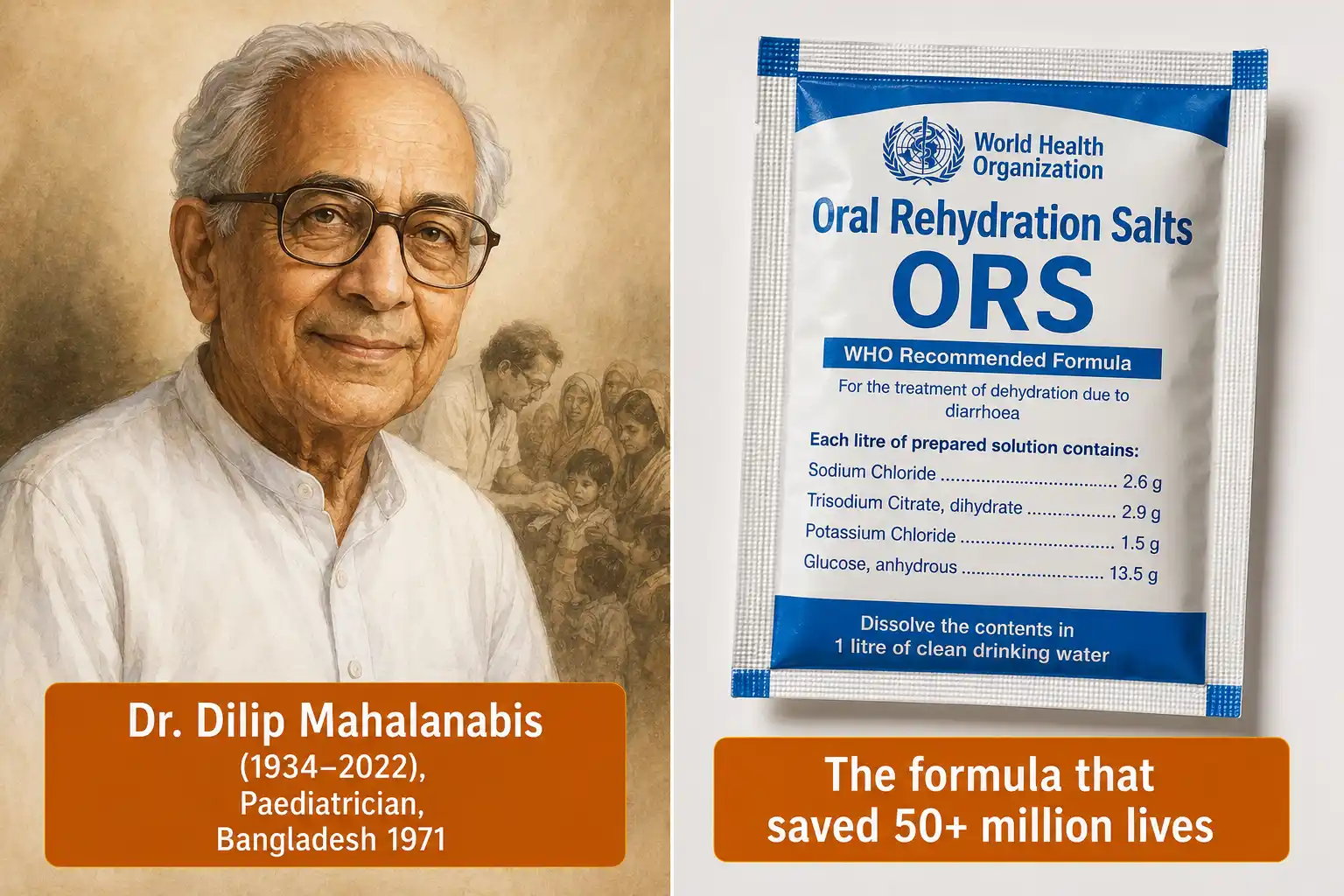
In 1971, as the Bangladesh Liberation War began, millions of refugees flooded into camps near Bongaon, West Bengal. Cholera broke out. Dr. Dilip Mahalanabis was running a camp with thousands of patients — and he was running out of IV fluid supplies.
He knew the science of oral rehydration from earlier research. He made a decision: use ORS on a massive scale, distributed by family members and camp workers without IV needles.
The mortality rate from cholera at the time was 20–30%. In his camp, it dropped to 3.6% — an astonishing result that proved ORS could replace intravenous fluids in most cases.
He published his findings. The world paid attention. The Lancet called ORS "potentially the most important medical advance of the 20th century."
Dr. Mahalanabis received the William Fogarty International Award and, in 2002, the Prince Mahidol Award (Asia's Nobel for health). He died in 2022 at age 87.
When severely dehydrated, drinking plain water alone is often insufficient to recover quickly — the body continues losing fluids. But ORS (glucose + sodium chloride + potassium chloride + water) works far better. A student asks: "What does adding salt do — doesn't salt make you more thirsty?" How would you answer?
Impact:
- Before ORS became widespread, diarrhoea killed 5 million children per year globally
- Today, that number has fallen below 500,000 — mostly due to ORS
- India distributes ORS packets through ASHA workers in every village
- It is the single most cost-effective medical intervention in history
This is what applied chemistry — a precise salt-and-sugar mixture — can do.
Page Summary
• ORS works because glucose and sodium are co-transported in the intestine, pulling water across even during diarrhoea • The exact composition (osmolarity 245 mOsm/L) is critical — not just any salt-sugar mix • Dr. Dilip Mahalanabis proved ORS works at scale during the 1971 Bangladesh refugee crisis • Childhood diarrhoea deaths have fallen 90% largely due to ORS — from 5 million to below 500,000 per year • A ₹5 packet of salt, sugar, and water is one of the greatest achievements in the history of medicine
Q1.What does ORS stand for, and what is its primary medical use?
A child has severe diarrhoea and is losing water and salts rapidly. No hospital, no IV drip. What simple household ingredients would you combine to make a life-saving drink — and why those specific ingredients?
In the entire history of medicine, few interventions have saved more lives than ORS — Oral Rehydration Solution. It costs less than ₹5 per packet. It requires no doctor, no needle, no hospital. And it was demonstrated to the world under the most desperate conditions imaginable — by an Indian doctor during one of the worst cholera outbreaks of the 20th century.
The Chemistry Behind ORS
Diarrhoea kills by dehydration — the body loses water and essential electrolytes (salts) faster than they can be replaced by drinking plain water alone.
The key scientific insight: glucose and sodium are absorbed together in the small intestine through a co-transport mechanism. When the ratio of glucose to sodium is exactly right, the intestine can absorb water even during severe diarrhoea.
WHO ORS formula (per litre of water):
- Sodium chloride: 2.6 g
- Sodium citrate: 2.9 g
- Potassium chloride: 1.5 g
- Anhydrous glucose: 13.5 g
This precise composition maintains the osmolarity of the solution at 245 mOsm/L — carefully matched to blood plasma.
Dr. Dilip Mahalanabis — The Crisis That Changed Medicine
In 1971, as the Bangladesh Liberation War began, millions of refugees flooded into camps near Bongaon, West Bengal. Cholera broke out. Dr. Dilip Mahalanabis was running a camp with thousands of patients — and he was running out of IV fluid supplies.
He knew the science of oral rehydration from earlier research. He made a decision: use ORS on a massive scale, distributed by family members and camp workers without IV needles.
The mortality rate from cholera at the time was 20–30%. In his camp, it dropped to 3.6% — an astonishing result that proved ORS could replace intravenous fluids in most cases.
He published his findings. The world paid attention. The Lancet called ORS "potentially the most important medical advance of the 20th century."
Dr. Mahalanabis received the William Fogarty International Award and, in 2002, the Prince Mahidol Award (Asia's Nobel for health). He died in 2022 at age 87.
When severely dehydrated, drinking plain water alone is often insufficient to recover quickly — the body continues losing fluids. But ORS (glucose + sodium chloride + potassium chloride + water) works far better. A student asks: "What does adding salt do — doesn't salt make you more thirsty?" How would you answer?
Impact:
- Before ORS became widespread, diarrhoea killed 5 million children per year globally
- Today, that number has fallen below 500,000 — mostly due to ORS
- India distributes ORS packets through ASHA workers in every village
- It is the single most cost-effective medical intervention in history
This is what applied chemistry — a precise salt-and-sugar mixture — can do.
Page Summary
• ORS works because glucose and sodium are co-transported in the intestine, pulling water across even during diarrhoea • The exact composition (osmolarity 245 mOsm/L) is critical — not just any salt-sugar mix • Dr. Dilip Mahalanabis proved ORS works at scale during the 1971 Bangladesh refugee crisis • Childhood diarrhoea deaths have fallen 90% largely due to ORS — from 5 million to below 500,000 per year • A ₹5 packet of salt, sugar, and water is one of the greatest achievements in the history of medicine
Q1.What does ORS stand for, and what is its primary medical use?