Solutions, Suspensions, and Colloids — A Side-by-Side Look
Three different mixtures, one single difference — particle size
A Tale of Three Particle Sizes
Imagine you could shrink yourself to the size of a single grain of sand and dive into each of the three beakers. What would you find?
- In the salt water (a solution), you would see only individual sodium and chloride particles — each smaller than 1 nanometre (a nanometre is a millionth of a millimetre). They are too small to be visible. Light passes through without scattering. Filter paper does nothing.
- In the milky water (a colloid), you would see fat droplets between 1 and 1000 nanometres — bigger than dissolved particles, but still too small for our eyes to spot directly. They are just big enough to scatter a beam of light, which is why a laser shines clearly through milk (the Tyndall Effect).
- In the muddy water (a suspension), the particles are huge — larger than 1000 nanometres. You can see them clearly. They settle at the bottom over time. Filter paper traps them.
So the difference between solution → colloid → suspension is really a difference of scale. The chemistry hasn't changed — just the size of the things floating around.
Putting Them Side by Side
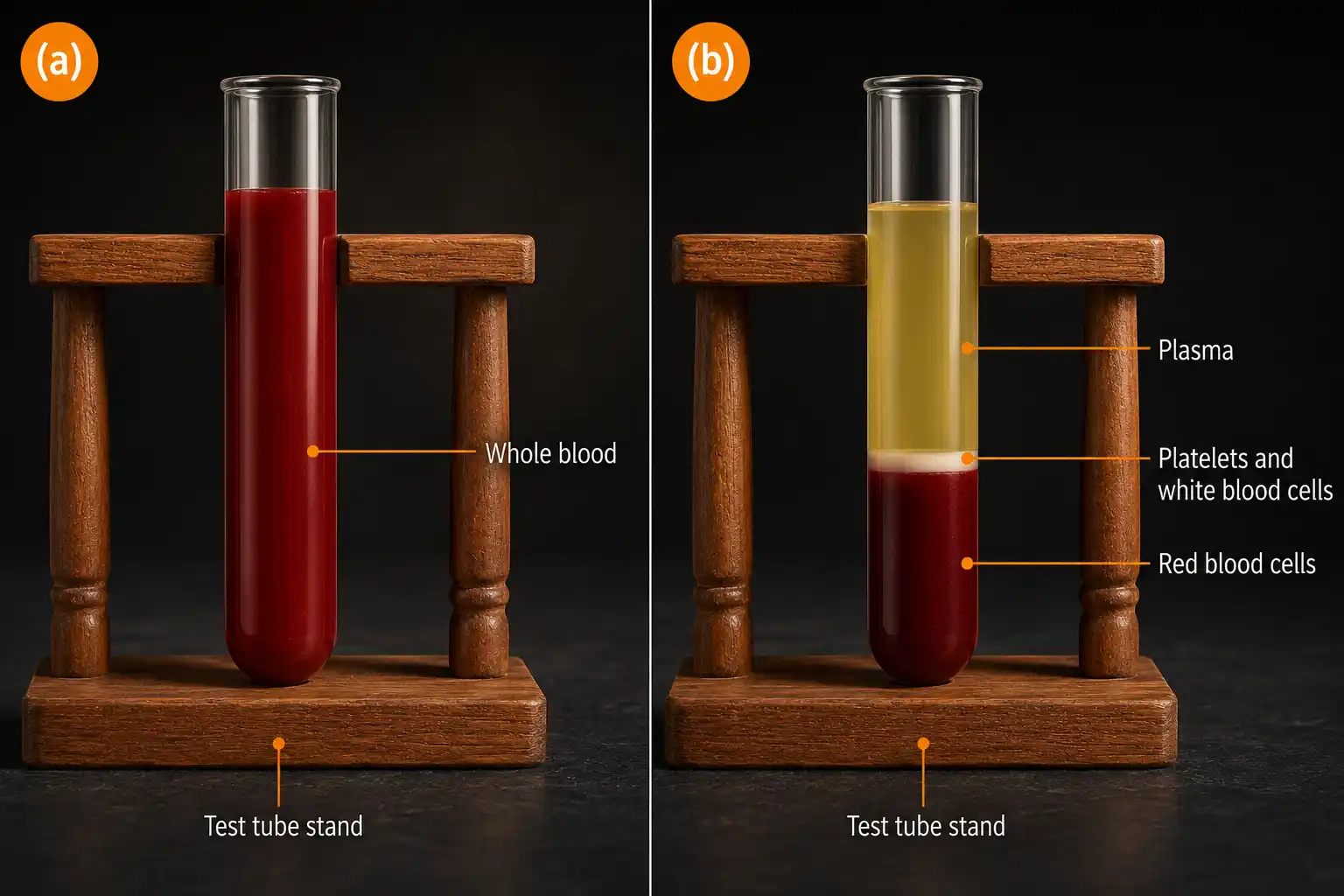
Why Knowing This Matters — A Visit to a Blood Bank
A Tale of Three Particle Sizes
Imagine you could shrink yourself to the size of a single grain of sand and dive into each of the three beakers. What would you find?
- In the salt water (a solution), you would see only individual sodium and chloride particles — each smaller than 1 nanometre (a nanometre is a millionth of a millimetre). They are too small to be visible. Light passes through without scattering. Filter paper does nothing.
- In the milky water (a colloid), you would see fat droplets between 1 and 1000 nanometres — bigger than dissolved particles, but still too small for our eyes to spot directly. They are just big enough to scatter a beam of light, which is why a laser shines clearly through milk (the Tyndall Effect).
- In the muddy water (a suspension), the particles are huge — larger than 1000 nanometres. You can see them clearly. They settle at the bottom over time. Filter paper traps them.
So the difference between solution → colloid → suspension is really a difference of scale. The chemistry hasn't changed — just the size of the things floating around.