Pure Substances vs. Mixtures
What's the difference?
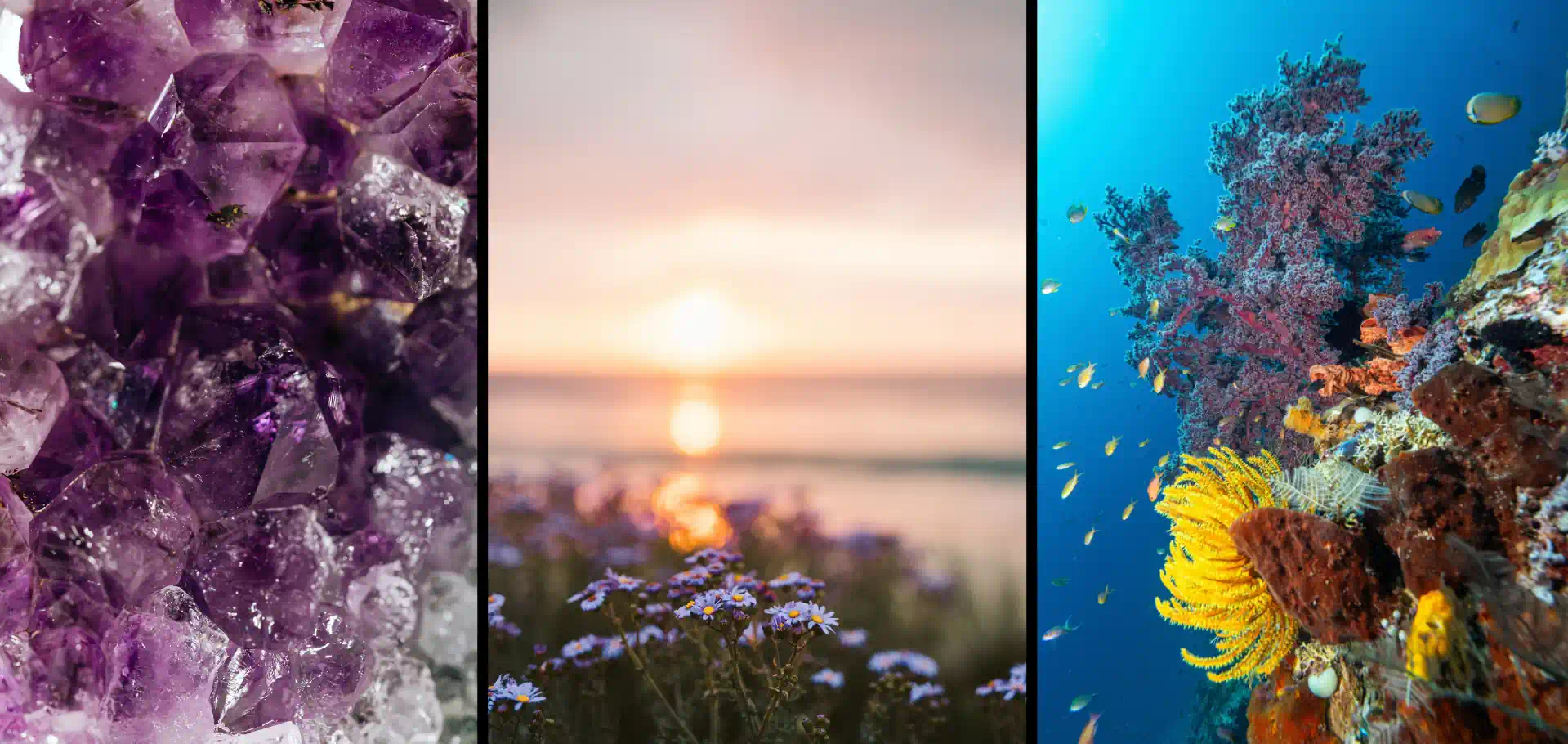
You pour yourself a glass of tap water. Your friend says it's "pure water — just H₂O." Is that right? What do you think is actually in that glass?
We breathe "air" every second — but air is not a pure substance. It's a mixture of nitrogen (78%), oxygen (21%), argon (0.9%), carbon dioxide (0.04%), and traces of other gases. No single sample of air has a fixed composition — it varies by altitude, location, and even by what someone nearby is cooking.
Pure Substances
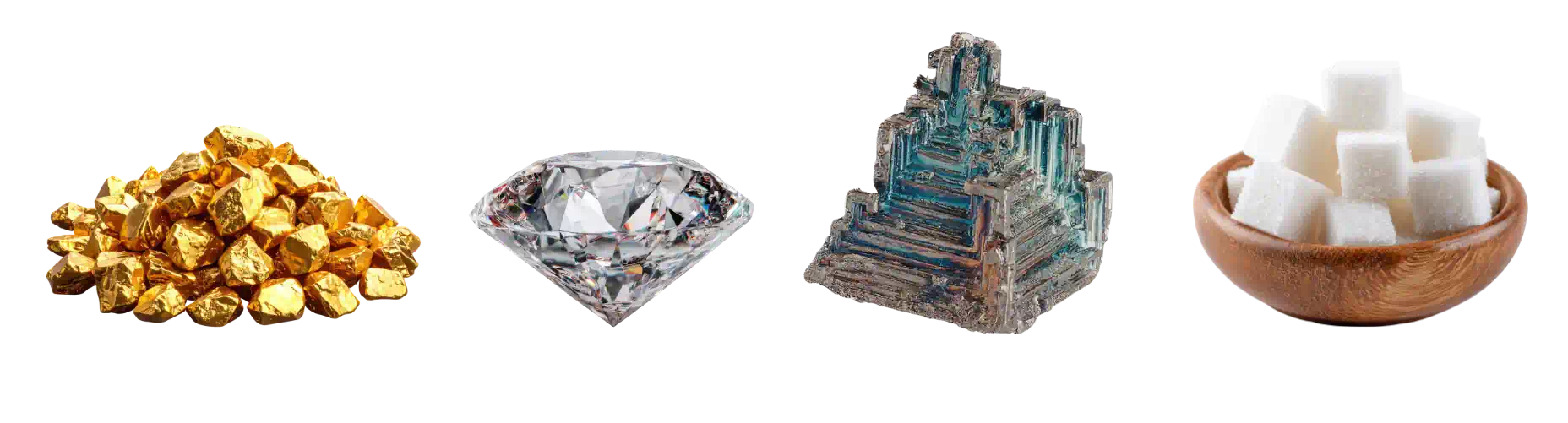
A pure substance is a substance that is not contaminated by any other substances and has a fixed, uniform composition throughout. Every sample of the substance has exactly the same properties — the same melting point, boiling point, density, and chemical behaviour.
Pure substances are of two types:
- Elements: Cannot be broken down further by chemical means. Examples: gold (), iron (), oxygen (), sulfur ()
- Compounds: Made of two or more elements in a fixed ratio by mass. Examples: water (), table salt (), carbon dioxide ()
always contains hydrogen and oxygen in the mass ratio 1:8, no matter where on Earth (or the universe) you find it.
Mixtures
A mixture contains two or more substances that are physically combined but not chemically bonded. The components retain their individual properties and can be separated by physical means.
Key features of mixtures:
- Variable composition: You can mix any ratio of salt and water
- No fixed melting/boiling point: Seawater boils over a range, not at exactly 100 °C
- Components keep their properties: Iron filings in sand — the iron is still magnetic, the sand is still sand
- Separated by physical methods: Filtration, distillation, evaporation, etc.
Remember
Virtually all the gases, liquids, and solids in the real world are mixtures—two or more substances mixed together physically, not combined chemically. Synthetic mixtures, such as glass and soap, usually contain only a dozen or so components, but natural mixtures, such as seawater and soil, often contain over 50. Living mixtures, such as trees and students, are the most complex—even a simple bacterial cell contains nearly 6000 different compounds.
You mix iron filings with sulfur powder. One classmate says the result is a compound of iron and sulfur. Another says it's just a mixture. Without doing any experiment, how would you decide who is right?
Mixture vs. Pure Substance
A Mixture...
- Can be separated into two or more pure substances by physical or mechanical means — filtering, boiling, using a magnet, or tweezers
- May be homogeneous (tap water, air) or heterogeneous (fruit cake, concrete)
- Displays the properties of the pure substances making it up — different parts of the mixture can show different properties
- Has properties that change as the relative amounts of the substances present are changed
- Has a variable composition — the relative amounts of each component can be varied
- Examples: sea water, air, coffee, milk, petrol, whisky, brass, silver coins
A Pure Substance...
- Cannot be separated into two or more substances by physical or mechanical means
- Is always homogeneous (e.g. crystals of sugar, a piece of copper)
- Has properties such as appearance, colour, density, melting and boiling points that are constant throughout the whole sample
- Has properties that do not change regardless of how it is prepared or how many times it is subjected to purification
- Has a fixed composition, no matter how it is made or where it comes from
- Examples: table salt, sugar, copper, aluminium, diamond, gold, polyethylene, alcohol
A Mixture...
- Can be separated into two or more pure substances by physical or mechanical means — filtering, boiling, using a magnet, or tweezers
- May be homogeneous (tap water, air) or heterogeneous (fruit cake, concrete)
- Displays the properties of the pure substances making it up — different parts of the mixture can show different properties
- Has properties that change as the relative amounts of the substances present are changed
- Has a variable composition — the relative amounts of each component can be varied
- Examples: sea water, air, coffee, milk, petrol, whisky, brass, silver coins
A Pure Substance...
- Cannot be separated into two or more substances by physical or mechanical means
- Is always homogeneous (e.g. crystals of sugar, a piece of copper)
- Has properties such as appearance, colour, density, melting and boiling points that are constant throughout the whole sample
- Has properties that do not change regardless of how it is prepared or how many times it is subjected to purification
- Has a fixed composition, no matter how it is made or where it comes from
- Examples: table salt, sugar, copper, aluminium, diamond, gold, polyethylene, alcohol
Where You See This Every Day
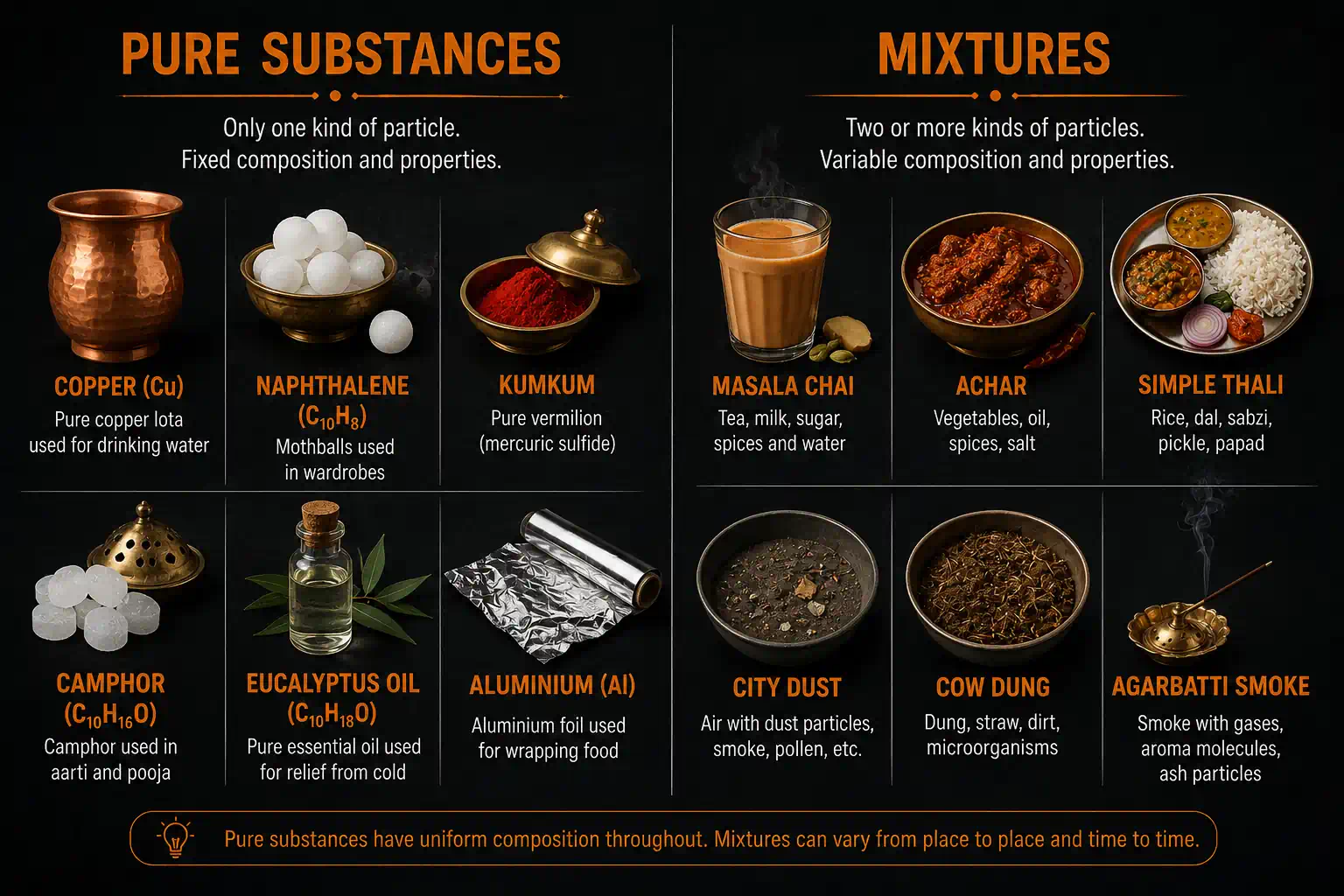
Pure substances and mixtures are all around you — and getting the distinction wrong has real consequences:
- Medicines must contain a pure active ingredient. A paracetamol tablet is a mixture (paracetamol + starch binders), but the paracetamol molecule itself is a pure compound. The dose depends on purity.
- Gold jewellery in India is sold in carats — 24-carat gold is closest to pure (99.9 %), while 22-carat is a mixture (gold + copper/silver alloy) that is harder and more durable.
- Distilled water vs tap water — municipal water is a mixture of water, dissolved minerals, and treated chemicals. The distilled water in car batteries and hospital autoclaves is as close to a pure substance as you can get at scale.
- Table salt (NaCl) is a pure compound with a sharp melting point of 801 °C. "Rock salt" from mines is a mixture — impurities give it its greyish colour.
- Human Body can also be described as a complex chemical mixture. It is composed of a vast, non-uniform arrangement of elements (mostly oxygen, carbon, hydrogen, nitrogen, calcium, and phosphorus) and compounds like water, proteins, and lipids, which together form a heterogeneous mixture necessary for life.
🏥 Real-World Impact
In the pharmaceutical industry, the purity of a drug is legally regulated. A compound that is 95 % pure and 5 % impurity could be ineffective — or toxic. This is why separation science is one of the most valuable skills in chemistry.
Q1.Which of the following is a pure substance?
You pour yourself a glass of tap water. Your friend says it's "pure water — just H₂O." Is that right? What do you think is actually in that glass?
We breathe "air" every second — but air is not a pure substance. It's a mixture of nitrogen (78%), oxygen (21%), argon (0.9%), carbon dioxide (0.04%), and traces of other gases. No single sample of air has a fixed composition — it varies by altitude, location, and even by what someone nearby is cooking.
Pure Substances
A pure substance is a substance that is not contaminated by any other substances and has a fixed, uniform composition throughout. Every sample of the substance has exactly the same properties — the same melting point, boiling point, density, and chemical behaviour.
Pure substances are of two types:
- Elements: Cannot be broken down further by chemical means. Examples: gold (), iron (), oxygen (), sulfur ()
- Compounds: Made of two or more elements in a fixed ratio by mass. Examples: water (), table salt (), carbon dioxide ()
always contains hydrogen and oxygen in the mass ratio 1:8, no matter where on Earth (or the universe) you find it.
Mixtures
A mixture contains two or more substances that are physically combined but not chemically bonded. The components retain their individual properties and can be separated by physical means.
Key features of mixtures:
- Variable composition: You can mix any ratio of salt and water
- No fixed melting/boiling point: Seawater boils over a range, not at exactly 100 °C
- Components keep their properties: Iron filings in sand — the iron is still magnetic, the sand is still sand
- Separated by physical methods: Filtration, distillation, evaporation, etc.
You mix iron filings with sulfur powder. One classmate says the result is a compound of iron and sulfur. Another says it's just a mixture. Without doing any experiment, how would you decide who is right?
Mixture vs. Pure Substance
A Mixture...
- Can be separated into two or more pure substances by physical or mechanical means — filtering, boiling, using a magnet, or tweezers
- May be homogeneous (tap water, air) or heterogeneous (fruit cake, concrete)
- Displays the properties of the pure substances making it up — different parts of the mixture can show different properties
- Has properties that change as the relative amounts of the substances present are changed
- Has a variable composition — the relative amounts of each component can be varied
- Examples: sea water, air, coffee, milk, petrol, whisky, brass, silver coins
A Pure Substance...
- Cannot be separated into two or more substances by physical or mechanical means
- Is always homogeneous (e.g. crystals of sugar, a piece of copper)
- Has properties such as appearance, colour, density, melting and boiling points that are constant throughout the whole sample
- Has properties that do not change regardless of how it is prepared or how many times it is subjected to purification
- Has a fixed composition, no matter how it is made or where it comes from
- Examples: table salt, sugar, copper, aluminium, diamond, gold, polyethylene, alcohol
A Mixture...
- Can be separated into two or more pure substances by physical or mechanical means — filtering, boiling, using a magnet, or tweezers
- May be homogeneous (tap water, air) or heterogeneous (fruit cake, concrete)
- Displays the properties of the pure substances making it up — different parts of the mixture can show different properties
- Has properties that change as the relative amounts of the substances present are changed
- Has a variable composition — the relative amounts of each component can be varied
- Examples: sea water, air, coffee, milk, petrol, whisky, brass, silver coins
A Pure Substance...
- Cannot be separated into two or more substances by physical or mechanical means
- Is always homogeneous (e.g. crystals of sugar, a piece of copper)
- Has properties such as appearance, colour, density, melting and boiling points that are constant throughout the whole sample
- Has properties that do not change regardless of how it is prepared or how many times it is subjected to purification
- Has a fixed composition, no matter how it is made or where it comes from
- Examples: table salt, sugar, copper, aluminium, diamond, gold, polyethylene, alcohol
Where You See This Every Day
Pure substances and mixtures are all around you — and getting the distinction wrong has real consequences:
- Medicines must contain a pure active ingredient. A paracetamol tablet is a mixture (paracetamol + starch binders), but the paracetamol molecule itself is a pure compound. The dose depends on purity.
- Gold jewellery in India is sold in carats — 24-carat gold is closest to pure (99.9 %), while 22-carat is a mixture (gold + copper/silver alloy) that is harder and more durable.
- Distilled water vs tap water — municipal water is a mixture of water, dissolved minerals, and treated chemicals. The distilled water in car batteries and hospital autoclaves is as close to a pure substance as you can get at scale.
- Table salt (NaCl) is a pure compound with a sharp melting point of 801 °C. "Rock salt" from mines is a mixture — impurities give it its greyish colour.
- Human Body can also be described as a complex chemical mixture. It is composed of a vast, non-uniform arrangement of elements (mostly oxygen, carbon, hydrogen, nitrogen, calcium, and phosphorus) and compounds like water, proteins, and lipids, which together form a heterogeneous mixture necessary for life.
Q1.Which of the following is a pure substance?