Lab Safety
Handling chemicals and apparatus correctly
Labs Are Where Accidents Happen — But Don't Have To
Most laboratory accidents result from not reading labels, not wearing protective equipment, or rushing. In professional chemistry labs, safety protocols are not suggestions — they are enforced rules. Developing safe laboratory habits in school is one of the most important things you can learn. These habits stay with you throughout your scientific career.
Personal Protective Equipment (PPE)
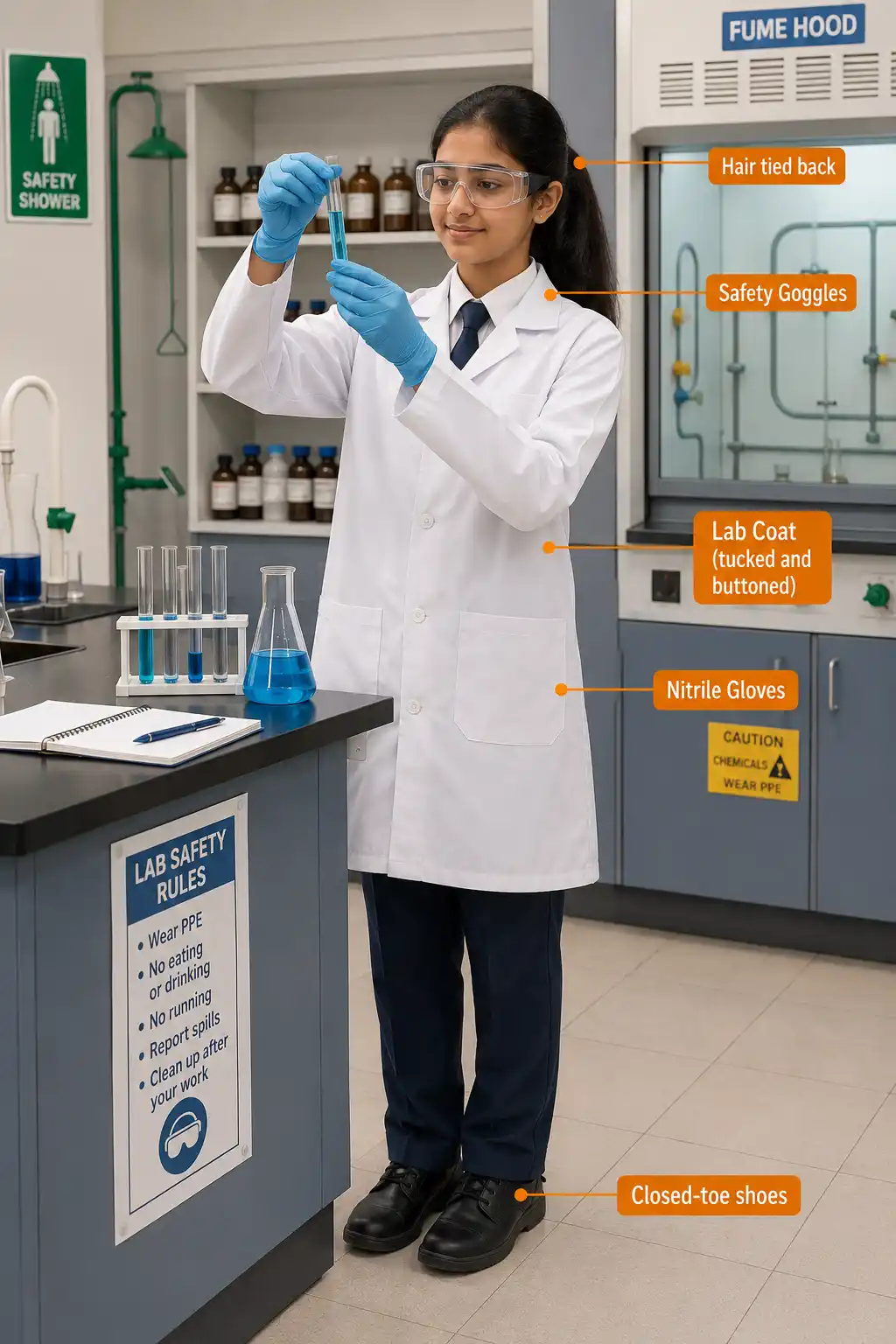
Always wear when working with chemicals:
- Safety goggles: Chemical splashes can cause permanent eye damage — even "mild" acids burn
- Lab coat or apron: Protects skin and clothing from spills
- Closed-toe shoes: No sandals in the lab — broken glass and acid spills reach the floor
- Gloves: When handling concentrated acids, alkalis, or toxic compounds
Tie back long hair and remove loose jewellery — both can catch fire or contaminate experiments.
Handling Chemicals Safely
Acids and alkalis:
- Always add acid to water — never water to acid (exothermic reaction can splatter)
- Memory aid: "AA" — Always Acid into water
- Neutralise spills with sodium bicarbonate (acid spills) or dilute acid (alkali spills) before wiping
Heating:
- Never point a test tube being heated toward anyone
- Use a water bath for flammable solvents — never heat directly
- Do not heat a closed container — pressure builds and glass can explode
Smelling chemicals:
- Never directly sniff a chemical — waft vapours gently toward your nose with your hand
WHMIS/GHS Hazard symbols: Learn the standard hazard symbols — flammable (flame), corrosive (dripping liquid), toxic (skull), oxidising (flame on circle), compressed gas (cylinder).
Emergency Procedures
- Chemical in eye: Immediately flush with large amounts of water for 15 minutes — go to eye wash station
- Chemical on skin: Flush with water; neutralise only after washing
- Fire: Small fire → CO₂ or sand extinguisher. Never use water on a chemical fire
- Broken glass: Do not touch with bare hands — use tongs or a brush and dustpan
- Know the location before starting: Fire extinguisher, eyewash, emergency exit, first aid kit
Lab Safety Rules — Quick Reference
• Wear goggles, lab coat, closed shoes at all times • Add acid TO water — never the reverse (AA rule) • Never heat a closed container • Waft chemicals to smell — never direct sniff • Know locations: eyewash, fire extinguisher, exit, first aid • Never work alone in a laboratory
Q1.
Labs Are Where Accidents Happen — But Don't Have To
Most laboratory accidents result from not reading labels, not wearing protective equipment, or rushing. In professional chemistry labs, safety protocols are not suggestions — they are enforced rules. Developing safe laboratory habits in school is one of the most important things you can learn. These habits stay with you throughout your scientific career.
Personal Protective Equipment (PPE)
Always wear when working with chemicals:
- Safety goggles: Chemical splashes can cause permanent eye damage — even "mild" acids burn
- Lab coat or apron: Protects skin and clothing from spills
- Closed-toe shoes: No sandals in the lab — broken glass and acid spills reach the floor
- Gloves: When handling concentrated acids, alkalis, or toxic compounds
Tie back long hair and remove loose jewellery — both can catch fire or contaminate experiments.
Handling Chemicals Safely
Acids and alkalis:
- Always add acid to water — never water to acid (exothermic reaction can splatter)
- Memory aid: "AA" — Always Acid into water
- Neutralise spills with sodium bicarbonate (acid spills) or dilute acid (alkali spills) before wiping
Heating:
- Never point a test tube being heated toward anyone
- Use a water bath for flammable solvents — never heat directly
- Do not heat a closed container — pressure builds and glass can explode
Smelling chemicals:
- Never directly sniff a chemical — waft vapours gently toward your nose with your hand
WHMIS/GHS Hazard symbols: Learn the standard hazard symbols — flammable (flame), corrosive (dripping liquid), toxic (skull), oxidising (flame on circle), compressed gas (cylinder).
Emergency Procedures
- Chemical in eye: Immediately flush with large amounts of water for 15 minutes — go to eye wash station
- Chemical on skin: Flush with water; neutralise only after washing
- Fire: Small fire → CO₂ or sand extinguisher. Never use water on a chemical fire
- Broken glass: Do not touch with bare hands — use tongs or a brush and dustpan
- Know the location before starting: Fire extinguisher, eyewash, emergency exit, first aid kit
Lab Safety Rules — Quick Reference
• Wear goggles, lab coat, closed shoes at all times • Add acid TO water — never the reverse (AA rule) • Never heat a closed container • Waft chemicals to smell — never direct sniff • Know locations: eyewash, fire extinguisher, exit, first aid • Never work alone in a laboratory
Q1.