Frontier Question — Can We Create Artificial Blood?
Where chemistry meets medicine
Real blood carries oxygen, fights infection, clots wounds, and transports nutrients — all at once. Scientists are trying to build an artificial replacement. Which of those jobs do you think would be the hardest to copy — and why?
Your blood is a colloidal-suspension mixture containing over 4,000 different proteins, hormones, salts, dissolved gases, lipids, vitamins, antibodies, and three types of blood cells — all in precise concentrations, maintained in real time by your kidneys and liver. Replacing this with a synthetic substitute is one of the hardest unsolved problems in medicine.
Why Do We Need Artificial Blood?
Natural blood has serious limitations for medical use:
- Storage: Red blood cells survive only 42 days refrigerated; platelets only 5–7 days
- Blood type matching: Transfusing the wrong type can be fatal — O negative (universal donor) is chronically scarce
- Disease transmission: HIV, hepatitis, and other pathogens can be transmitted through contaminated blood
- Shortage: India needs 15 million units of blood per year — it collects barely 10 million
An artificial blood substitute that could be manufactured, stored indefinitely, used universally without type matching, and was pathogen-free would transform medicine.
What Scientists Are Trying
Haemoglobin-based Oxygen Carriers (HBOCs): Extract haemoglobin from human or bovine red blood cells, modify it chemically so it can carry oxygen in plasma without being inside a cell. Several have reached clinical trials. Most failed due to side effects — free haemoglobin scavenges nitric oxide (needed for blood vessel relaxation), causing vasoconstriction and organ damage.
Perfluorocarbon emulsions (PFCs): Fluorine-rich organic molecules that dissolve oxygen (and CO₂) far better than water. Fluosol-DA was the first FDA-approved oxygen carrier. Works in principle — but requires the patient to breathe 100% oxygen, and early products had limited shelf life.
Synthetic red blood cells: Nanoparticles coated with haemoglobin, enclosed in a lipid shell that mimics the red blood cell membrane. Still in research stage — promising in animal models.
Lab-grown blood: Scientists at the University of Bristol grew red blood cells from stem cells and transfused them into human volunteers in 2022 — the first lab-grown blood to be used in humans. Only 5 mL doses so far, but proof that it's possible.
A fish extracts dissolved oxygen from water through gills. A human extracts oxygen from air through lungs. Both need oxygen to power their cells. A scientist working on artificial blood says: "We need a liquid that carries oxygen the same way haemoglobin does." What properties would that liquid absolutely need?
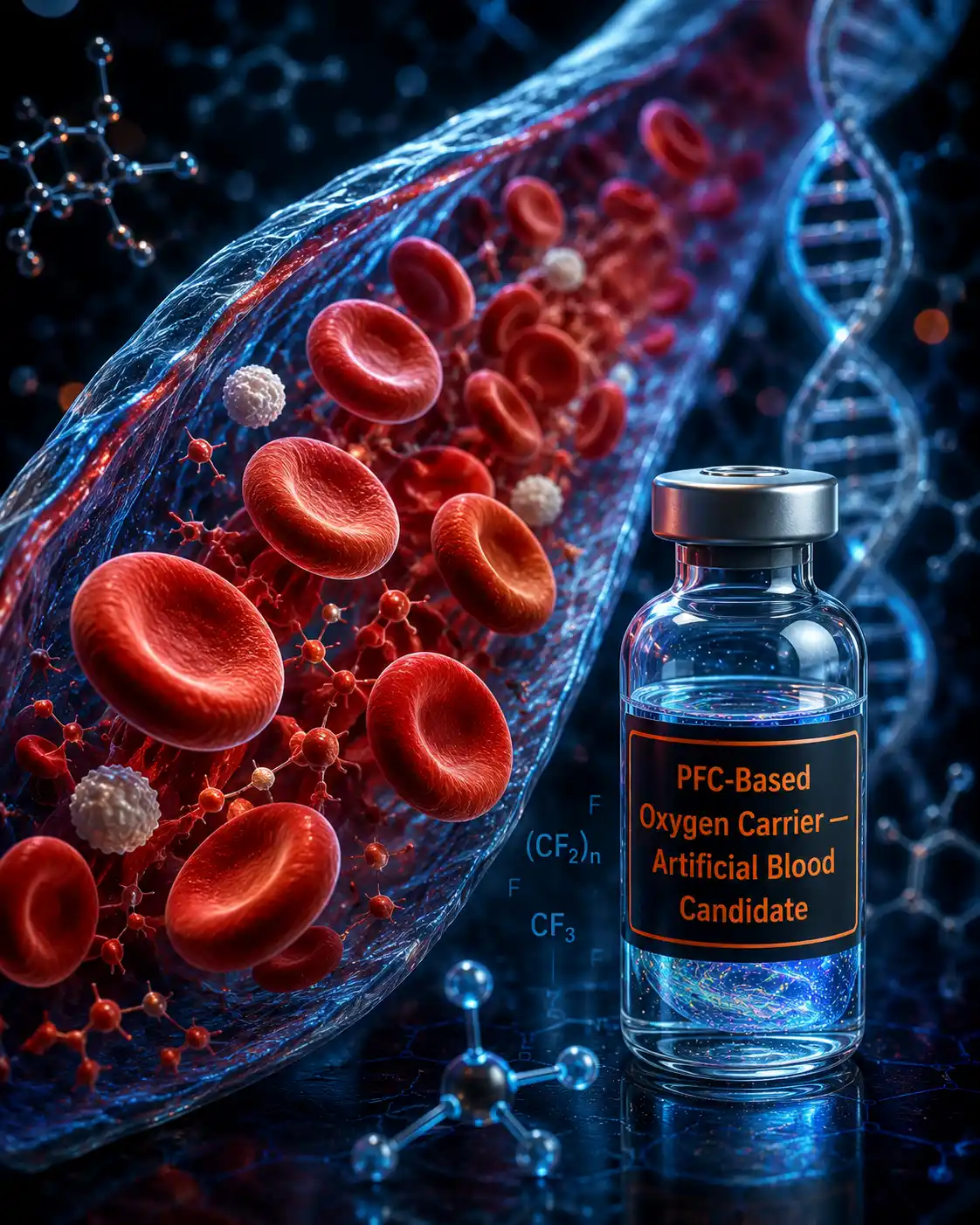
The Frontier Question
Can we create artificial blood that:
- Carries oxygen and carbon dioxide as efficiently as haemoglobin?
- Has no blood type — works for everyone?
- Can be stored for months or years?
- Is free of pathogens?
- Has no harmful side effects?
- Can be manufactured at scale?
This remains unsolved. The challenge is not just chemistry — it's getting all these properties simultaneously in a safe, manufacturable product.
Your role: The chemists, materials scientists, and biomedical engineers who will solve this problem are likely in school right now. The concepts you are learning — solubility, colloidal chemistry, gas behaviour, molecular structure — are the building blocks of that solution.
Chapter 5 — What You've Learned
• Matter is classified as pure substance (element or compound) or mixture (homogeneous or heterogeneous) • Colloids show the Tyndall Effect; solutions do not; suspensions settle on standing • Separation technique = match to property difference: boiling pt → distillation; solubility → crystallisation; density → centrifugation; sublimation point → sublimation; Rf → chromatography • ORS saved tens of millions of lives — a precisely calculated mixture of salts and glucose • Artificial blood is an unsolved frontier where chemistry and medicine intersect
Q1.Which component of real blood is responsible for carrying oxygen to body cells?
Real blood carries oxygen, fights infection, clots wounds, and transports nutrients — all at once. Scientists are trying to build an artificial replacement. Which of those jobs do you think would be the hardest to copy — and why?
Your blood is a colloidal-suspension mixture containing over 4,000 different proteins, hormones, salts, dissolved gases, lipids, vitamins, antibodies, and three types of blood cells — all in precise concentrations, maintained in real time by your kidneys and liver. Replacing this with a synthetic substitute is one of the hardest unsolved problems in medicine.
Why Do We Need Artificial Blood?
Natural blood has serious limitations for medical use:
- Storage: Red blood cells survive only 42 days refrigerated; platelets only 5–7 days
- Blood type matching: Transfusing the wrong type can be fatal — O negative (universal donor) is chronically scarce
- Disease transmission: HIV, hepatitis, and other pathogens can be transmitted through contaminated blood
- Shortage: India needs 15 million units of blood per year — it collects barely 10 million
An artificial blood substitute that could be manufactured, stored indefinitely, used universally without type matching, and was pathogen-free would transform medicine.
What Scientists Are Trying
Haemoglobin-based Oxygen Carriers (HBOCs): Extract haemoglobin from human or bovine red blood cells, modify it chemically so it can carry oxygen in plasma without being inside a cell. Several have reached clinical trials. Most failed due to side effects — free haemoglobin scavenges nitric oxide (needed for blood vessel relaxation), causing vasoconstriction and organ damage.
Perfluorocarbon emulsions (PFCs): Fluorine-rich organic molecules that dissolve oxygen (and CO₂) far better than water. Fluosol-DA was the first FDA-approved oxygen carrier. Works in principle — but requires the patient to breathe 100% oxygen, and early products had limited shelf life.
Synthetic red blood cells: Nanoparticles coated with haemoglobin, enclosed in a lipid shell that mimics the red blood cell membrane. Still in research stage — promising in animal models.
Lab-grown blood: Scientists at the University of Bristol grew red blood cells from stem cells and transfused them into human volunteers in 2022 — the first lab-grown blood to be used in humans. Only 5 mL doses so far, but proof that it's possible.
A fish extracts dissolved oxygen from water through gills. A human extracts oxygen from air through lungs. Both need oxygen to power their cells. A scientist working on artificial blood says: "We need a liquid that carries oxygen the same way haemoglobin does." What properties would that liquid absolutely need?
The Frontier Question
Can we create artificial blood that:
- Carries oxygen and carbon dioxide as efficiently as haemoglobin?
- Has no blood type — works for everyone?
- Can be stored for months or years?
- Is free of pathogens?
- Has no harmful side effects?
- Can be manufactured at scale?
This remains unsolved. The challenge is not just chemistry — it's getting all these properties simultaneously in a safe, manufacturable product.
Your role: The chemists, materials scientists, and biomedical engineers who will solve this problem are likely in school right now. The concepts you are learning — solubility, colloidal chemistry, gas behaviour, molecular structure — are the building blocks of that solution.
Chapter 5 — What You've Learned
• Matter is classified as pure substance (element or compound) or mixture (homogeneous or heterogeneous) • Colloids show the Tyndall Effect; solutions do not; suspensions settle on standing • Separation technique = match to property difference: boiling pt → distillation; solubility → crystallisation; density → centrifugation; sublimation point → sublimation; Rf → chromatography • ORS saved tens of millions of lives — a precisely calculated mixture of salts and glucose • Artificial blood is an unsolved frontier where chemistry and medicine intersect
Q1.Which component of real blood is responsible for carrying oxygen to body cells?